
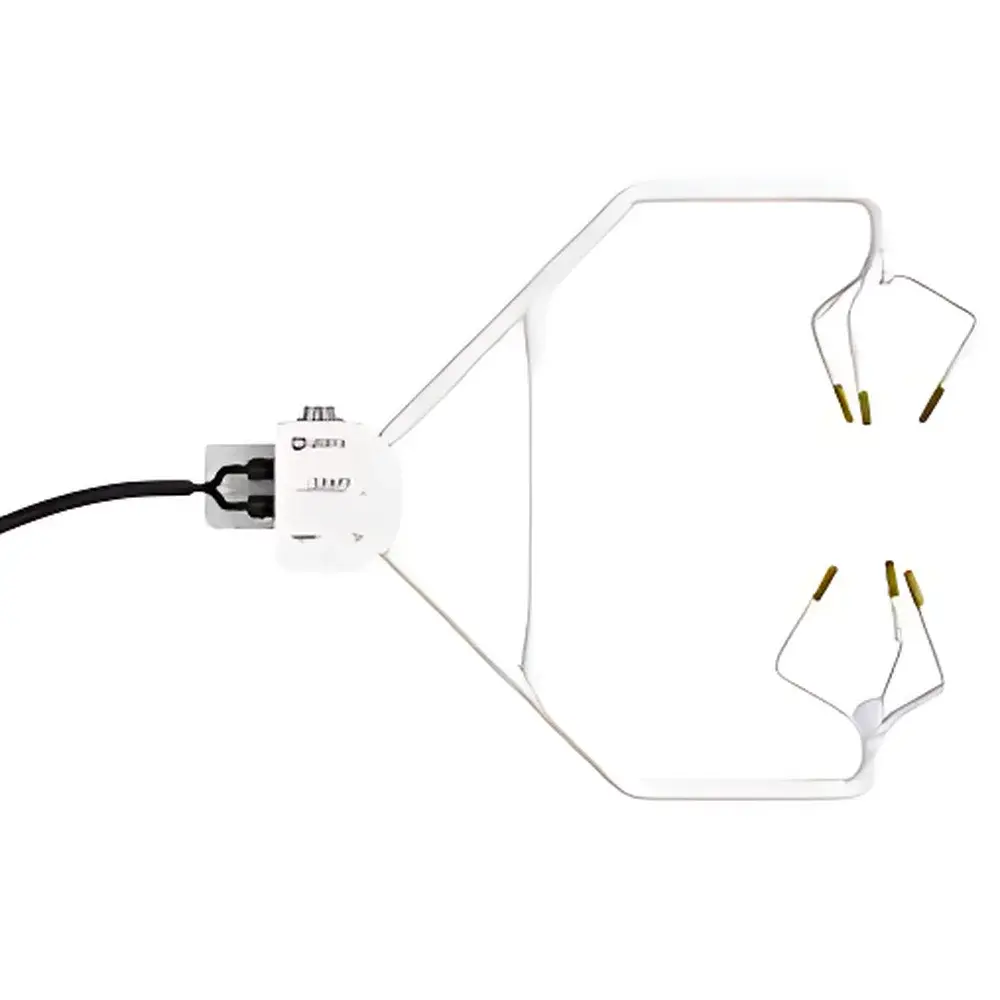
Campbell Scientific CSAT3 3-D Sonic Anemometer
| Brand | Campbell Scientific |
|---|---|
| Origin | USA |
| Model | CSAT3 |
| Measurement Principle | Ultrasonic Time-of-Flight (TOF) in Three Orthogonal Axes |
| Vertical Path Length | 10 cm |
| Output Frequency | Up to 50 Hz |
| Output Options | Analog (±5 V) and Digital (SDM, RS-232) |
| Operating Temperature Range | –30°C to +50°C |
| Ingress Protection | IP66-rated enclosure |
| Compliance | Designed for eddy covariance systems compliant with AmeriFlux, ICOS, and FLUXNET protocols |
| Integrated Clock | Internal temperature-compensated crystal oscillator (TCXO), ±1 ppm stability over operating range |
| Synchronization | SDM-compatible for precise multi-sensor timing alignment |
Overview
The Campbell Scientific CSAT3 is a high-precision, three-dimensional sonic anemometer engineered for eddy covariance (EC) flux measurements in atmospheric boundary layer research. It operates on the ultrasonic time-of-flight (TOF) principle, measuring the speed of sound along three orthogonal acoustic paths (X, Y, Z) to compute instantaneous three-component wind velocity vectors (u, v, w) and sonic temperature. Its 10 cm vertical path length enables spatial resolution appropriate for micrometeorological applications while minimizing flow distortion. The instrument’s aerodynamic housing—shaped using computational fluid dynamics (CFD)-informed design—reduces wake interference and ensures minimal perturbation of the ambient airflow, a critical requirement for high-fidelity turbulence characterization. Built for continuous operation in remote and harsh environments, the CSAT3 features a sealed, corrosion-resistant aluminum housing rated IP66, with integrated rain mitigation via hydrophobic acoustic transducer mesh and adaptive signal processing algorithms that maintain measurement integrity during precipitation events.
Key Features
- Three-axis ultrasonic wind measurement with simultaneous sonic temperature output at up to 50 Hz sampling rate
- Aerodynamically optimized sensor head geometry validated for low-flow-disturbance performance per ISO 16452:2021 guidelines for sonic anemometer calibration
- Internal temperature-compensated crystal oscillator (TCXO) ensuring timing accuracy ≤ ±1 ppm across –30°C to +50°C operational range
- Dual-output interface: analog (±5 V, 0–5 kHz bandwidth) and digital (SDM protocol for Campbell CR-series dataloggers; RS-232 for PC-based configuration and diagnostics)
- Integrated synchronization capability via SDM commands—enabling sub-millisecond timing alignment with co-located gas analyzers (e.g., EC150/EC155) and auxiliary sensors
- Hermetically sealed electronics compartment with conformal coating and stainless-steel mounting hardware for long-term field deployment
- Factory-calibrated sensitivity coefficients traceable to NIST standards; calibration certificate provided with each unit
Sample Compatibility & Compliance
The CSAT3 is designed for integration into standardized eddy covariance systems adhering to AmeriFlux, ICOS, and FLUXNET best practices. Its physical dimensions and mounting interface comply with the “Twin-Boom” mast configuration standard used in global flux networks. When paired with Campbell’s EC150 or EC155 CO₂/H₂O analyzers—and optionally with FW05 fine-wire thermocouples—the system satisfies requirements for momentum flux (τ = ρ⟨u’w’⟩), friction velocity (u*), sensible heat flux (H), and latent heat flux (LE) computation under turbulent conditions. All firmware and data output formats are compatible with post-processing software including EddyPro®, TK3, and EdiRe. The device meets electromagnetic compatibility (EMC) requirements per EN 61326-1:2013 and environmental protection standards per IEC 60529 (IP66). No hazardous substances are used in construction, complying with RoHS Directive 2011/65/EU.
Software & Data Management
Configuration, diagnostics, and real-time monitoring are performed via Campbell’s PC-based LoggerNet software (v4.4+), which supports automated firmware updates, clock synchronization, and SDM command scripting. Raw TOF values and derived u/v/w/TS outputs are logged in Campbell’s native CRBasic format, enabling direct ingestion into flux calculation pipelines. Timestamps include microsecond-level precision when synchronized with CR6 or CR1000X dataloggers using internal GPS or PTP (Precision Time Protocol) inputs. Audit trails for configuration changes and clock adjustments are retained per GLP-compliant data management workflows. Export options include CSV, NetCDF-4, and HDF5 formats, all preserving metadata fields required by FAIR (Findable, Accessible, Interoperable, Reusable) data principles.
Applications
- Long-term eddy covariance flux towers for carbon, water, and energy exchange studies
- Boundary layer turbulence profiling in agricultural, forest, and urban canopy environments
- Validation of numerical weather prediction (NWP) and large-eddy simulation (LES) models
- Wind resource assessment for small-scale renewable energy installations
- Atmospheric dispersion modeling support through high-frequency turbulence statistics (e.g., Reynolds stresses, integral length scales)
- Soil-atmosphere interaction studies requiring concurrent momentum and scalar flux quantification
FAQ
What is the recommended mounting height for optimal turbulence measurement?
For most ecosystem-scale eddy covariance applications, the CSAT3 should be mounted at least 2 m above the displacement height (d) and within the constant-flux layer—typically 2–5 m above vegetation or surface roughness elements.
Can the CSAT3 operate without a Campbell datalogger?
Yes—via RS-232 serial interface, it can interface with third-party controllers supporting ASCII command sets; however, SDM-based synchronization and advanced diagnostics require Campbell CR-series dataloggers.
Is factory recalibration required annually?
Campbell recommends verification against a reference anemometer every 12–24 months depending on exposure conditions; full recalibration is advised if drift exceeds ±0.05 m/s in horizontal wind components or ±0.2°C in sonic temperature.
How does the CSAT3 handle rain-induced signal attenuation?
Its proprietary acoustic signal processing algorithm dynamically adjusts gain and pulse detection thresholds, while the hydrophobic transducer mesh prevents water film formation—maintaining >95% data capture efficiency during light-to-moderate rainfall (≤5 mm/h).
Related Products







