
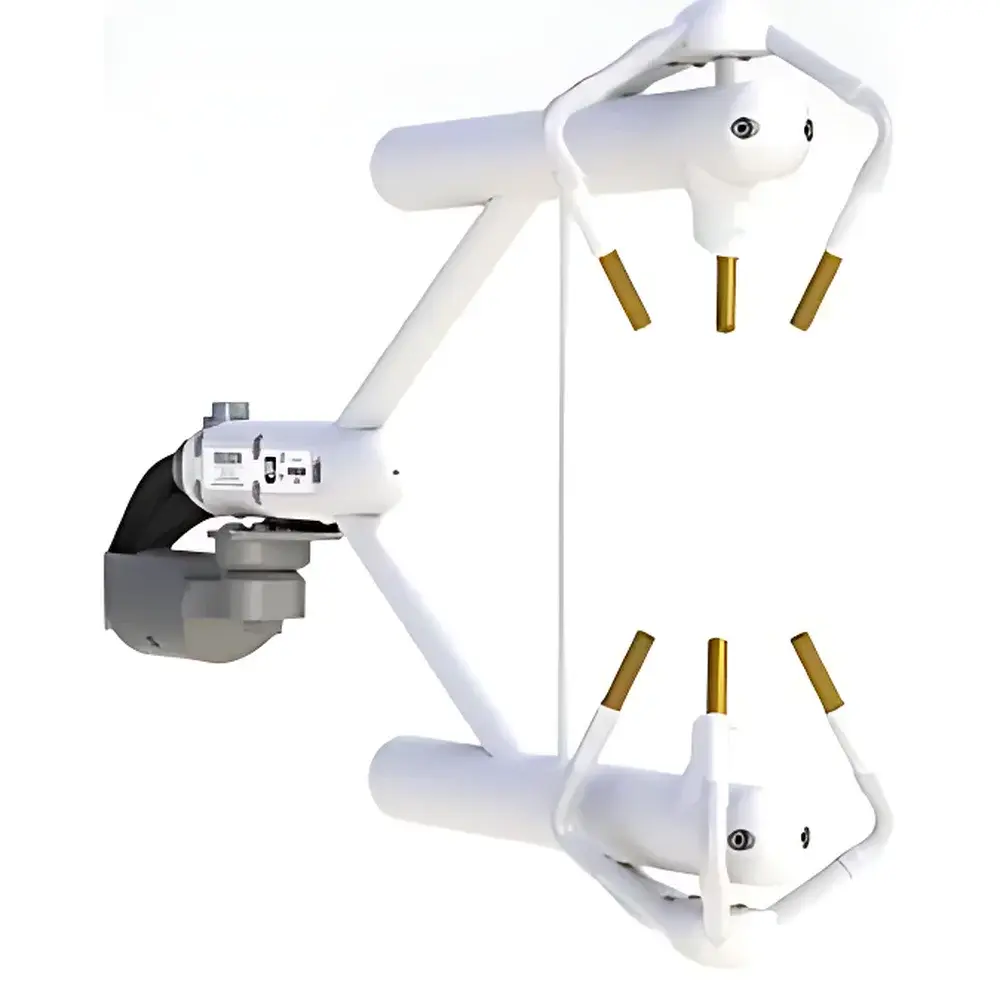
Campbell Scientific IRGASON Integrated Open-Path Eddy Covariance System
| Brand | Campbell Scientific |
|---|---|
| Origin | USA |
| Model | IRGASON |
| Measurement Principle | Simultaneous open-path infrared absorption (CO₂/H₂O) and ultrasonic anemometry (3D wind velocity, sonic temperature) |
| Output Frequency | Up to 60 Hz |
| Bandwidth | 20 Hz |
| Power Consumption | Low-power design compatible with solar power systems |
| Environmental Rating | IP65-rated enclosure |
| Calibration | Factory-calibrated for CO₂, H₂O, air temperature, barometric pressure, and sonic temperature across wide operational ranges |
| Diagnostic Capabilities | Comprehensive real-time diagnostics including signal strength, window contamination status, transducer health, and acoustic path integrity |
| Data Compatibility | Native support for Campbell Scientific CR series dataloggers (e.g., CR6, CR1000X) with full integration of setup, zero/span adjustment, and configuration via direct serial or SDI-12 interface |
| Rain Mitigation | Patented hydrophobic mesh + adaptive ultrasonic signal processing to maintain wind vector accuracy during precipitation |
| Optical Design | Angled optical windows with anti-water-adhesion geometry and tolerance for mild surface contamination |
| Thermal Management | Passive temperature compensation—no active heater required |
Overview
The Campbell Scientific IRGASON Integrated Open-Path Eddy Covariance System is a purpose-engineered instrument for high-fidelity, long-term eddy covariance (EC) flux measurements of carbon dioxide (CO₂), water vapor (H₂O), sensible heat, and momentum. Unlike traditional two-sensor EC configurations—where separate open-path gas analyzers and ultrasonic anemometers are mounted at distinct locations—the IRGASON co-locates both measurement modalities within a single, aerodynamically optimized housing. This monolithic architecture ensures that the infrared absorption path and the three orthogonal ultrasonic acoustic paths intersect precisely at the same sampling volume. As a result, spatial misalignment-induced high-frequency flux attenuation is eliminated, and time synchronization errors—common in multi-instrument setups requiring post-hoc latency correction—are inherently avoided. The system operates on the principles of non-dispersive infrared (NDIR) spectroscopy for CO₂ and H₂O concentration quantification, and time-of-flight ultrasonics for 3D wind vector and sonic temperature derivation. Its design conforms to the physical requirements of turbulent scalar transport theory under atmospheric boundary layer conditions, making it suitable for FLUXNET-standard compliant flux towers, AmeriFlux sites, and long-term ecological research infrastructure.
Key Features
- Monolithic integration of open-path CO₂/H₂O infrared analyzer and 3D ultrasonic anemometer—eliminates spatial separation artifacts and inter-sensor timing drift
- Patented angled optical windows with hydrophobic surface treatment and rain-shedding geometry—maintains optical transmission integrity during light-to-moderate precipitation
- Triple-path ultrasonic configuration with cross-wind error correction algorithm—improves wind vector accuracy under oblique flow conditions
- Passive thermal compensation architecture—no heater required; stable performance across −25°C to +50°C ambient range
- Low-power electronics (< 3 W typical) enabling reliable solar-battery operation in remote field deployments
- Real-time diagnostic suite—including window contamination index, signal-to-noise ratio per acoustic path, transducer impedance monitoring, and spectral quality metrics
- Native firmware-level compatibility with Campbell CR6 and CR1000X dataloggers—enabling on-site zero/span calibration, configuration updates, and diagnostic interrogation without external software
Sample Compatibility & Compliance
The IRGASON is designed for continuous, unattended measurement of atmospheric turbulence in terrestrial ecosystems, agricultural fields, forest canopies, wetlands, and urban boundary layers. It complies with internationally recognized eddy covariance best practices outlined in the ICOS (Integrated Carbon Observation System) and FluxNet-2019 guidelines. While not certified to ISO/IEC 17025 as a standalone metrological standard, its factory calibration traceability follows NIST-traceable reference gases and primary acoustic standards. All output variables—including CO₂ mixing ratio (µmol mol⁻¹), H₂O mixing ratio (mmol mol⁻¹), u/v/w wind components (m s⁻¹), sonic temperature (°C), and atmospheric pressure (kPa)—are delivered in physically consistent units aligned with CF (Climate and Forecast) metadata conventions. The system supports GLP-aligned data provenance through embedded timestamping, firmware version logging, and diagnostic flagging—facilitating audit-ready data streams for USDA ARS, NSF-funded LTER networks, and EU Horizon projects.
Software & Data Management
Data acquisition and system control are fully supported through Campbell Scientific’s LoggerNet and PC400 software environments, as well as the open-source eddy4R R package ecosystem. Raw 60 Hz time series are stored in binary or CSV formats with microsecond-precision hardware timestamps. The IRGASON embeds configurable averaging intervals (e.g., 10-, 30-, or 60-minute flux integrations) and automatic gap-filling logic based on user-defined thresholds for signal quality. All diagnostic parameters—including window transmittance degradation, acoustic path dropout events, and internal temperature gradients—are logged alongside scientific variables, enabling automated QA/QC filtering during post-processing. The device supports SDI-12 and RS-232 communication protocols and integrates seamlessly into SCADA-style telemetry architectures via cellular or satellite uplinks when paired with compatible Campbell telemetry modules.
Applications
- Long-term carbon and water flux monitoring in FLUXNET-tier eddy covariance towers
- Soil–vegetation–atmosphere transfer (SVAT) model validation across biomes (boreal, temperate, tropical)
- Agricultural water use efficiency (WUE) assessment in precision irrigation trials
- Urban heat island and anthropogenic CO₂ emission quantification in metropolitan observatories
- Post-disturbance recovery studies following wildfire, deforestation, or land-use change
- Atmospheric chemistry–turbulence coupling investigations in VOC-rich forest canopies
FAQ
Does the IRGASON require periodic recalibration in the field?
Field recalibration is not routinely required; however, zero/span checks using certified gas standards and calibrated pressure/temperature references are recommended annually or after extended exposure to extreme environmental conditions.
Can the IRGASON operate reliably during rainfall?
Yes—its dual-layer rain mitigation strategy (hydrophobic transducer mesh + adaptive ultrasonic pulse rejection logic) maintains wind vector fidelity during light-to-moderate rain; heavy downbursts may temporarily reduce SNR but do not induce systematic bias.
Is the IRGASON compatible with non-Campbell dataloggers?
While native firmware integration is optimized for Campbell CR-series loggers, analog voltage outputs and ASCII serial streaming modes allow integration with third-party systems (e.g., National Instruments DAQ, Raspberry Pi-based edge nodes) using documented protocol specifications.
What is the minimum detectable flux magnitude for CO₂ under typical field conditions?
Detection limits depend on turbulence intensity and sensor height; under moderate stability (z/L ≈ −0.1) and 2 m s⁻¹ mean wind speed, the 30-minute CO₂ flux uncertainty is typically ≤ 0.1 µmol m⁻² s⁻¹ (1σ) for well-maintained systems.
How is sonic temperature used in flux calculations?
Sonic temperature provides the virtual temperature component essential for computing buoyancy fluxes and correcting CO₂/H₂O density fluctuations in the Webb-Pearman-Leuning (WPL) correction framework—eliminating the need for concurrent fast-response thermistor measurements.
Related Products







