
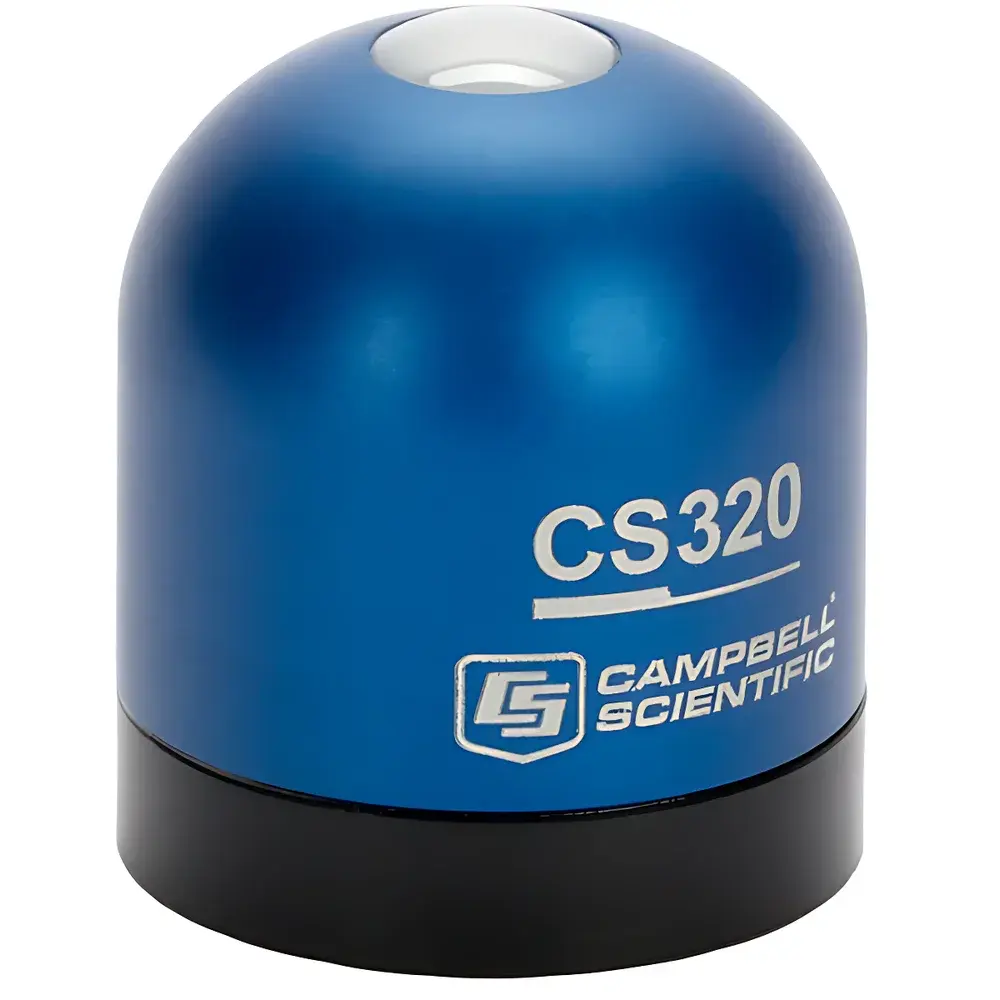
Campbell Scientific CS320 Pyranometer
| Brand | Campbell Scientific |
|---|---|
| Origin | USA |
| Model | CS320 |
| Sensor Type | Thermopile-based Total Solar Radiation Sensor |
| Calibration Uncertainty | ±5% |
| Measurement Range | 0–2000 W/m² |
| Repeatability | <1% |
| Long-term Drift | <2% per year |
| Non-linearity | <1% |
| Spectral Range | 385–2105 nm |
| Field of View | 180° (hemispherical) |
| Response Time | 2 s |
| Temperature Dependence | <5% over −15 to +45 °C |
| Operating Temperature | −50 to +50 °C |
| Heating Power | 0.2 W |
| Supply Voltage | 6–24 VDC |
| Current Consumption | 5 mA (during measurement) |
| Output Protocol | SDI-12 digital interface |
| Sensor Diameter | 34.3 mm |
| Height | 39.6 mm |
| Mass | 64.9 g |
Overview
The Campbell Scientific CS320 is a precision thermopile-based pyranometer engineered for accurate, long-term measurement of global solar irradiance (total hemispherical solar radiation) across diverse environmental and meteorological applications. Unlike silicon photodiode sensors, the CS320 employs a black-body thermopile detector with a spectrally flat response from 385 nm to 2105 nm—covering the dominant shortwave solar spectrum as well as a portion of the near-infrared band critical for energy balance studies. Its 180° field of view ensures full hemispherical capture under standard mounting conditions. The sensor operates on the principle of thermal conversion: incident radiation heats an absorber surface, generating a voltage proportional to the temperature gradient across the thermopile junctions. This fundamental physical principle eliminates spectral responsivity errors inherent in semiconductor-based detectors, especially under varying atmospheric conditions or non-standard solar angles. Designed for unattended deployment in remote networks—from agricultural weather stations to ecological flux towers—the CS320 integrates seamlessly into SDI-12-compatible data loggers without requiring external signal conditioning or custom firmware.
Key Features
- Thermopile sensing element with black-body absorption coating for spectrally uniform response (385–2105 nm)
- Integrated heater (0.2 W, user-controllable) to mitigate dew, frost, and snow accumulation on the quartz dome—improving data continuity and accuracy in high-humidity or sub-zero environments
- SDI-12 digital output protocol ensures noise-immune communication, simplifies wiring, and eliminates analog signal degradation over long cable runs
- Factory-calibrated coefficients permanently stored in onboard memory; no manual coefficient entry required during configuration
- Compact, lightweight design (64.9 g) with IP68-rated detachable waterproof connector for robust field serviceability and transport
- Hemispherical quartz dome optimized for minimal rainwater retention and reduced soiling—enhancing long-term stability and reducing maintenance frequency
- Low power consumption (5 mA during measurement) and wide supply range (6–24 VDC) compatible with battery- or solar-powered remote stations
- Proven long-term stability: <2% annual drift and <1% measurement repeatability under ISO 9060:2018 Class C specifications
Sample Compatibility & Compliance
The CS320 is suitable for outdoor deployment across terrestrial ecosystems, including croplands, forests, alpine sites, coastal zones, and urban micrometeorological arrays. It meets the functional requirements of ISO 9060:2018 for secondary standard pyranometers (Class C), supporting compliance with WMO observational guidelines and FAO-56 reference evapotranspiration protocols. While not certified to ISO 9060:2018 Class B or A, its thermopile architecture, spectral fidelity, and low drift characteristics make it appropriate for research-grade monitoring where cost-effective scalability is essential. The sensor’s SDI-12 interface supports interoperability with Campbell Scientific CR series, Onset HOBO, and other third-party loggers compliant with SDI-12 v1.3. No regulatory certification (e.g., NIST-traceable calibration certificate included with shipment) is required for routine environmental monitoring, though optional NIST-traceable recalibration services are available through authorized Campbell Scientific service centers.
Software & Data Management
Data acquisition is fully supported via Campbell Scientific’s LoggerNet, PC400, and RTDAQ software suites, which auto-detect SDI-12 devices and parse calibration coefficients directly from sensor memory. Raw SDI-12 responses are converted in real time to W/m² using the embedded slope and offset values. All measurements are timestamped at the logger level, enabling synchronization with co-located sensors (e.g., net radiometers, soil heat flux plates) for surface energy balance modeling. The CS320 generates no proprietary file formats; output is delivered as ASCII text or CSV—ensuring compatibility with Python (Pandas, NumPy), R, MATLAB, and GIS platforms such as QGIS and ArcGIS Pro. Audit trails, metadata tagging, and automated QC flagging (e.g., out-of-range irradiance, heater status logs) can be implemented within custom script workflows aligned with FAIR data principles and GLP-aligned field data management practices.
Applications
- Networked agricultural meteorology for irrigation scheduling and crop modeling (e.g., FAO-56 Penman-Monteith)
- Long-term ecological research (LTER) sites requiring multi-decade solar radiation baselines
- Urban climate monitoring and building energy simulation input
- Validation of satellite-derived surface irradiance products (e.g., NASA POWER, CM SAF)
- Photovoltaic system performance ratio analysis and soiling loss quantification
- Atmospheric science campaigns measuring diurnal and seasonal irradiance variability
- Educational instrumentation for university atmospheric physics and environmental engineering laboratories
FAQ
Does the CS320 require periodic recalibration?
Yes—Campbell Scientific recommends recalibration every two years for research-critical deployments or annually under harsh environmental exposure (e.g., high UV, dust, or coastal salt). Recalibration maintains traceability to WRR (World Radiometric Reference) via NIST-traceable standards.
Can the heater be left on continuously?
The heater is designed for intermittent use and draws only 0.2 W, but continuous operation is permissible if power budget allows; however, prolonged heating may slightly elevate dome temperature and introduce minor thermal offset—best practice is to activate only during dew/frost/snow events.
Is the CS320 compatible with non-Campbell data loggers?
Yes—any SDI-12 v1.3–compliant logger (e.g., Onset U30, Delta-T GP1, Decagon EM50) can communicate with the CS320; full command set and timing specifications are publicly documented in the SDI-12 standard.
What mounting hardware is recommended?
A leveled, north-facing mounting bracket with bubble level and adjustable tilt is advised; Campbell Scientific offers the CM220 leveling base and 18352 mounting plate for optimal orientation and vibration damping.
How does the CS320 compare to ISO Class B pyranometers?
While the CS320 meets Class C performance criteria (ISO 9060:2018), it lacks the temperature-controlled housing and secondary glass dome of Class B instruments; thus, it is optimized for cost-sensitive, high-density networks—not primary reference stations requiring sub-1% uncertainty.
Related Products







