
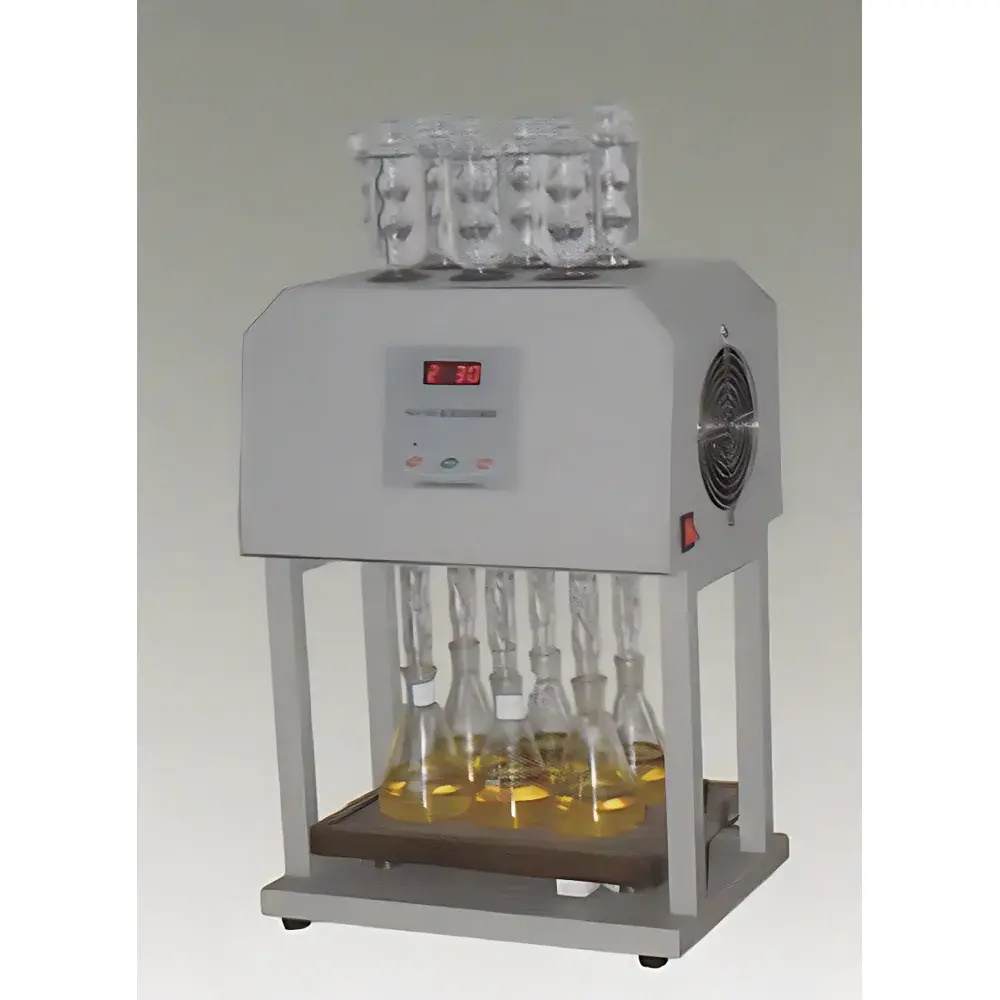
KY-COD Reflux Digestion System Compliant with HJ 828–2017 Standard
| Brand | Keyuan Instruments |
|---|---|
| Origin | Jiangsu, China |
| Manufacturer Type | Direct Manufacturer |
| Country of Origin | China |
| Model | KY-100 (6-position) |
| Digestion Method | Rapid Reflux Digestion |
| Heating Module | Precision Ceramic Heating Block |
| Batch Capacity | 6 samples simultaneously |
| Temperature Range | 25–170 °C (adjustable, ±1 °C accuracy) |
| Digestion Vessel Capacity | 250 mL conical flasks with reflux condensers |
| Timer Accuracy | ±1 second over full 180-minute range |
| Power Supply | AC 220 V ±10%, 50 Hz |
| Rated Power | 1500 W |
| Ambient Operating Temperature | 5–40 °C |
| COD Measurement Range | 16–700 mg/L (dilutable for higher concentrations) |
| Analytical Precision | RSD ≤5.0% for potassium hydrogen phthalate standard (500 mg/L) |
| Compliance | HJ 828–2017 (replacing GB 11914–1989), aligned with ISO 6060 principles |
Overview
The KY-COD Reflux Digestion System (Model KY-100, 6-position) is a laboratory-grade, microprocessor-controlled digestion apparatus engineered for precise and reproducible chemical oxygen demand (COD) determination in aqueous matrices. It implements the closed-reflux, dichromate oxidation method as specified in China’s national standard HJ 828–2017 — the legally mandated procedure for environmental water quality monitoring and regulatory compliance reporting. Unlike open-boiling or block-heater-only systems, this unit integrates programmable ceramic heating blocks with air-cooled reflux condensers to maintain stable thermal conditions throughout the 2-hour reflux cycle, ensuring complete oxidation of organic matter under controlled boiling (micro-boil) conditions. The system eliminates reliance on continuous tap-water cooling, reducing water consumption by >95% compared to traditional water-cooled reflux setups while maintaining thermal stability and operator safety.
Key Features
- Microprocessor-based timer and temperature controller with digital display, enabling independent adjustment of heating time (0–180 min) and setpoint temperature (25–170 °C, ±1 °C accuracy)
- Six parallel digestion stations using standardized 250 mL Erlenmeyer flasks fitted with borosilicate glass reflux condensers — fully compatible with HJ 828–2017 sample preparation protocols
- Air-cooled condensation system replacing conventional water-jacketed condensers; eliminates external plumbing, reduces lab infrastructure dependency, and supports sustainable operation
- Ceramic heating module with uniform thermal distribution and rapid heat-up response; designed for long-term stability under repeated high-temperature cycling
- Automatic power cutoff upon timer completion; includes over-temperature protection and thermal fuse redundancy
- Compliance-ready design: meets mechanical, thermal, and procedural requirements of HJ 828–2017 and reflects foundational alignment with ISO 6060 (Water quality — Determination of chemical oxygen demand)
Sample Compatibility & Compliance
The KY-100 is validated for liquid environmental samples including surface water, wastewater effluents, industrial discharges, and treated municipal influents. It accommodates standard reagent volumes per HJ 828–2017: 10.0 mL sample + 5.0 mL 0.25 mol/L K₂Cr₂O₇ + 15 mL Ag₂SO₄–H₂SO₄ catalyst solution. Sample matrix interference mitigation (e.g., chloride masking with HgSO₄) follows prescribed methodology. The system supports GLP-aligned documentation through manual logbook integration and is routinely deployed in laboratories undergoing CNAS (China National Accreditation Service) or provincial ecological environment monitoring center audits. While not inherently 21 CFR Part 11 compliant (as it lacks electronic signature capability), its operational traceability — via timestamped temperature/time settings, physical reagent logs, and consistent hardware performance — satisfies ISO/IEC 17025 clause 7.2.2 for equipment suitability verification.
Software & Data Management
The KY-100 operates via embedded firmware without proprietary software dependency. All configuration parameters (set temperature, duration, start time) are retained in non-volatile memory across power cycles. No USB, Ethernet, or Bluetooth interfaces are included; data output is limited to visual display and user-recorded operational logs. For laboratories requiring digital audit trails, integration with LIMS is achieved externally via manual entry or barcode-scanned batch ID logging. Optional accessories include calibrated PT100 probe kits (for independent temperature validation) and NIST-traceable reference standards for routine performance verification — supporting internal QA/QC programs aligned with ISO/IEC 17025 Section 7.7.
Applications
- Regulatory COD testing for discharge permits under China’s “Emission Standards of Pollutants for Municipal Wastewater Treatment Plants” (GB 18918–2002) and “Integrated Wastewater Discharge Standard” (GB 8978–1996)
- Process control in wastewater treatment plants, including influent characterization, bioreactor loading assessment, and effluent compliance verification
- Environmental impact assessment (EIA) studies requiring standardized oxidation demand quantification
- Research applications involving organic load evaluation in agricultural runoff, landfill leachate, and pharmaceutical manufacturing effluents
- Method validation and interlaboratory comparison exercises conducted under MEE (Ministry of Ecology and Environment) technical guidance documents
FAQ
Does the KY-100 meet international standards such as ISO 6060 or ASTM D1252?
Yes — while certified specifically to HJ 828–2017, its reflux geometry, thermal profile, reagent stoichiometry, and reaction time align with the core principles of ISO 6060 and ASTM D1252 Method B (reflux titrimetric). Cross-method validation studies show <5% bias versus accredited ISO-compliant instruments.
Can the unit be used for chloride-rich samples without modification?
No — HJ 828–2017 mandates chloride interference correction using mercury sulfate (HgSO₄) at defined mass ratios. The KY-100 accommodates this protocol but does not integrate automated chloride compensation; manual reagent addition remains required.
Is third-party calibration certification available?
Yes — Keyuan Instruments provides optional factory calibration reports traceable to CNAS-accredited metrology labs, covering temperature uniformity across all six positions and timer accuracy verification.
What maintenance is required for long-term reliability?
Annual verification of heating block emissivity and condenser seal integrity is recommended. Cleaning of ceramic surfaces with ethanol and inspection of fan airflow paths ensure thermal consistency and prevent overheating faults.
How is method equivalence demonstrated when replacing older GB 11914–1989 systems?
The KY-100 replicates the original GB 11914 reflux kinetics and stoichiometry. Laboratories transitioning from legacy systems should conduct paired-sample analysis (n ≥20) per HJ/T 91–2002 guidelines to establish method correlation prior to accreditation update.







