
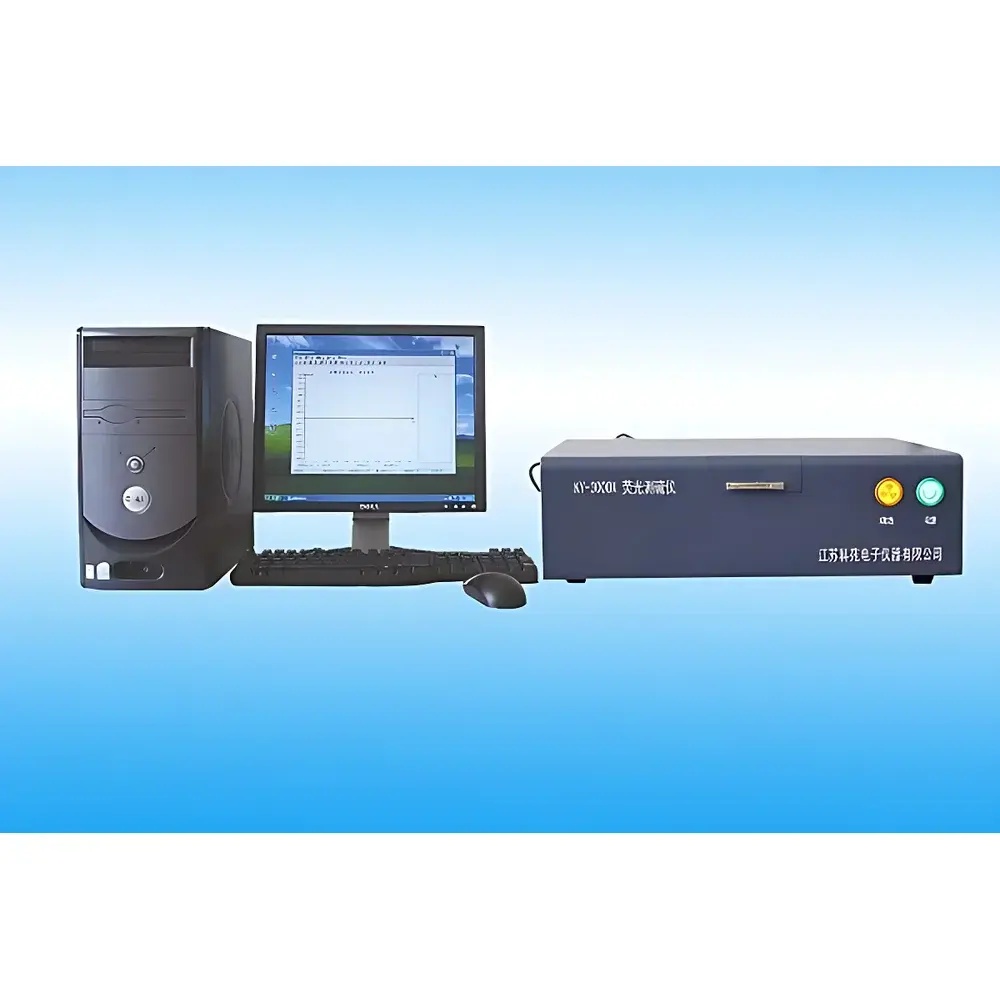
Kyoyuan KY-3000 Energy-Dispersive X-Ray Fluorescence Sulfur Analyzer
| Brand | Kyoyuan |
|---|---|
| Origin | Jiangsu, China |
| Manufacturer Type | OEM Manufacturer |
| Country of Origin | China |
| Model | KY-3000 |
| Price | Upon Request |
| Analysis Time | 1–999 s (recommended 60 s) |
| Detection Limit | 10 ppm |
| Sulfur Range | 0.001–9 wt% (petroleum matrix) |
| Accuracy | Compliant with GB/T 17040, SH/T 0742–2004, ASTM D4294, and GB/T 11140 |
| Operating Temperature | 5–40 °C |
| Relative Humidity | ≤85% at 30 °C |
| Power Supply | 220 V ±20 V, 50 Hz |
| Power Consumption | <150 W |
| Dimensions (L×W×H) | 560 × 470 × 150 mm |
| Weight | 20 kg |
Overview
The Kyoyuan KY-3000 Energy-Dispersive X-Ray Fluorescence (ED-XRF) Sulfur Analyzer is a dedicated benchtop instrument engineered for rapid, non-destructive quantification of total sulfur in liquid hydrocarbon matrices—primarily petroleum products, diesel fuels, lubricating oils, and gasoline blends. It operates on the fundamental principle of energy-dispersive X-ray fluorescence spectroscopy: a high-stability X-ray tube excites sulfur atoms (atomic number Z = 16) in the sample, inducing characteristic Kα emission at 2.307 keV; this fluorescent signal is collected by a high-resolution silicon drift detector (SDD), digitized, and processed via peak deconvolution and matrix-corrected calibration algorithms. Unlike wavelength-dispersive systems, the KY-3000 leverages optimized geometric configuration and spectral deconvolution to deliver laboratory-grade precision without vacuum or helium purge requirements—enabling routine QC analysis directly in refinery labs, fuel testing centers, and third-party certification facilities.
Key Features
- Rapid single-measurement analysis: Delivers statistically robust sulfur concentration results in as little as 60 seconds, with full measurement cycles configurable from 1 to 999 seconds.
- Automated C/H ratio correction: Compensates for matrix effects arising from variable hydrocarbon composition, ensuring accuracy across diverse fuel types—from naphtha to residual fuel oil.
- Multi-algorithm curve selection engine: Integrates empirically validated calculation models—including fundamental parameter (FP), empirical calibration, and scatter-ratio methods—to mitigate bias introduced by additive packages (e.g., detergents, antioxidants, metal deactivators) that distort conventional Compton/Rayleigh ratio approaches.
- Intelligent auto-curve assignment: The system evaluates spectral quality and intensity distribution in real time to select the optimal calibration curve—eliminating manual range selection or pre-knowledge of sulfur concentration.
- Active spectral stabilization: Real-time energy drift compensation adjusts for temperature-induced detector gain shifts and X-ray tube aging, maintaining peak centroid stability within ±0.5 eV over extended operation—reducing annual recalibration frequency to ≤2 times per year.
- Onboard reference standard integration: A sealed, traceable sulfur-containing reference material is housed internally and automatically engaged during startup and periodic validation, correcting for long-term X-ray tube output decay and detector efficiency drift.
- Rotary sample positioning mechanism: Samples are loaded onto a motorized turntable and precisely indexed into the shielded measurement chamber—physically separating sample loading aperture from irradiation zone to eliminate primary beam leakage pathways.
- Regulatory-compliant radiation safety: Fully type-approved under Chinese environmental exemption regulations (MEP Notice No. 115); certified for unrestricted use without local registration or routine leakage testing—meets IEC 61010-1 and GBZ 126–2011 shielding performance requirements.
Sample Compatibility & Compliance
The KY-3000 accepts standard 30–40 mm diameter liquid samples in disposable polyethylene or borosilicate glass vials (10–20 mL volume). It is validated for homogeneous liquids only; heterogeneous, viscous, or particulate-laden samples require prior filtration or homogenization. Method validation adheres to ISO/IEC 17025:2017 general requirements for competence of testing laboratories. Analytical performance meets or exceeds mandatory specifications in ASTM D4294 (Standard Test Method for Sulfur in Petroleum and Petroleum Products by Energy-Dispersive X-Ray Fluorescence Spectrometry), GB/T 17040 (Petroleum Products—Determination of Sulfur Content—Energy-Dispersive X-Ray Fluorescence Spectrometry), SH/T 0742–2004 (Determination of Sulfur in Gasoline and Diesel Fuel), and GB/T 11140 (Petroleum Products—Determination of Sulfur—Wavelength-Dispersive X-Ray Fluorescence Spectrometry). Instrument design supports GLP audit readiness with full electronic record retention and user-access logging.
Software & Data Management
The embedded Kyoyuan Analytical Suite (v3.2+) provides intuitive touchscreen control, method setup, and real-time spectral visualization. All measurement parameters—including acquisition time, voltage/current settings, curve selection logic, and background subtraction mode—are fully configurable and stored with each result. Data export supports CSV, PDF, and XML formats compliant with LIMS integration protocols. Audit trail functionality records operator ID, timestamp, method version, and raw spectrum hash—meeting FDA 21 CFR Part 11 requirements for electronic records and signatures when deployed in regulated environments. Firmware updates are delivered via USB or Ethernet with cryptographic signature verification.
Applications
- Refinery process stream monitoring: Real-time sulfur tracking in hydrotreater feed and product streams to optimize catalyst life and meet pipeline specifications.
- Fuel quality assurance: Routine compliance testing against Euro 5/6, Tier 3, and China VI sulfur limits (≤10 ppm for diesel, ≤15 ppm for gasoline).
- Blending tank certification: Quantitative verification of low-sulfur blend components prior to dispatch.
- Research & development: Screening of novel desulfurization catalysts or oxidative desulfurization efficacy.
- Contract laboratory accreditation: Supporting ISO/IEC 17025 scope expansion for ED-XRF-based sulfur testing.
FAQ
Is vacuum or helium purging required for sulfur detection?
No. The KY-3000 employs optimized air-path geometry and high-sensitivity SDD detection, enabling reliable 2.307 keV Kα measurement without atmosphere removal.
Can the instrument analyze solid or semi-solid samples?
It is validated exclusively for homogeneous liquids. Solids require dissolution in low-sulfur solvent or fusion into borate glass beads—a separate application protocol not covered under standard warranty.
What documentation is provided for regulatory audits?
Factory calibration certificate, ISO 17025-accredited verification report, radiation safety certification (MEP Exemption No.), and full software validation package including IQ/OQ documentation.
How often must the internal standard be replaced?
The sealed reference source has a certified service life of ≥5 years under normal operating conditions and requires no user replacement.
Does the system support multi-element analysis beyond sulfur?
While optimized for sulfur, the spectral acquisition engine captures full 0.5–20 keV range data—enabling optional post-acquisition evaluation of Cl, Si, Ca, or Zn if calibrated using appropriate standards.
Related Products





