
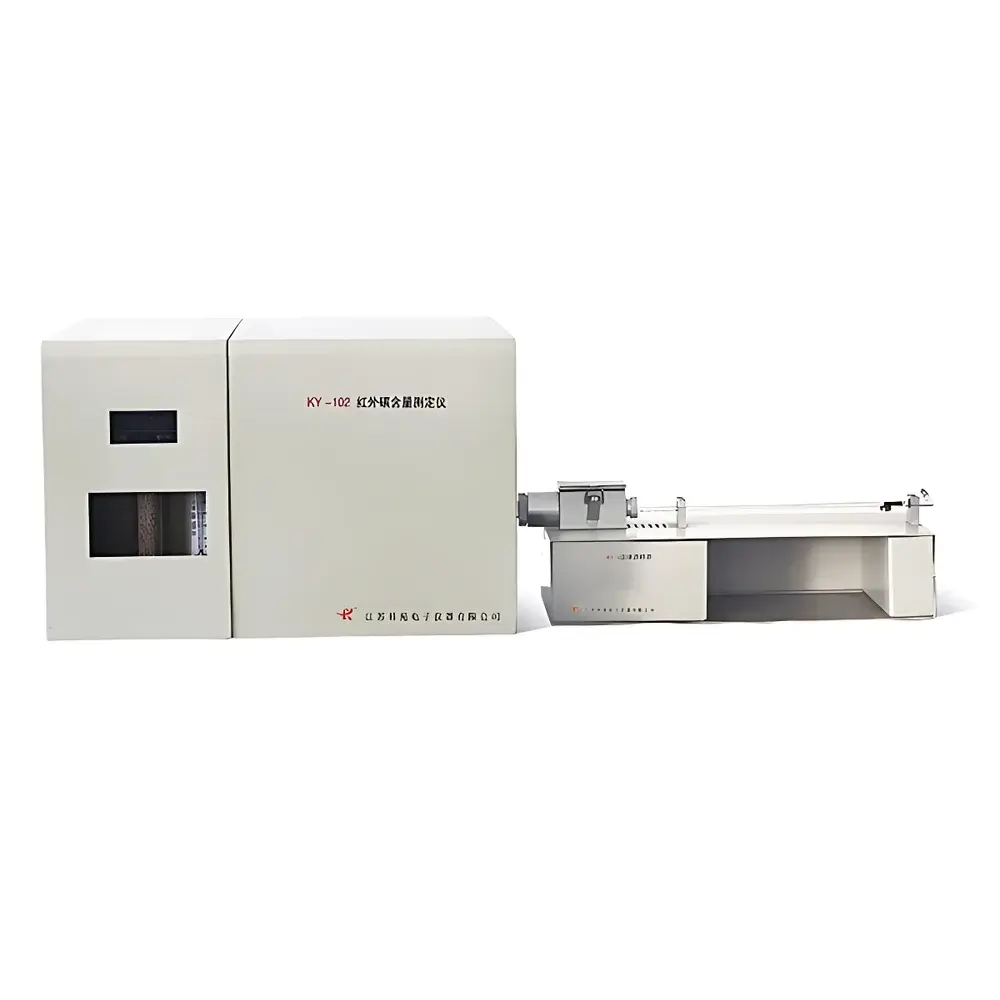
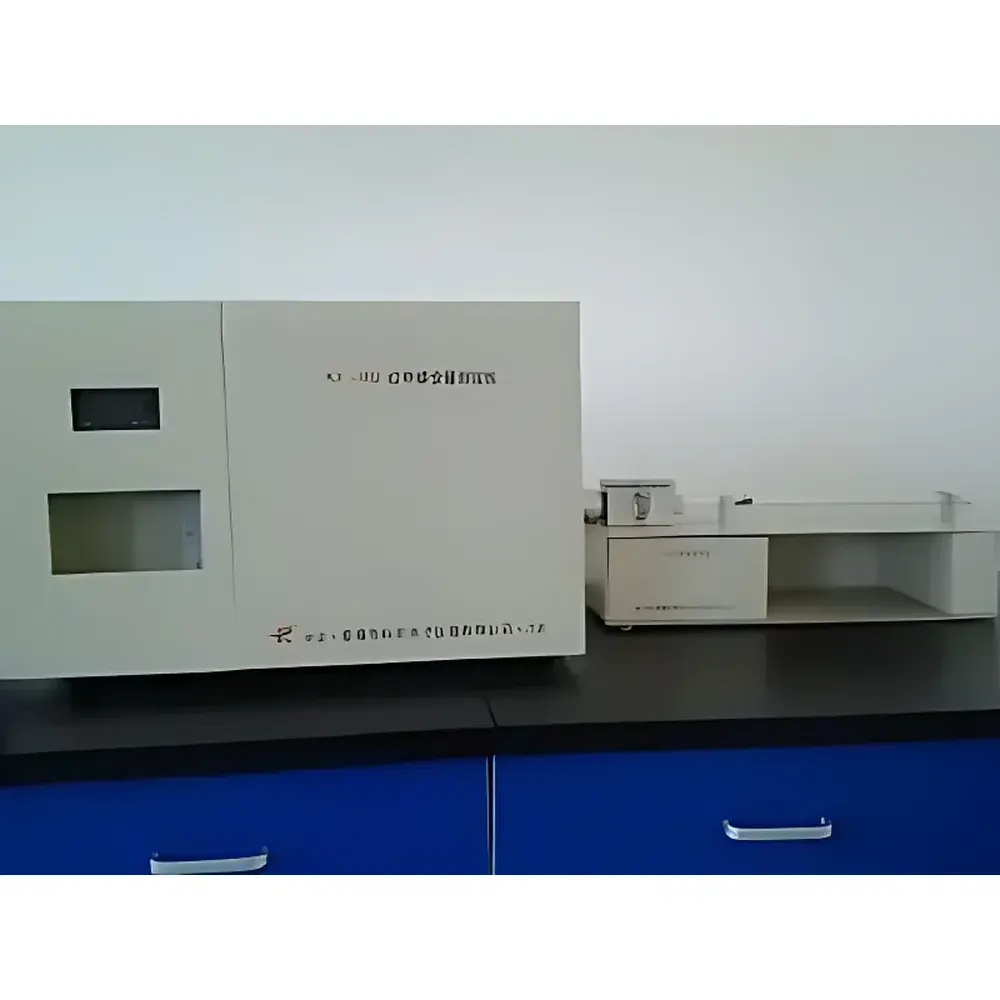
KY-102 Infrared Carbon-Sulfur Analyzer by Keyuan Instruments
| Brand | Keyuan Instruments |
|---|---|
| Origin | Jiangsu, China |
| Manufacturer Type | Direct Manufacturer |
| Model | KY-102 |
| Measurement Principle | Infrared Absorption (CO₂ & SO₂) |
| Carbon Range | 0.005–10.0000% (extendable to 99.999%) |
| Sulfur Range | 0.0005–0.3500% (extendable to 99.999%) |
| Analysis Time | ~35 s (excluding sample weighing) |
| Detection Limit | 200 ppm |
| Sample Mass | 100 mg – 1 g |
| Repeatability | ±200 ppm (200–1000 ppm) |
| Weighing Capacity | 0–100 g |
| Readability | 0.001 g |
| Required Gas | O₂ at 0.5 MPa, ≥99.7% purity |
| Combustion Methods | Tube Furnace (for viscous samples), Arc Furnace (for solid samples) |
| Compliance Standards | GB/T 223.69–1997 (C), GB/T 223.68–1997 (S) |
| Interface | Windows-based GUI with real-time curve display |
| Data Acquisition | PCI-bus integrated control and acquisition system |
| Detector | Low-noise, high-sensitivity, anti-interference infrared detector |
| Channel Configuration | 16 independent channels for carbon, 16 for sulfur (32 total, user-configurable) |
Overview
The KY-102 Infrared Carbon-Sulfur Analyzer is a precision elemental combustion analyzer engineered for quantitative determination of total carbon (C) and total sulfur (S) in solid and semi-solid materials. It operates on the principle of high-temperature combustion followed by non-dispersive infrared (NDIR) spectroscopic detection. During analysis, a precisely weighed sample is combusted in a controlled oxygen-rich atmosphere—either via high-frequency arc ignition (for metals, alloys, and refractory solids) or resistive tube furnace heating (for catalysts, polymers, or viscous matrices). Carbon is quantitatively oxidized to CO₂, and sulfur to SO₂. These gaseous products are swept through dust- and moisture-removal modules into dual-wavelength infrared cells, where absorption intensities are measured at characteristic wavelengths (4.26 µm for CO₂, 7.35 µm for SO₂). Concentrations are calculated in real time using the Lambert–Beer law, referenced against calibration curves established with certified reference materials traceable to NIST or national metrology institutes.
Key Features
- PCI-bus-integrated hardware architecture ensures deterministic timing, low-latency signal acquisition, and long-term operational stability under continuous laboratory use.
- Dual-channel NDIR detection system with thermoelectrically cooled detectors delivers high signal-to-noise ratio and immunity to ambient thermal drift.
- Real-time graphical visualization of C/S release profiles during combustion—enabling diagnostic assessment of sample homogeneity, combustion efficiency, and potential interferences.
- Automatic balance integration supports dynamic, non-fixed sample weighing (100 mg–1 g), eliminating manual entry errors and streamlining throughput.
- Configurable channel mapping: 16 independently calibrated spectral channels per element allow simultaneous multi-range analysis—e.g., low-level catalyst carbon (200 ppm–0.1%) and high-carbon steel (2–6%) within a single instrument configuration.
- Non-contact, high-voltage spark initiation for arc combustion reduces electrode wear, minimizes maintenance intervals, and avoids cross-contamination between analyses.
- Fully Windows-native software interface compliant with ISO/IEC 17025 documentation requirements—supports audit trails, user access levels, electronic signatures, and raw data export in CSV/ASCII format.
Sample Compatibility & Compliance
The KY-102 accommodates diverse sample forms including metal alloys, ferroalloys, catalysts, activated carbons, graphite powders, ceramics, and polymer composites. Its dual-combustion design (arc + tube furnace) extends applicability across material classes with varying ignition thresholds and ash-forming tendencies. All analytical protocols align with Chinese national standards GB/T 223.69–1997 (carbon) and GB/T 223.68–1997 (sulfur), which are harmonized with ISO 4935 (steel analysis) and ASTM E1019 (standard test method for C/S in steel, iron, and ferroalloys). Method validation reports—including limit of detection (LOD), limit of quantitation (LOQ), linearity (R² > 0.9995 over full range), and intermediate precision (n = 6 per level)—are provided with factory certification. The system supports GLP-compliant operation when configured with timestamped metadata logging and 21 CFR Part 11–ready software options.
Software & Data Management
The embedded analytical software provides comprehensive data governance capabilities: parameter management (calibration coefficients, blank offsets, integration windows), channel-specific curve re-fitting, breakpoint correction for incomplete combustion artifacts, and automated blank subtraction routines. All measurement events—including sample ID, operator, date/time stamp, raw absorbance values, peak area integrals, and final %C/%S results—are stored in a relational SQLite database with immutable records. Export functions support direct transfer to LIMS platforms via ODBC or delimited text. Audit trail logs record every user action (method modification, calibration update, result override) with operator ID and timestamp—ensuring full traceability for regulatory review. Software updates are delivered via signed firmware packages validated against SHA-256 checksums.
Applications
- Quality control of metallurgical feedstocks and finished alloys (e.g., stainless steel, titanium, nickel superalloys)
- Carbon content verification in heterogeneous catalysts (e.g., Pd/C, Pt/C, Ni/Mo₂C) where residual carbon affects activity and selectivity
- Specification testing of graphite anodes and cathode materials in battery R&D
- Impurity profiling in high-purity silicon and semiconductor-grade ceramics
- Regulatory compliance testing for sulfur in low-sulfur steels per ASTM A751 and EN 10027
- Research-scale quantification of coke deposition on spent FCC catalysts in petrochemical laboratories
FAQ
What combustion methods does the KY-102 support, and how are they selected?
The instrument offers two selectable combustion modes: high-frequency arc ignition (optimized for conductive solid metals and alloys) and resistance-heated tube furnace (suitable for non-conductive, heat-sensitive, or viscous samples such as catalyst slurries or polymer pellets). Selection is software-controlled and requires no hardware reconfiguration.
Is the KY-102 compliant with international quality standards for laboratory instrumentation?
Yes—the hardware design, calibration protocol, and software architecture meet foundational requirements for ISO/IEC 17025 accreditation. Full compliance with 21 CFR Part 11 (electronic records/signatures) is achievable via optional software licensing and procedural documentation.
Can the analyzer distinguish between organic and inorganic carbon forms?
No. The KY-102 measures total carbon content only. Speciation (e.g., carbonate vs. elemental carbon) requires coupling with complementary techniques such as XRD, TGA-FTIR, or selective acid dissolution prior to analysis.
What routine maintenance is required to sustain measurement accuracy?
Daily: desiccant replacement in gas drying traps; weekly: cleaning of ceramic combustion tubes and inspection of O₂ pressure regulator; quarterly: verification of detector baseline stability and recalibration using CRMs certified for both C and S.






