
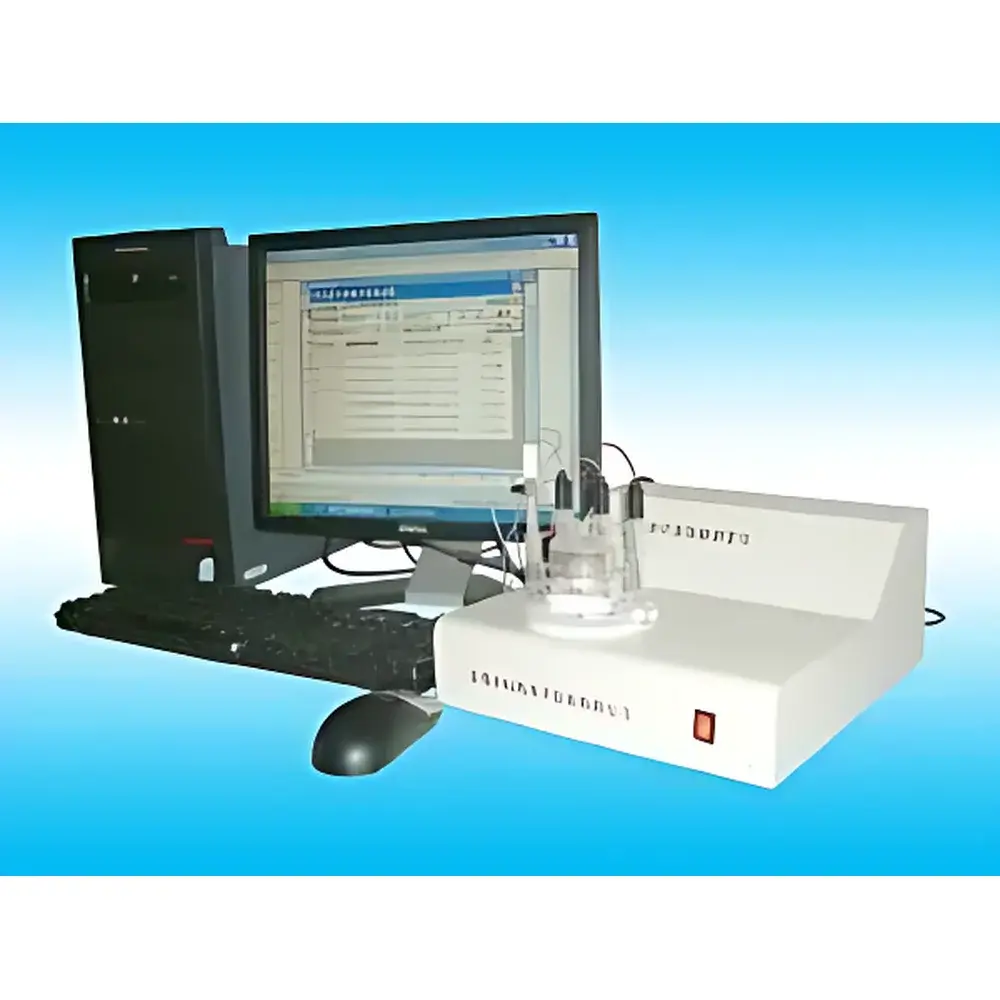
Koyuan KY-4 Coulometric Karl Fischer Moisture Analyzer
| Brand | Koyuan |
|---|---|
| Origin | Jiangsu, China |
| Manufacturer Type | Direct Manufacturer |
| Instrument Type | Coulometric Karl Fischer Moisture Analyzer |
| Titration Mode | Fully Automatic Electrolytic Titration |
| Sample Form | Liquid |
| Measurement Range | 3 ppm – 99.99% H₂O |
| Detection Sensitivity | 0.01 µg H₂O |
| Resolution | 0.1 ppm (typical for coulometric systems) |
| Endpoint Detection | Potentiometric (dual-current mode) |
| Power Consumption | 50 W |
| Dimensions | 280 × 280 × 160 mm |
| Compliance | GB/T 7600–1987, SH/T 0246–1992, SH/T 0255–1992 |
| Interface | USB 2.0 (PC-controlled) |
| Electrolysis Cell | Custom Fritted-Glass Electrode Assembly (membrane-free design) |
Overview
The Koyuan KY-4 Coulometric Karl Fischer Moisture Analyzer is a precision laboratory instrument engineered for trace-level water quantification in liquid samples using the electrochemical coulometric principle of the Karl Fischer reaction. Unlike volumetric KF titrators, this system generates iodine *in situ* via controlled electrolysis of iodide ions within a sealed anolyte chamber—eliminating the need for manual reagent standardization and minimizing exposure to volatile or toxic components. The analyzer operates on the stoichiometric relationship where 1 mole of iodine reacts with 1 mole of water (10.72 mg H₂O per coulomb), enabling direct, absolute quantification without calibration curves. Designed for high reproducibility in regulated environments, it delivers sub-microgram detection capability (0.01 µg H₂O) and supports measurement across an exceptionally broad dynamic range—from ultra-trace (3 ppm) to near-pure water (99.99% w/w). Its compact, self-contained architecture integrates a dual-current potentiometric endpoint detection circuit, ensuring stable baseline response and minimal electrical noise interference during low-water-content analysis.
Key Features
- Membrane-free electrolytic cell design featuring a proprietary sintered-glass frit electrode assembly—eliminates routine ion-exchange membrane replacement and reduces long-term maintenance overhead.
- Odorless, pyridine-free Karl Fischer reagent compatibility—enhances operator safety and lab air quality while maintaining full analytical equivalence to classical KF chemistry.
- Dual-current endpoint control: low-current mode (for precise endpoint discrimination in trace moisture analysis) and high-current mode (for accelerated titration of high-moisture samples; typical analysis time ≤ 2 minutes).
- USB 2.0 interface enables seamless integration with Windows-based host computers for real-time data acquisition, automated calculation, graphical trend visualization, and GLP-compliant reporting.
- Sealed titration environment with inert gas purging capability (optional)—prevents ambient moisture ingress and ensures measurement integrity under variable laboratory humidity or temperature conditions.
- Low reagent consumption: average usage < 1 mL per sample—reducing operational cost and chemical waste generation.
Sample Compatibility & Compliance
The KY-4 is validated for use with a wide range of liquid matrices including petroleum distillates (e.g., gasoline, jet fuel, lubricating oils), organic solvents (acetone, methanol, THF), pharmaceutical excipients, and specialty chemicals. It conforms to multiple national standards governing moisture determination in industrial fluids: GB/T 7600–1987 (moisture in in-service transformer oil), SH/T 0246–1992 (light petroleum products), and SH/T 0255–1992 (additive-containing lubricants). While not pre-certified for FDA 21 CFR Part 11, its PC-based software architecture supports audit trail implementation, electronic signature readiness, and raw data retention—facilitating alignment with GMP/GLP documentation requirements when configured with appropriate IT controls.
Software & Data Management
The KY-4 operates via dedicated Windows-compatible software that provides full instrument control, method parameter configuration (e.g., current thresholds, stirring speed, delay times), and automated endpoint recognition. All raw current-time profiles, calculated water mass (µg), concentration (% w/w or ppm), and statistical summaries (mean, RSD, n = 3–6) are stored in encrypted binary format with timestamping and user ID logging. Export options include CSV, PDF, and XLSX formats for external LIMS integration or regulatory submission. Data integrity safeguards include write-protected storage paths, automatic backup on session close, and configurable auto-delete policies compliant with internal QA retention schedules.
Applications
- Quality control of transformer oils and insulating fluids in power generation and transmission facilities.
- Moisture specification testing of aviation turbine fuels per ASTM D6304 (coulometric mode).
- Stability-indicating assay of hygroscopic APIs and excipients during pharmaceutical development.
- Process monitoring of solvent recovery streams in fine chemical synthesis.
- Verification of dryness validation for packaging materials used in moisture-sensitive electronics manufacturing.
FAQ
What types of samples can be analyzed with the KY-4?
Liquid samples compatible with non-aqueous Karl Fischer chemistry—including hydrocarbons, polar aprotic solvents, and halogenated compounds. Viscous or suspended-phase liquids require homogenization prior to injection.
Is the instrument compliant with ISO/IEC 17025 requirements?
The KY-4 meets technical performance criteria referenced in ISO 12937 and ASTM D6304. Full ISO/IEC 17025 compliance depends on laboratory-specific validation protocols, uncertainty budgeting, and documented traceability to NIST-traceable water standards.
Does the system support multi-user access with role-based permissions?
Native software does not include built-in RBAC; however, Windows OS-level user accounts and folder permissions can be leveraged to enforce procedural segregation of duties during method setup, analysis execution, and report generation.
Can the electrolytic cell be cleaned and reused after extended operation?
Yes—the sintered-glass frit and platinum electrodes are chemically resistant and may be regenerated using recommended solvent rinses (e.g., methanol, chloroform) followed by nitrogen drying. Routine cleaning intervals depend on sample matrix cleanliness and daily throughput.
What is the recommended recalibration frequency?
No reagent standardization is required. System verification should be performed before each analytical batch using certified water standards (e.g., 1.00 ± 0.02 mg H₂O/mg standard), with results recorded in the instrument logbook per GLP practice.
Related Products




