
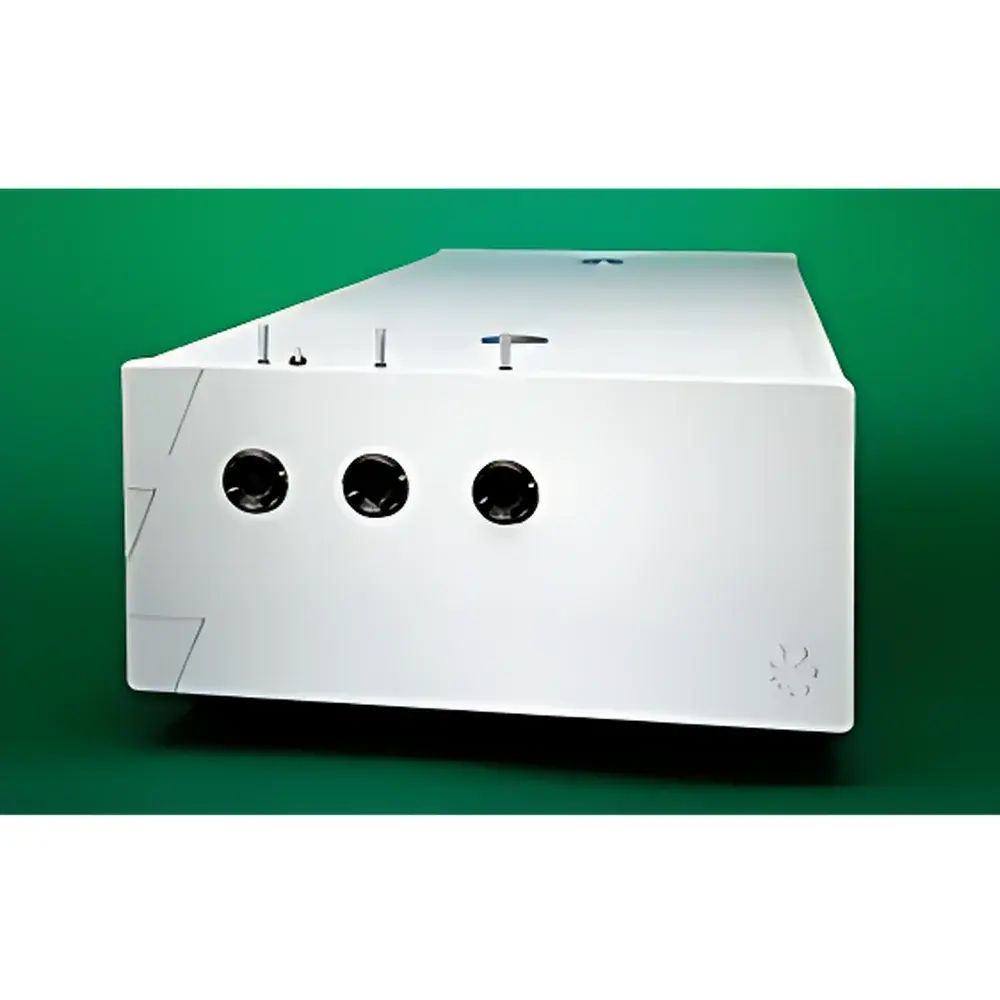
Ekspla PhotoSonus T High-Energy Table-Top Tunable Wavelength Laser System for Photoacoustic Imaging
| Brand | Ekspla |
|---|---|
| Origin | Lithuania |
| Manufacturer Type | Original Equipment Manufacturer (OEM) |
| Import Status | Imported |
| Model | PhotoSonus T |
| Core Technology | Nd:YAG-pumped Optical Parametric Oscillator (OPO) |
| Pulse Energy | Up to 230 mJ (660–2600 nm), 35 mJ (330–660 nm) |
| Wavelength Range | 330–2600 nm (automated tuning) |
| Pulse Duration | 3–5 ns |
| Linewidth | <10 cm⁻¹ (signal), <20 cm⁻¹ (idler) |
| Tuning Resolution | 1 cm⁻¹ (signal/idler), 2 cm⁻¹ (SHG) |
| Beam Diameter | 7–9 mm (1/e²) |
| Beam Divergence | <2 mrad (full angle, FWHM) |
| Repetition Rate | 10–20 Hz |
| Polarization | Horizontal (signal), vertical (idler & SHG) |
| Control Interfaces | USB, RS232, optional LAN/WLAN |
| Compliance | CE, IEC 60825-1:2014 Class 4 Laser Product |
Overview
The Ekspla PhotoSonus T is a high-integration, benchtop-grade tunable laser system engineered specifically for photoacoustic imaging (PAI) and time-resolved photobiological studies. At its core lies a diode-pumped, Q-switched Nd:YAG laser (532 nm fundamental, optionally 1064 nm) serving as the pump source for a fully integrated optical parametric oscillator (OPO). This architecture enables continuous, hands-free wavelength tuning across an ultra-broad spectral range — from deep ultraviolet (330 nm, via second harmonic generation) through visible and near-infrared (660–1320 nm signal band) to mid-infrared (1065–2600 nm idler band). The system delivers high pulse energies (up to 230 mJ in the OPO output range) with sub-5 ns pulse duration and narrow spectral linewidth (<10 cm⁻¹ over most of the signal tuning range), satisfying the stringent requirements of quantitative PAI, where optical absorption contrast must be precisely mapped across endogenous chromophores (e.g., hemoglobin, melanin, lipids) and exogenous contrast agents. Its compact footprint (456 × 821 × 270 mm) and modular design support seamless integration into multi-modal imaging platforms, including hybrid PAI–ultrasound or PAI–MRI setups.
Key Features
- Automated, computer-controlled wavelength tuning from 330 nm to 2600 nm with resolution down to 1 cm⁻¹ (signal/idler) and 2 cm⁻¹ (SHG)
- High pulse energy output: up to 230 mJ (660–2600 nm), 35 mJ (330–660 nm), enabling deep-tissue penetration and high signal-to-noise ratio in photoacoustic detection
- Narrow, stable linewidth (90% of the tuning range — critical for spectroscopic PAI and pump-probe applications
- Dual-beam architecture: dedicated, collimated 532 nm pump output port (standard); optional 1064 nm port for alternative pumping configurations or independent use
- Robust cavity design permitting flashlamp replacement without realignment — eliminating downtime and preserving beam pointing stability and M² performance
- OPO pump energy monitoring circuitry to optimize optical component lifetime and ensure consistent conversion efficiency over extended operation
- Multiple control options: intuitive backlit keypad with real-time display (usable with laser safety eyewear) and LabVIEW™-compatible drivers (USB/RS232 standard; LAN/WLAN optional)
Sample Compatibility & Compliance
The PhotoSonus T is compatible with diverse biological and material samples used in preclinical and translational photoacoustic research, including excised tissues, small-animal models (mice, rats), tissue-mimicking phantoms, and optically scattering media. Its broad tunability supports spectral unmixing of overlapping absorbers (e.g., oxy- vs. deoxy-hemoglobin at 700–900 nm) and targeted excitation of NIR-II window chromophores (1000–1350 nm). The system complies with IEC 60825-1:2014 for Class 4 laser safety and meets CE marking requirements for electromagnetic compatibility (EMC) and low-voltage directive (LVD). It is designed for GLP-aligned laboratories: full audit trail capability is supported via LabVIEW logging, timestamped parameter records, and user-accessible firmware versioning. While not FDA-cleared, its specifications align with common validation benchmarks for research-grade PAI instrumentation referenced in ASTM E3122–20 (Standard Guide for Photoacoustic Imaging Systems) and ISO 13485–compatible quality management frameworks.
Software & Data Management
The PhotoSonus T ships with native LabVIEW™ drivers (Windows 10/11, 64-bit), enabling direct integration into custom acquisition pipelines for synchronized laser triggering, data capture from ultrasound transducers or hydrophones, and real-time spectral scanning. All wavelength, energy, and timing parameters are programmatically addressable via VIs or SCPI-like ASCII commands over USB or RS232. Optional LAN/WLAN connectivity allows remote monitoring and control from networked workstations — essential for shared-core facility environments. The system supports external TTL triggering (input/output) for synchronization with high-speed cameras, oscilloscopes, or data acquisition cards (e.g., National Instruments PXI). Energy meter integration (optional) provides closed-loop feedback for automated energy stabilization during long-duration spectral scans. Export formats include CSV and HDF5, ensuring compatibility with MATLAB®, Python (NumPy/H5Py), and commercial PAI reconstruction software (e.g., ViewMSOT, PAI-Studio).
Applications
- Biomedical Photoacoustic Imaging: Quantitative oxygen saturation mapping, tumor angiogenesis monitoring, inflammation tracking (e.g., renal or cerebral), and label-free functional imaging in rodent models
- Flash Photolysis & Ultrafast Photobiology: Nanosecond-resolved transient absorption studies of photosensitive proteins (e.g., opsins, cryptochromes) and photoactive nanomaterials
- Nonlinear Spectroscopy: Coherent anti-Stokes Raman scattering (CARS) pump source, stimulated Raman gain spectroscopy (SRGS), and two-photon absorption characterization
- Remote Sensing & Environmental Analysis: Differential absorption LIDAR (DIAL) simulations and gas-phase species detection using mid-IR idler output
- Photoacoustic Microscopy & Tomography: High-resolution vascular imaging at multiple wavelengths with active contour-based image enhancement algorithms
FAQ
What is the minimum pulse energy stability specification?
Pulse energy stability is specified as ≤2.5% RMS (standard deviation) over 1 hour at constant ambient conditions (20–25°C, stable line voltage), measured at 700 nm using a calibrated thermopile sensor.
Can the system operate in single-shot mode?
Yes — the repetition rate is fully programmable from single-shot to 20 Hz (depending on model), with TTL-compatible external trigger input supporting gated acquisition protocols.
Is water cooling mandatory?
The base configuration requires recirculated chilled water (≤20°C, flow rate <10 L/min); however, an air-cooled power supply option is available for reduced infrastructure dependency.
How is wavelength calibration verified?
Each unit undergoes factory calibration using a high-resolution wavemeter (±0.1 nm accuracy). A NIST-traceable calibration certificate is provided, and users may perform periodic verification using the built-in reference photodiode and oscilloscope interface.
Are service contracts and spare parts available globally?
Ekspla provides worldwide warranty (24 months) and post-warranty support via authorized service centers in North America, EU, and APAC regions; all critical spares (flashlamps, OPO crystals, pump diodes) are stocked and ship within 5 business days.





