LaVision FlowMaster® Thermographic Particle Image Velocimeter
| Brand | LaVision GmbH |
|---|---|
| Origin | Germany |
| Manufacturer Type | Authorized Distributor |
| Origin Category | Imported |
| Model | FlowMaster® thermographic |
| Measurement Capability | Planar (2D/3D) |
| Repetition Rate | 3 kHz |
| Velocity Range | ≤ 3.5 km/s |
| Temperature & Velocity Accuracy | ±1% of reading |
| Measurement Field Size | 200 mm × 200 mm |
| Particle Tracer | Micrometer-scale thermographic phosphor particles |
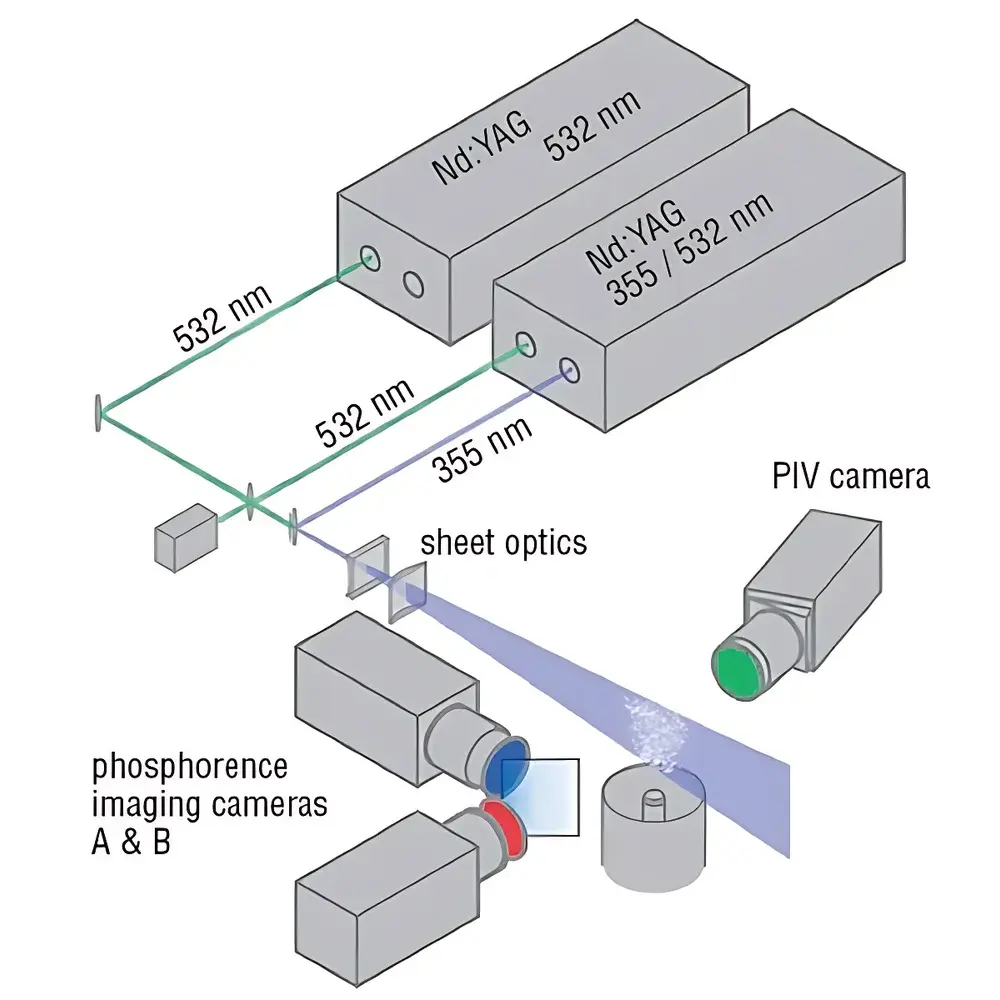
| Core Principle | Simultaneous phosphorescence lifetime-based thermometry and cross-correlation PIV |
Overview
The LaVision FlowMaster® Thermographic Particle Image Velocimeter is a high-fidelity, dual-parameter optical diagnostic system engineered for simultaneous, planar measurement of gas-phase temperature and velocity fields in transient and turbulent flows. Unlike conventional single-modality techniques, this system integrates time-resolved phosphor thermometry with particle image velocimetry (PIV) within a unified optical architecture. It employs micrometer-scale thermographic phosphor particles—typically Y2O3:Eu or Mg4FGeO6:Mn—as dual-function tracers: their phosphorescence decay lifetime is intrinsically sensitive to local gas temperature, while their spatial displacement between successive laser pulses enables velocity vector calculation via digital cross-correlation. The system operates at a native repetition rate of 3 kHz, supporting time-resolved acquisition of coupled thermal–hydrodynamic phenomena with microsecond temporal resolution. Designed for laboratory-scale wind tunnels, combustion chambers, and aerothermal test rigs, it delivers non-intrusive, quantitative data essential for validating high-fidelity CFD simulations of conjugate heat transfer, wake dynamics, and unsteady mixing processes.
Key Features
- Simultaneous acquisition of 2D temperature and velocity vector fields on a single camera frame sequence
- Integrated dual-laser illumination: pulsed Nd:YAG (for PIV seeding) and gated UV LED or pulsed UV laser (for phosphor excitation)
- High-sensitivity sCMOS or intensified CCD camera with precise inter-frame timing control (sub-microsecond jitter)
- Real-time phosphorescence lifetime fitting using multi-exponential decay models (e.g., bi-exponential fit for surface temperature correction)
- Calibration traceability to NIST-traceable blackbody sources and certified flow standards
- Modular optical layout compatible with stereoscopic and tomographic extensions for 3D reconstruction
- Ruggedized optomechanical housing with kinematic mounts and vibration-damping baseplate
Sample Compatibility & Compliance
The FlowMaster® Thermographic PIV is optimized for gaseous environments—including air, nitrogen, hydrogen, and combustion products—at pressures ranging from 0.1 to 5 bar and temperatures from −50 °C to +1200 °C (dependent on phosphor composition). Phosphor particle size (0.5–3 µm) ensures rapid thermal and momentum response (Stokes number < 0.01), satisfying the fundamental requirement for faithful fluid-following behavior in high-frequency flows. The system complies with ISO 20487:2021 (optical measurement systems for fluid mechanics), adheres to ASTM E2847-22 guidelines for uncertainty quantification in PIV-derived quantities, and supports GLP-compliant data archiving through audit-trail-enabled software logging. All calibration procedures are documented per ISO/IEC 17025 requirements for accredited metrology laboratories.
Software & Data Management
Acquisition and analysis are performed using LaVision’s DaVis® 10.2 platform, which provides synchronized control of lasers, cameras, and gating electronics. The software includes dedicated modules for phosphor lifetime mapping (with pixel-wise decay curve fitting), PIV post-processing (adaptive correlation, ensemble averaging, vorticity/strain computation), and fused parameter visualization (e.g., temperature–velocity joint PDFs, Reynolds stress tensor overlays). Raw image sequences, calibration metadata, and processing parameters are stored in HDF5 format with embedded MIAME-compliant headers. Export options include ASCII, NetCDF4, and VTK for interoperability with ParaView, MATLAB, and ANSYS Fluent. Full 21 CFR Part 11 compliance is available via optional DaVis® Secure Edition, featuring electronic signatures, role-based access control, and immutable audit trails.
Applications
- Transient thermal wake characterization behind heated bluff bodies (e.g., cylinders, turbine blades)
- Unsteady flame–vortex interactions in premixed and diffusion flames
- Boundary layer transition studies under thermal gradient forcing
- Validation of LES and DNS simulations of turbulent heat flux transport
- Aerothermal management in hypersonic inlet design and scramjet combustors
- Non-intrusive validation of conjugate heat transfer models in compact heat exchangers
FAQ
What phosphor materials are supported, and how is temperature calibration performed?
LaVision provides pre-characterized phosphor batches (Y2O3:Eu, Gd2O3:Tb, Mg4FGeO6:Mn) with full lifetime–temperature calibration curves (0–1200 °C) referenced to blackbody radiance standards. Calibration is performed in situ using a controlled-temperature calibration rig.
Can the system resolve 3D temperature–velocity fields?
Yes—when configured with stereoscopic PIV optics and multi-view phosphor imaging, the system supports tomographic reconstruction of 3D vector fields and volumetric temperature maps using iterative algebraic reconstruction techniques (ART).
Is synchronization with external triggers (e.g., engine crank angle, laser ignition) possible?
Absolutely—the DaVis® timing engine supports TTL, LVDS, and optical trigger inputs with <100 ns jitter, enabling phase-locked acquisition in cyclic processes such as internal combustion or pulsating jets.
What is the minimum resolvable temperature difference and velocity increment?
At 3 kHz, typical temperature resolution is ±0.5 K (at 500 K), and velocity resolution is ±0.05 m/s, limited by photon statistics, particle image sharpness, and correlation peak uncertainty—quantified per ISO/TR 20487 Annex B.
Does the system require specialized safety infrastructure?
UV excitation sources necessitate Class 3B laser safety protocols (interlocks, beam enclosures, operator training); all components comply with IEC 60825-1:2014 and EN 60825-1:2014 standards.