
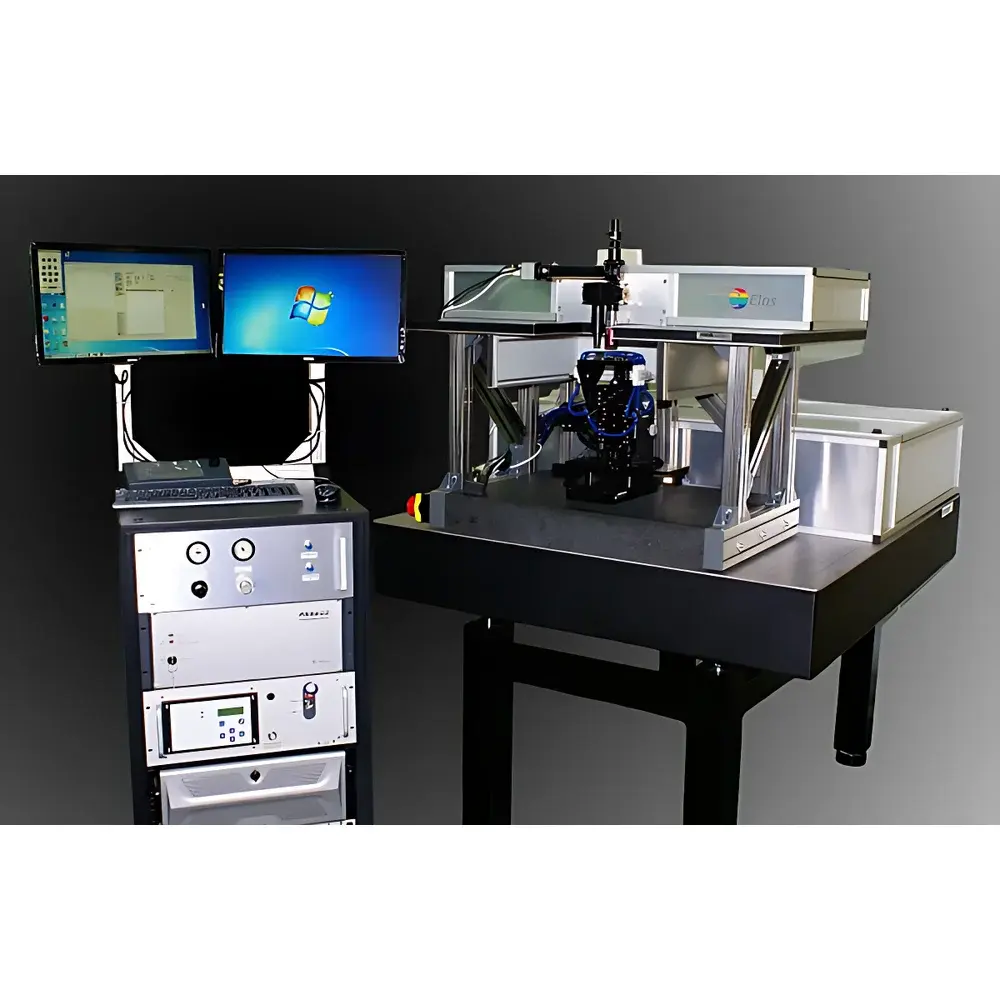
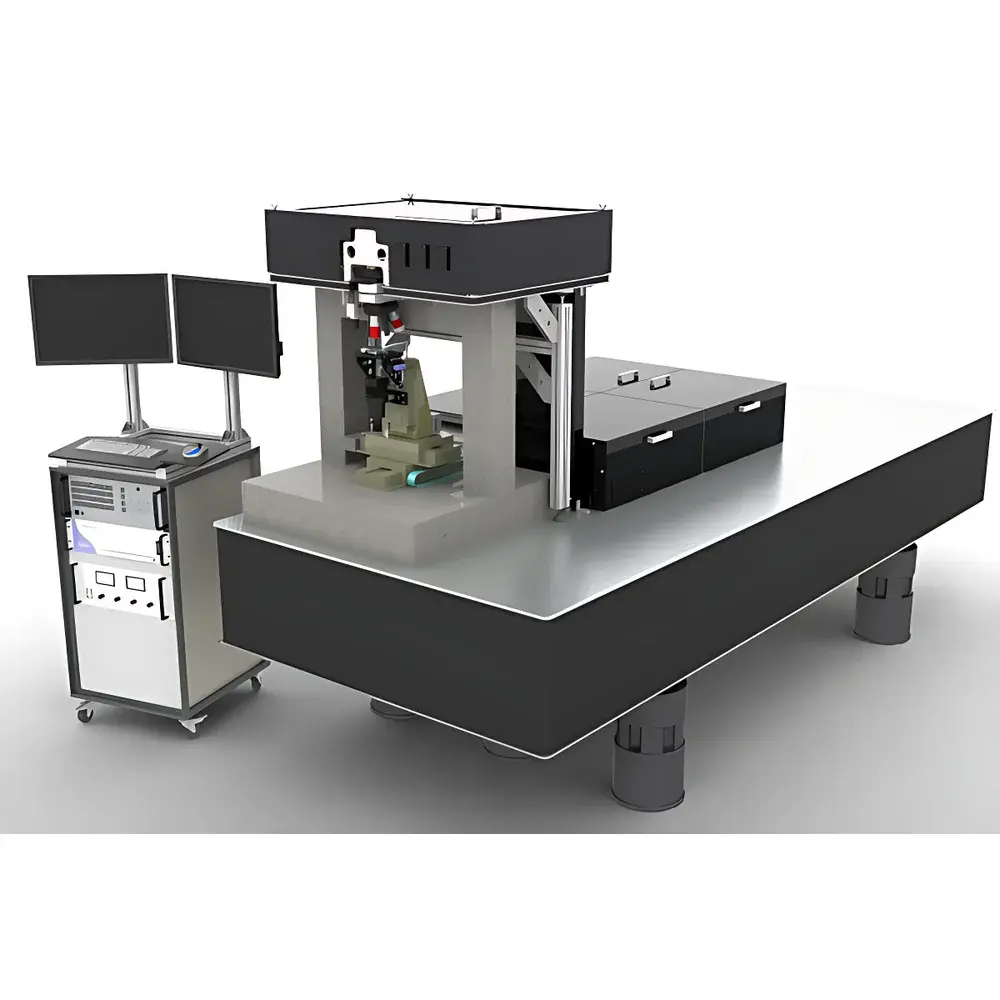
ELAS FemtoLAB Laboratory System for Femtosecond Laser Micromachining
| Brand | ELAS |
|---|---|
| Origin | Imported (Non-Chinese) |
| Manufacturer Type | Authorized Distributor |
| Model | FemtoLAB (Laboratory Systems) |
| Core Components | Industrial-Grade Femtosecond Laser Source (PHAROS), Galvanometric Beam Steering, Nanopositioning XYZ Stages, SCA Control Software |
| Compliance | Designed for ISO/IEC 17025-aligned lab environments |
| Software | SCA v4.x with hardware-integrated real-time control and GLP-compliant audit trail logging |
| Physical Footprint | ≤1.0 m × 2.5 m (fully assembled on optical table) |
| Laser Source | PHAROS femtosecond laser (1030 nm, up to 20 W avg. power, <290 fs pulse width, repetition rate 1–200 kHz) |
| Harmonic Generation | SHG (515 nm), THG (343 nm), FHG (257 nm) modules integrated |
| Positioning Accuracy | ±20 nm (closed-loop piezo-driven XYZ stages) |
| Beam Steering | Dual-axis galvo-scanners (±15° mechanical scan angle, <50 µrad pointing stability) |
| Autofocus | Motorized objective Z-stage + CMOS machine vision feedback loop |
| Optional Modules | SLM-based beam shaping, harmonic mirror turrets, 4F relay optics, polarization rotators, WATT PILOT attenuators |
Overview
The ELAS FemtoLAB Laboratory System is a turnkey femtosecond laser micromachining platform engineered for precision 3D microfabrication in academic, governmental, and industrial R&D laboratories. Built upon the physical principles of nonlinear light–matter interaction—specifically multiphoton absorption, plasma-mediated ablation, and non-thermal photomodification—the system enables sub-diffraction-limit material processing in transparent dielectrics, semiconductors, polymers, and biological matrices. Unlike nanosecond or picosecond systems, FemtoLAB leverages ultrashort pulses (<290 fs) to confine energy deposition within the focal volume, minimizing collateral thermal damage and enabling high-aspect-ratio features with nanometer-scale positional fidelity. Its modular architecture integrates a PHAROS industrial femtosecond laser, closed-loop nanopositioning stages, high-stability galvanometric scanners, and harmonically enhanced beam delivery—forming a complete, reconfigurable optical workstation compliant with laboratory space constraints (≤1.0 m × 2.5 m footprint).
Key Features
- Industrial-grade PHAROS femtosecond laser source (1030 nm fundamental, optional SHG/THG/FHG outputs) with programmable repetition rate (1–200 kHz) and pulse energy stability <±0.7% RMS over 8 hours
- Nanometer-accurate sample positioning via piezo-enhanced XYZ linear stages (20 nm resolution, 100 mm travel range per axis) with active drift compensation
- High-bandwidth galvanometric beam steering (scan speed up to 12 m/s, step response <80 µs) supporting both raster and vector writing modes
- Integrated machine vision subsystem with autofocus capability: real-time focus lock using CMOS imaging and motorized objective Z-control (±500 µm range, 100 nm repeatability)
- SCA software suite (v4.x) providing unified control of laser parameters, scanner trajectories, stage motion, harmonic switching, and attenuator/polarization settings—all synchronized at sub-millisecond latency
- Modular optical expansion support: plug-and-play compatibility with spatial light modulators (SLMs), 4F beam relay configurations, harmonic mirror turrets, and WATT PILOT variable attenuators
Sample Compatibility & Compliance
FemtoLAB accommodates substrates ranging from fused silica and sapphire to silicon wafers, polymer resins (e.g., IP-L, OrmoComp), lithium niobate, and hydrated biological tissues. Its non-contact, maskless processing eliminates tool wear and enables direct-write fabrication without vacuum requirements. The system adheres to ISO 13857 (safety of machinery), IEC 60825-1 (laser product safety), and supports GLP/GMP workflows through SCA’s built-in electronic logbook, user access controls, and 21 CFR Part 11–compliant audit trail generation. All hardware interlocks, emergency stop circuits, and laser shutter sequencing are validated per EN 61511 for functional safety in laboratory automation contexts.
Software & Data Management
The SCA software serves as the central orchestration layer, offering Python API integration (via RESTful endpoints and native SDK), batch script execution, and parameterized job queuing. Experimental metadata—including laser fluence maps, stage coordinates, pulse count per voxel, and harmonic selection—is embedded into each exported TIFF/OME-TIFF file. Raw trajectory data (G-code equivalents) and hardware synchronization logs are stored in HDF5 format for traceability. Version-controlled experiment templates allow reproducible setup replication across users and instruments, while role-based permissions ensure separation of calibration, operation, and analysis privileges—critical for multi-user core facilities and regulated QC labs.
Applications
- 3D multiphoton polymerization for micro-optics, metamaterial scaffolds, and microfluidic channel fabrication
- Subsurface refractive index modification in glass for embedded waveguides, photonic lanterns, and quantum memory devices
- High-fidelity micro-drilling of fuel injector nozzles, MEMS pressure sensor diaphragms, and biomedical stent patterns
- Laser-induced periodic surface structures (LIPSS) for anti-reflective, hydrophobic, or antibacterial functionalization
- Photo-induced etching of fused silica using femtosecond-laser-sensitized chemical development
- Custom scribing of thin-film solar cells (CIGS, perovskite) with minimized edge recombination losses
- Biomedical microstructuring: cell-adhesion patterning on hydrogels, neural probe surface texturing, and corneal flap creation protocols
FAQ
Is FemtoLAB compatible with existing optical tables and vibration isolation systems?
Yes—FemtoLAB is designed for bolt-down integration onto standard 12 mm or 25 mm pitch optical breadboards. Mounting interface plates and kinematic leveling feet are included for alignment stability under ISO 22477-1 Class A environmental conditions.
Can the system be upgraded with additional harmonic modules after initial installation?
All harmonic generators (SHG, THG, FHG) are field-installable via standardized optomechanical mounts and software-recognized plug-and-play configuration. No firmware reflash is required.
Does SCA software support automated calibration routines for galvo-scanner distortion correction?
Yes—SCA includes a camera-assisted auto-calibration workflow that acquires reference grid images and computes pixel-to-angle mapping corrections, storing LUTs per objective magnification and working distance.
What level of technical support is provided for application-specific process development?
ELAS offers remote beam profiling assistance, ablation threshold mapping services, and collaborative DOE-based parameter optimization—documented in ASTM E2921-compliant test reports.
Are training programs available for new operators and facility managers?
Comprehensive on-site or virtual training modules cover laser safety (ANSI Z136.1), SCA workflow certification, preventive maintenance scheduling, and GLP-compliant recordkeeping practices—with trainee competency assessments aligned to ISO/IEC 17025 Clause 6.2.5.




