
Ekspla PGx03 kHz-Pulse Picosecond Optical Parametric Generator
| Brand | Ekspla |
|---|---|
| Origin | Lithuania |
| Manufacturer Type | Original Equipment Manufacturer (OEM) |
| Product Category | Imported Scientific Instrument |
| Model | PGx03 |
| Pulse Repetition Rate | 1 kHz |
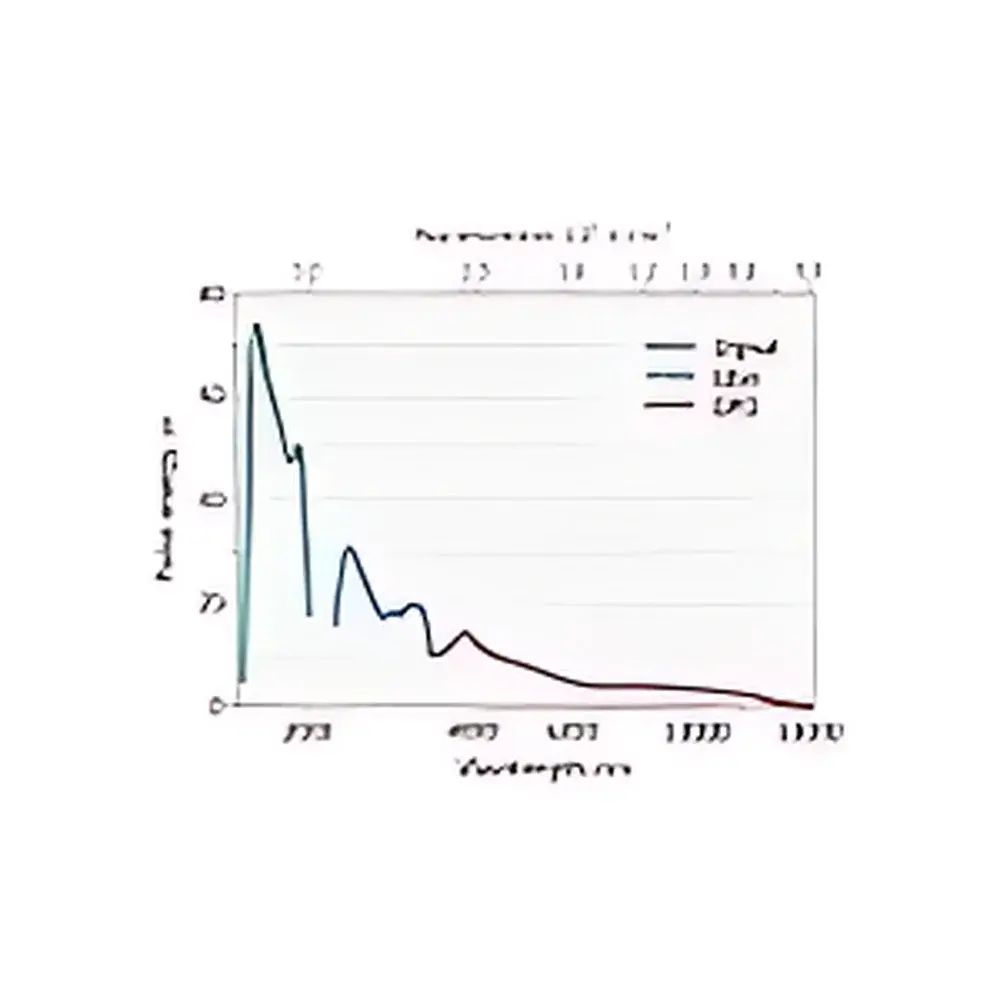
| Tuning Range | 210–16000 nm |
| Spectral Linewidth | <6 cm⁻¹ |
| Beam Divergence | <2 mrad |
| Control Interface | USB (RS232 optional), LabVIEW™ driver included |
| Core Architecture | Solid-State Pump Laser + Synchronously Pumped OPG/OPA System |
Overview
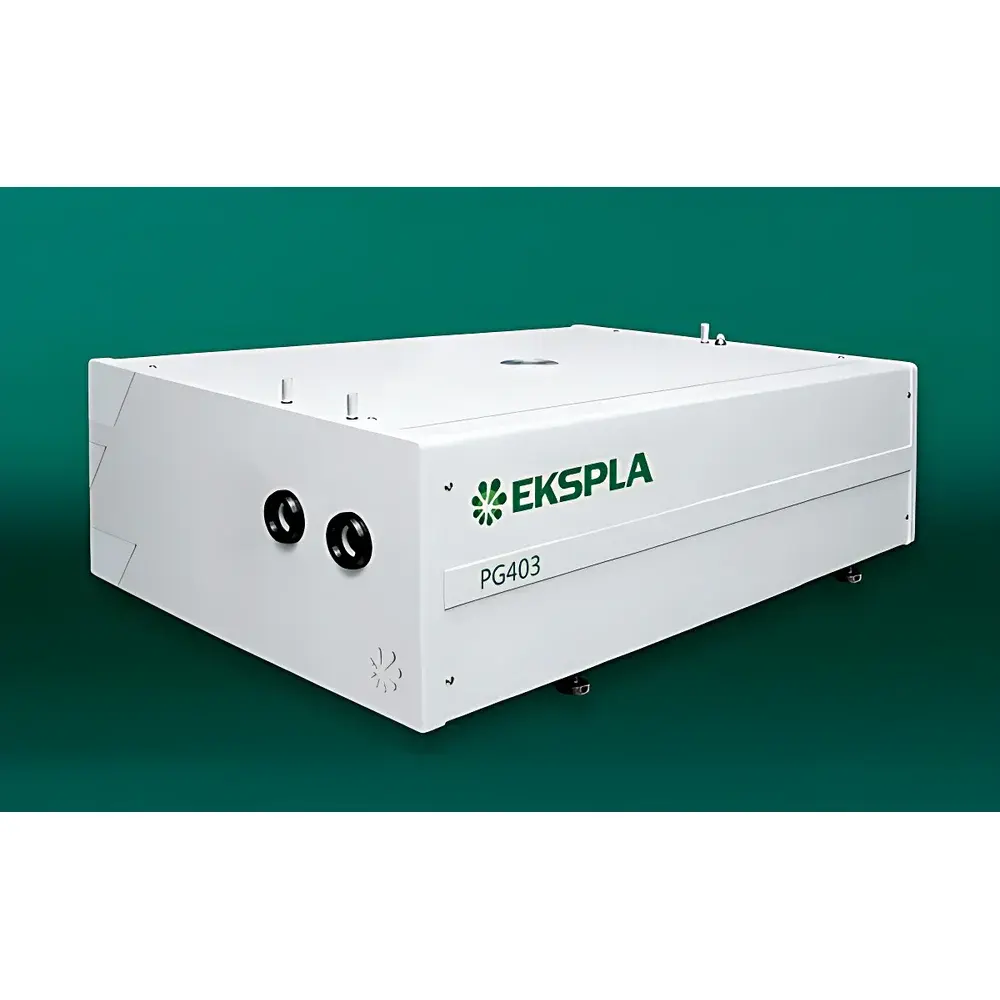
The Ekspla PGx03 is a high-repetition-rate, picosecond optical parametric generator engineered for advanced ultrafast spectroscopy and nonlinear optics laboratories. Built around a synchronously pumped, diode-pumped solid-state (DPSS) Nd:YAG or Nd:YLF master oscillator power amplifier (MOPA) platform, the PGx03 delivers transform-limited picosecond pulses at 1 kHz repetition rate, enabling high signal-to-noise temporal resolution without compromising acquisition speed. Its core functionality relies on optical parametric generation (OPG) and subsequent amplification (OPA) in nonlinear crystals (e.g., BBO, KTA, or AgGaS₂ depending on spectral region), providing continuous, motorized wavelength tuning across an exceptionally broad spectral range—from deep ultraviolet (210 nm) through visible and near-infrared to mid-infrared (16,000 nm). This wide coverage supports multi-regime probing in a single instrument, eliminating the need for multiple laser sources in complex pump-probe or multidimensional spectroscopic setups.
Key Features
- Picosecond pulse duration (<10 ps typical, dependent on pump configuration and crystal selection) with high temporal stability and shot-to-shot reproducibility
- 1 kHz fixed repetition rate synchronized to the pump laser’s cavity, ensuring phase coherence for time-resolved experiments
- Motorized, software-controlled wavelength tuning over 210–16000 nm; no manual realignment required between spectral regions
- Narrow spectral linewidth (<6 cm⁻¹ FWHM) achieved via intracavity dispersion management and optimized crystal phase-matching conditions
- Low beam divergence (<2 mrad full angle), enabling efficient coupling into monochromators, interferometers, and fiber-based delivery systems
- Integrated handheld control unit for rapid parameter adjustment during alignment or preliminary scans
- Native LabVIEW™ driver and comprehensive API support for custom automation, including pulse delay triggering, wavelength stepping, and energy monitoring
- USB 2.0 standard interface (RS232 available upon request) compatible with Windows-based data acquisition environments
Sample Compatibility & Compliance
The PGx03 is designed for use with gas-phase molecular beams, solid thin films, liquid solutions, and surface-adsorbed monolayers. Its tunable output enables resonance matching with electronic, vibrational, and rotational transitions across diverse material systems—including semiconductors, catalysts, biomolecules, and quantum materials. The system complies with IEC 60825-1:2014 Class 4 laser safety requirements and incorporates interlocked enclosures, beam shutters, and emission indicators conforming to EN 60825-1 and FDA 21 CFR Part 1040.10. All firmware and control logic are structured to support GLP/GMP-aligned experimental documentation when integrated with timestamped, audit-trail-enabled data acquisition platforms.
Software & Data Management
The PGx03 ships with Ekspla’s proprietary OPG Control Suite—a modular Windows application supporting real-time wavelength calibration, energy stabilization feedback (via optional photodiode integration), and automated spectral scanning protocols. The LabVIEW™ driver exposes low-level hardware registers for advanced users implementing custom pump-probe timing sequences or closed-loop optimization algorithms (e.g., for adaptive spectroscopy). Data export is supported in HDF5 and ASCII formats, facilitating interoperability with Python (NumPy, SciPy), MATLAB, and Igor Pro analysis pipelines. Firmware updates are delivered via signed binary packages with SHA-256 verification, ensuring traceability and integrity in regulated research environments.
Applications
- Time-resolved pump-probe spectroscopy for carrier dynamics in perovskites and 2D materials
- Laser-induced fluorescence (LIF) mapping of combustion intermediates and atmospheric radicals
- Vibrational sum-frequency generation (v-SFG) for in situ characterization of electrochemical interfaces and polymer surfaces
- Surface second-harmonic generation (surface-SHG) studies of chiral monolayers and non-centrosymmetric crystal domains
- CARS microscopy for label-free chemical imaging of lipid membranes and pharmaceutical crystallinity
- Z-scan measurements for third-order nonlinear susceptibility (χ⁽³⁾) quantification in novel optical polymers and nanocomposites
- Mid-IR transient absorption for tracking low-energy phonon modes and hydrogen-bond network reorganization
FAQ
What pump lasers are compatible with the PGx03?
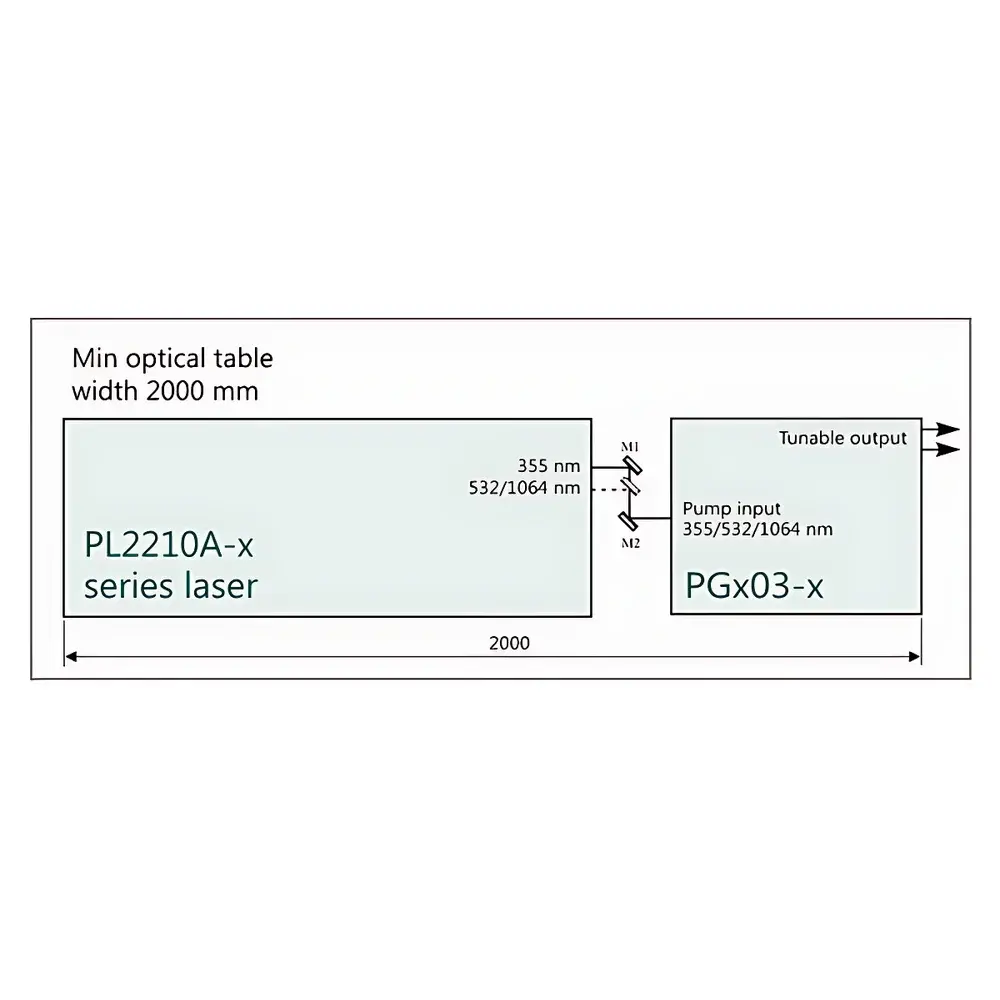
The PGx03 is factory-aligned for use with Ekspla’s Atlantic or FemtoLux series picosecond DPSS pump lasers (1064 nm, 532 nm, or 355 nm outputs); custom configurations for third-party 1-kHz picosecond oscillators are available under OEM agreement.
Is vacuum UV (VUV) output supported below 210 nm?
No—210 nm is the practical short-wavelength limit due to material transmission constraints in standard harmonic generation and OPG stages; VUV extension requires external gas-filled cells and specialized optics not included in the base system.
Can the PGx03 be integrated into a commercial ultrafast spectrometer?
Yes—its TTL-synchronized trigger outputs, USB/RS232 command set, and LabVIEW™ API enable seamless integration with commercial transient absorption, fluorescence upconversion, or multidimensional IR spectrometers from manufacturers including Ultrafast Systems, Light Conversion, and Newport.
Does the system include wavelength calibration standards?
Yes—a NIST-traceable holmium oxide filter and neon lamp reference source are supplied for periodic verification of spectral accuracy across UV–VIS–NIR ranges; mid-IR calibration uses methane and water vapor absorption features.
What maintenance is required for long-term stability?
Annual preventive maintenance includes crystal alignment verification, thermal drift compensation recalibration, and optical coating inspection; no consumables or user-serviceable parts are required under normal laboratory operating conditions.





