
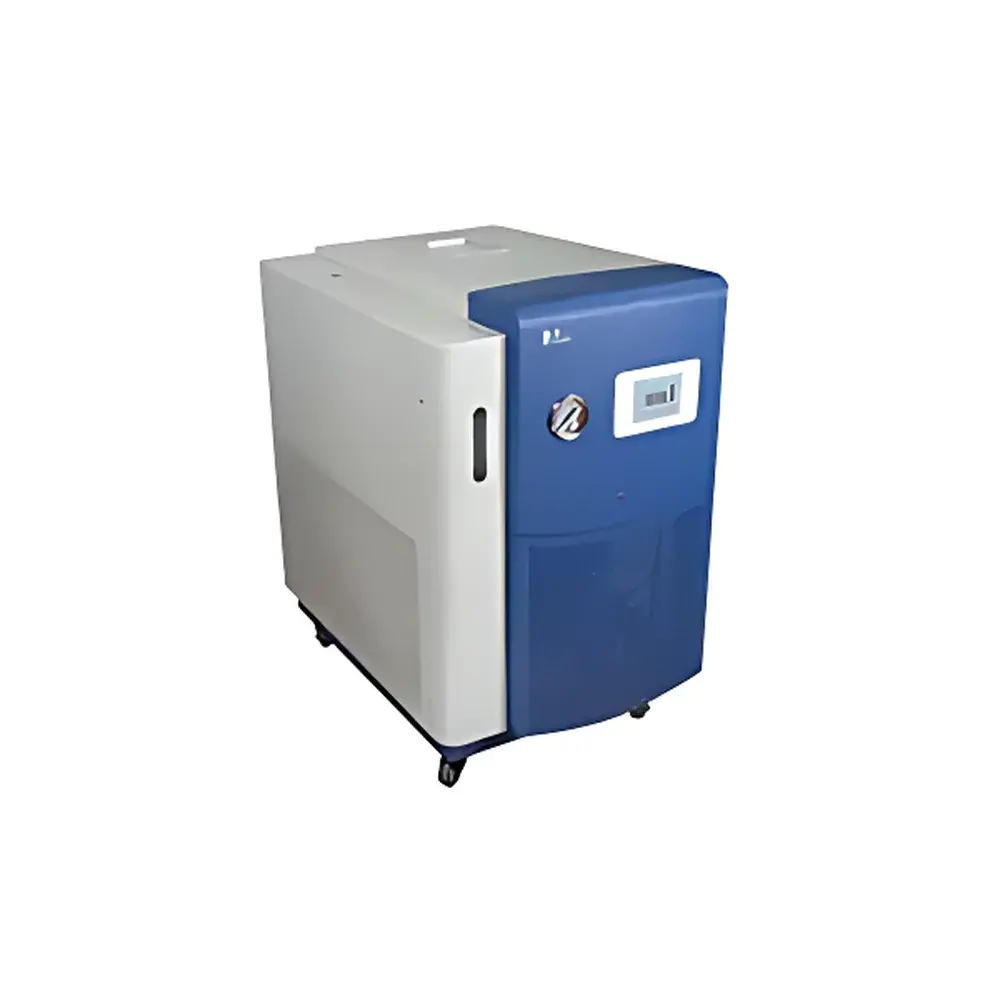
MICHEM MC-1600BP Variable-Frequency Circulating Chiller
| Brand | MICHEM |
|---|---|
| Origin | Beijing, China |
| Model | MC-1600BP |
| Instrument Type | Integrated Circulating Chiller |
| Cooling Method | Water-Cooled |
| Temperature Range | 5–35 °C |
| Cooling Capacity | 1600 W |
| Temperature Stability | ±0.1 °C |
| Circulation Pump Pressure | 7 bar |
| Circulation Flow Rate | 6 L/min |
| Reservoir Volume | 10 L |
| Operating Mode | Continuous |
Overview
The MICHEM MC-1600BP Variable-Frequency Circulating Chiller is an engineered thermal management solution designed for precise, energy-efficient cooling of analytical instruments, laser systems, spectrometers, and other laboratory equipment requiring stable coolant delivery. Unlike conventional on/off chillers or municipal water-cooling methods—both associated with high resource consumption, inconsistent thermal performance, and scaling-related maintenance—the MC-1600BP employs inverter-driven compressor technology to dynamically match refrigeration output to real-time thermal load. This closed-loop system circulates deionized or treated water (or water-glycol mixtures) at tightly regulated temperature, pressure, and flow, eliminating dependence on municipal water supply while ensuring long-term instrument reliability and operational continuity.
Key Features
- Inverter-Controlled Compressor: Enables continuous modulation of refrigeration capacity between 20% and 100% of rated output (1600 W), achieving fine-grained thermal response without cycling-induced thermal overshoot or mechanical stress.
- PID + Microprocessor Control: Integrated digital controller with adaptive PID algorithm delivers ±0.1 °C temperature stability across the full 5–35 °C operating range, with user-adjustable ramp rates and setpoint hold functions.
- Soft-Start Compressor Drive: Gradual ramp-up of compressor motor frequency over ≤20 seconds minimizes inrush current, reduces electrical grid impact, and extends compressor service life by mitigating mechanical shock during startup.
- High-Performance Circulation System: Imported centrifugal pump delivers up to 6 L/min at a maximum head of 7 bar; pressure is continuously adjustable via integrated bypass regulation, supporting both low-resistance benchtop instruments and high-backpressure applications such as HPLC column ovens or vacuum jacketed reactors.
- Robust Thermal Architecture: Optimized evaporator design, high-efficiency condenser with axial fan cooling, and refrigerant charge calibrated for R410A ensures consistent heat rejection under ambient temperatures up to 35 °C and relative humidity ≤80% RH.
- Integrated 10-L Reservoir: Stainless steel-lined tank with level sensor, overflow protection, and corrosion-resistant internal coating; accommodates standard antifreeze formulations and includes drain valve for routine maintenance and fluid replacement.
Sample Compatibility & Compliance
The MC-1600BP is compatible with all laboratory instruments requiring external liquid cooling, including but not limited to FTIR spectrometers, ICP-OES/MS plasma sources, X-ray diffractometers, NMR probe preamplifiers, and high-power LED or diode laser modules. Its closed-loop operation eliminates mineral deposition risks associated with hard-water cooling, making it suitable for use in regions with elevated calcium/magnesium content in municipal supplies. The unit complies with IEC 61000-6-3 (EMC emission standards) and IEC 61000-6-2 (immunity), and meets CE marking requirements for safety (EN 61010-1). While not certified to UL or CSA standards out-of-the-box, its electrical architecture supports third-party certification for North American deployment upon request. For GLP/GMP environments, optional audit-trail-enabled firmware (v3.2+) supports 21 CFR Part 11-compliant electronic records when paired with validated network logging infrastructure.
Software & Data Management
The MC-1600BP operates autonomously via its front-panel touchscreen interface, which displays real-time values for outlet temperature, reservoir level, pump status, compressor frequency (%), and system fault codes. RS-485 Modbus RTU communication is standard, enabling integration into centralized lab monitoring platforms (e.g., LabVantage, Thermo Fisher SampleManager) for remote parameter adjustment, alarm forwarding, and historical trend logging. Optional Ethernet/Wi-Fi module (MC-NET-1) adds TCP/IP connectivity, TLS-secured web interface, and SNMP v3 support for enterprise IT integration. All temperature logs are timestamped and stored onboard for ≥30 days; data export is supported via USB flash drive in CSV format. Firmware updates are performed via signed .bin files to ensure integrity and traceability.
Applications
- Cooling of high-heat-load optical components in Raman and fluorescence spectrometers
- Thermal stabilization of mass spectrometer ion sources and detector housings
- Continuous temperature control for calorimetry cells and reaction calorimeters
- Supporting chilled mirror hygrometers and dew point analyzers requiring sub-ambient dew point suppression
- Providing regulated coolant to semiconductor wafer probers and photolithography alignment stages
- Backup cooling for critical infrastructure in cleanroom analytical suites where redundancy is mandated
FAQ
What is the minimum allowable coolant temperature setpoint?
The MC-1600BP is rated for stable operation from 5 °C to 35 °C. Operation below 5 °C is not recommended due to risk of condensation-induced electrical hazards and potential freezing if glycol concentration is insufficient.
Can the unit operate with 30% propylene glycol solution?
Yes—the system is fully compatible with aqueous solutions containing ≤35% (v/v) propylene or ethylene glycol. Viscosity increase must be accounted for in pump head calculations; maximum allowable kinematic viscosity at 20 °C is 5.0 cSt.
Is external water supply required for condenser cooling?
No—the MC-1600BP is air-cooled; no external water connection is needed. Ambient airflow must meet minimum clearance requirements: 150 mm unobstructed space on all sides and above the unit.
How often should the refrigerant circuit be serviced?
Under normal laboratory conditions (24/7 operation, ambient ≤32 °C), the sealed R410A system requires no scheduled refrigerant servicing. Annual inspection of condenser coil cleanliness and fan operation is recommended.
Does the chiller support external temperature feedback control?
Yes—via analog 0–10 V or 4–20 mA input, the unit can accept a remote sensor signal (e.g., from instrument jacket outlet) to override internal setpoint and implement cascade temperature control.
Related Products



