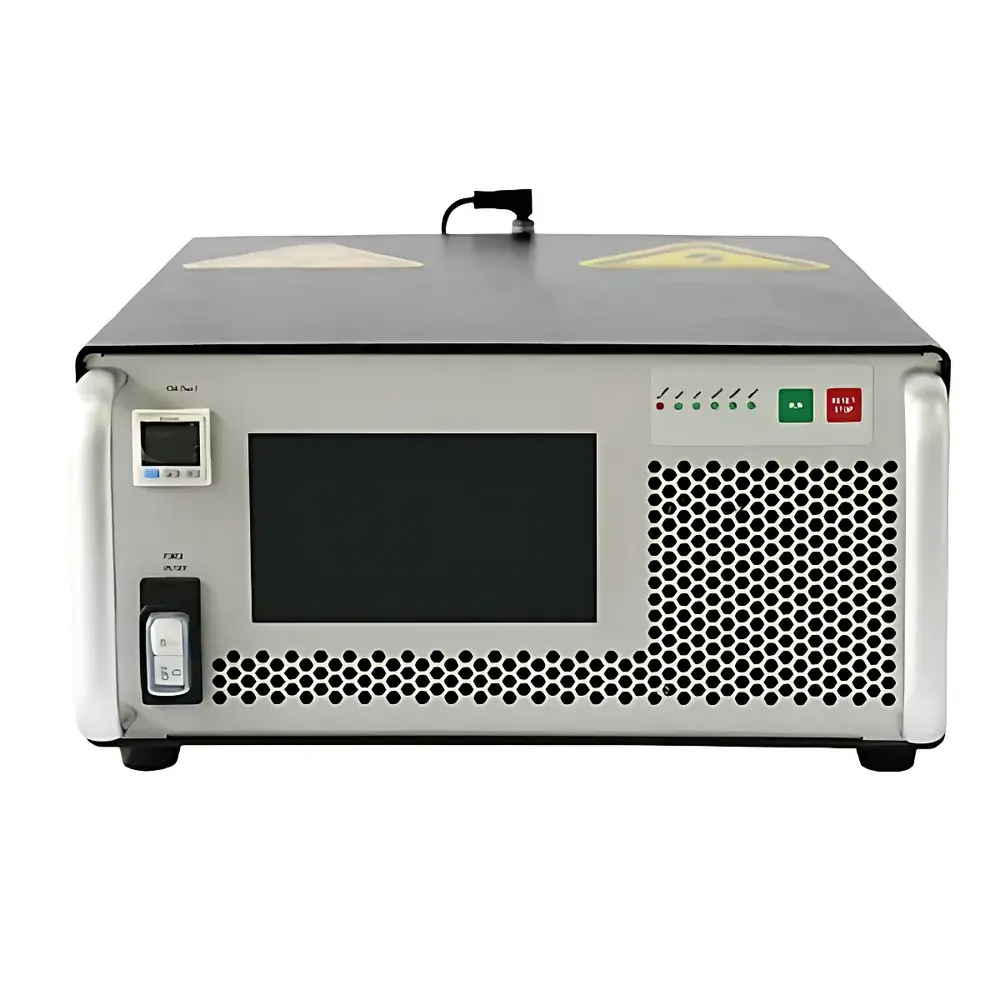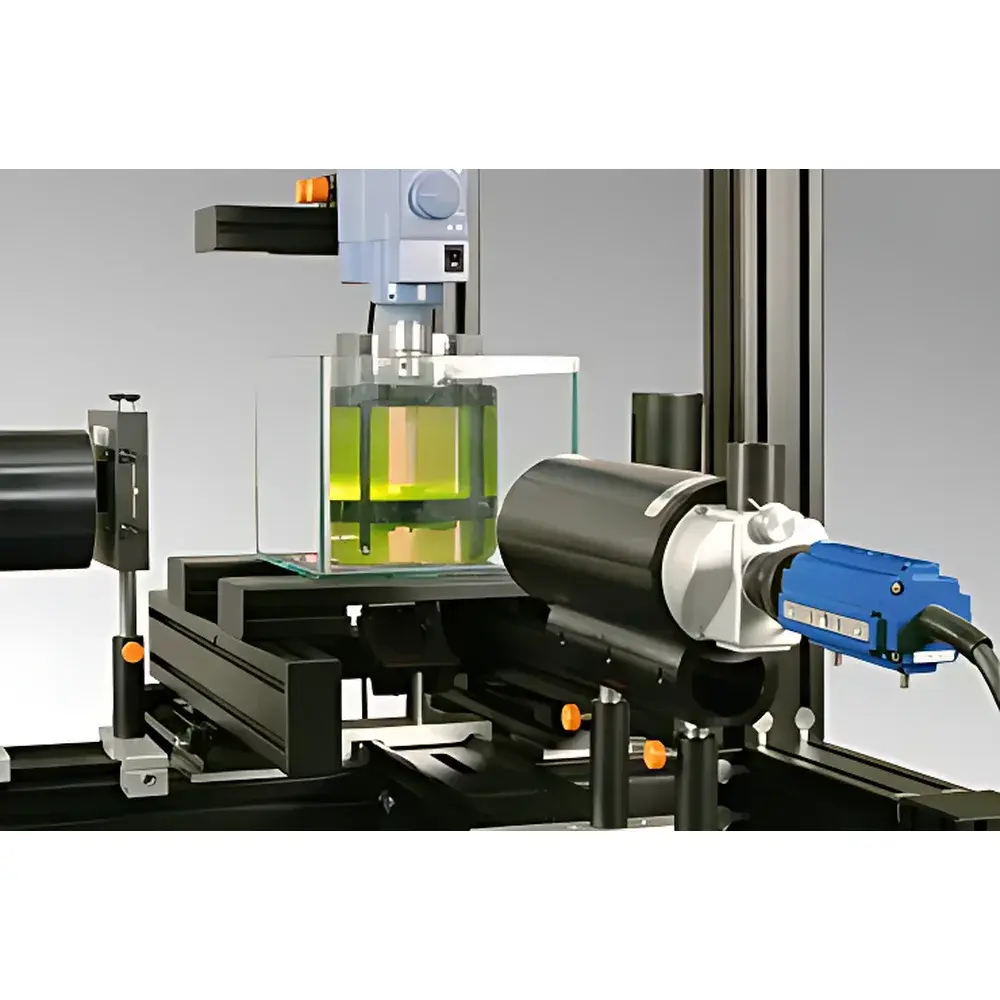
FluidMaster Online Reaction Analysis System by LaVision GmbH
| Brand | LaVision GmbH |
|---|---|
| Origin | Germany |
| Model | FluidMaster |
| Type | Turnkey Laser Imaging System for Quantitative Fluid Mixing & Thermal Flow Analysis |
| Imaging Modalities | Planar Laser-Induced Fluorescence (LIF), Rayleigh Scattering, Raman Scattering |
| Measurement Outputs | Instantaneous 2D/3D concentration fields, temperature fields, pH distribution, reactive mixing degree, gas density maps |
| Spatial Resolution | µm-to-mm scale (application-dependent) |
| Temporal Resolution | Up to kHz frame rates (camera- and laser-pulse-limited) |
| Calibration | Traceable hardware and signal calibration per ISO/IEC 17025 principles |
| Software Platform | DaVis v10+ with real-time acquisition, multi-parameter synchronization, and GLP-compliant data logging |
Overview
The FluidMaster Online Reaction Analysis System is a turnkey laser imaging platform engineered by LaVision GmbH for non-intrusive, quantitative spatiotemporal analysis of fluid mixing, chemical reaction progression, and thermal transport phenomena in industrial process environments. Based on planar laser-induced fluorescence (LIF), Rayleigh scattering, and spontaneous Raman scattering, the system delivers pixel-resolved, time-synchronized maps of concentration, temperature, pH, and reactive mixing degree—enabling direct correlation between hydrodynamic structure and chemical state evolution. Unlike point-sampling or bulk-property analyzers, FluidMaster captures full-field dynamics at microsecond-to-second timescales, making it suitable for closed-loop process optimization, reactor scale-up validation, and mechanistic study of transient mixing-limited reactions. Its modular optical architecture supports integration into pilot-scale reactors, continuous flow systems, and multiphase contactors while maintaining operational safety under Class 1M laser compliance.
Key Features
- Application-optimized laser-camera pairing: Selection of pulsed Nd:YAG (266–1064 nm), tunable OPO, or CW diode lasers matched to target fluorophores or scattering cross-sections.
- Multi-modal imaging capability: Simultaneous or sequential acquisition of LIF (for species concentration and pH), Rayleigh thermometry (for gas-phase temperature), and O2-LIF (for oxygen distribution and quenching-based mixing quantification).
- 3D volumetric reconstruction: Enabled via stereoscopic camera setups or tomographic LIF (tomo-LIF) configurations with calibrated multi-view registration and GPU-accelerated volume rendering.
- Time-resolved digital cinematography: High-speed CMOS and ICCD cameras support framing rates from single-shot to >10 kHz, synchronized with laser pulses and external process triggers (e.g., pump start, valve actuation).
- Integrated DaVis software suite: Provides end-to-end control—from laser pulse delay tuning and camera gain optimization to real-time background subtraction, spectral unmixing, and intensity-to-concentration calibration using reference standards.
- Traceable metrology framework: Hardware calibration includes NIST-traceable photometric standards, temperature-controlled reference cells, and in-situ signal drift monitoring compliant with ISO 9001 and ISO/IEC 17025 requirements.
Sample Compatibility & Compliance
FluidMaster accommodates transparent to semi-opaque liquid systems—including aqueous solutions, organic solvents, polymer melts, and gas-liquid dispersions—provided optical access is maintained via quartz or sapphire windows rated for pressure (up to 100 bar) and temperature (−40 °C to +200 °C). The system complies with IEC 60825-1:2014 for Class 1M laser safety when interlocked and properly enclosed; optional ATEX/IECEx certification kits are available for Zone 1/21 hazardous area deployment. Data integrity meets FDA 21 CFR Part 11 requirements through DaVis audit trails, electronic signatures, and immutable raw-data archiving. All measurement protocols align with ASTM E2533 (standard guide for LIF applications) and ISO 20457 (optical measurement of fluid dynamics).
Software & Data Management
DaVis v10.5 serves as the unified acquisition, processing, and reporting engine. It enables hardware-synchronized multi-channel recording (LIF + PIV + thermographic channels), batch calibration using polynomial or lookup-table methods, and export of calibrated field data in HDF5 or NetCDF4 formats for downstream CFD validation. The software supports automated report generation with embedded metadata (laser energy, exposure time, calibration date, operator ID), version-controlled analysis pipelines, and role-based user permissions. Raw datasets include timestamped headers compliant with FAIR (Findable, Accessible, Interoperable, Reusable) principles, facilitating integration with MES or LIMS platforms via REST API or OPC UA connectors.
Applications
- Real-time monitoring of acid-base neutralization, precipitation, or polymerization kinetics in continuous stirred-tank reactors (CSTRs) and tubular reactors.
- Quantification of mixing efficiency and segregation intensity in static mixers, jet impingement devices, and microfluidic manifolds.
- Validation of computational fluid dynamics (CFD) models for turbulent blending, heat exchanger fouling prediction, and gas-liquid mass transfer coefficient estimation.
- In-process characterization of emulsion formation, droplet breakup/coalescence, and interfacial tension-driven instabilities.
- Thermal management assessment in battery electrolyte filling, pharmaceutical lyophilization chambers, and catalytic monolith reactors.
FAQ
Can FluidMaster be integrated into an existing DCS or PLC-controlled production line?
Yes—via Ethernet/IP, Modbus TCP, or OPC UA gateways; DaVis supports hardware-triggered acquisition and status feedback to industrial controllers.
Is on-site installation and IQ/OQ validation supported?
LaVision-certified engineers provide GMP-aligned installation qualification (IQ), operational qualification (OQ), and performance qualification (PQ) documentation packages upon request.
What maintenance is required for long-term stability?
Annual recalibration of laser energy meters and camera quantum efficiency curves is recommended; optical components undergo preventive cleaning per ISO 10110 standards.
Does the system support Good Manufacturing Practice (GMP) workflows?
Yes—DaVis includes 21 CFR Part 11-compliant electronic records, audit trails, and role-based access control for regulated pharmaceutical and fine chemical manufacturing.
How is uncertainty quantified for concentration measurements?
Uncertainty budgets follow GUM (JCGM 100:2008) methodology, incorporating photon shot noise, calibration curve residuals, laser pulse energy fluctuations, and refractive index variations across the field of view.
Related Products