
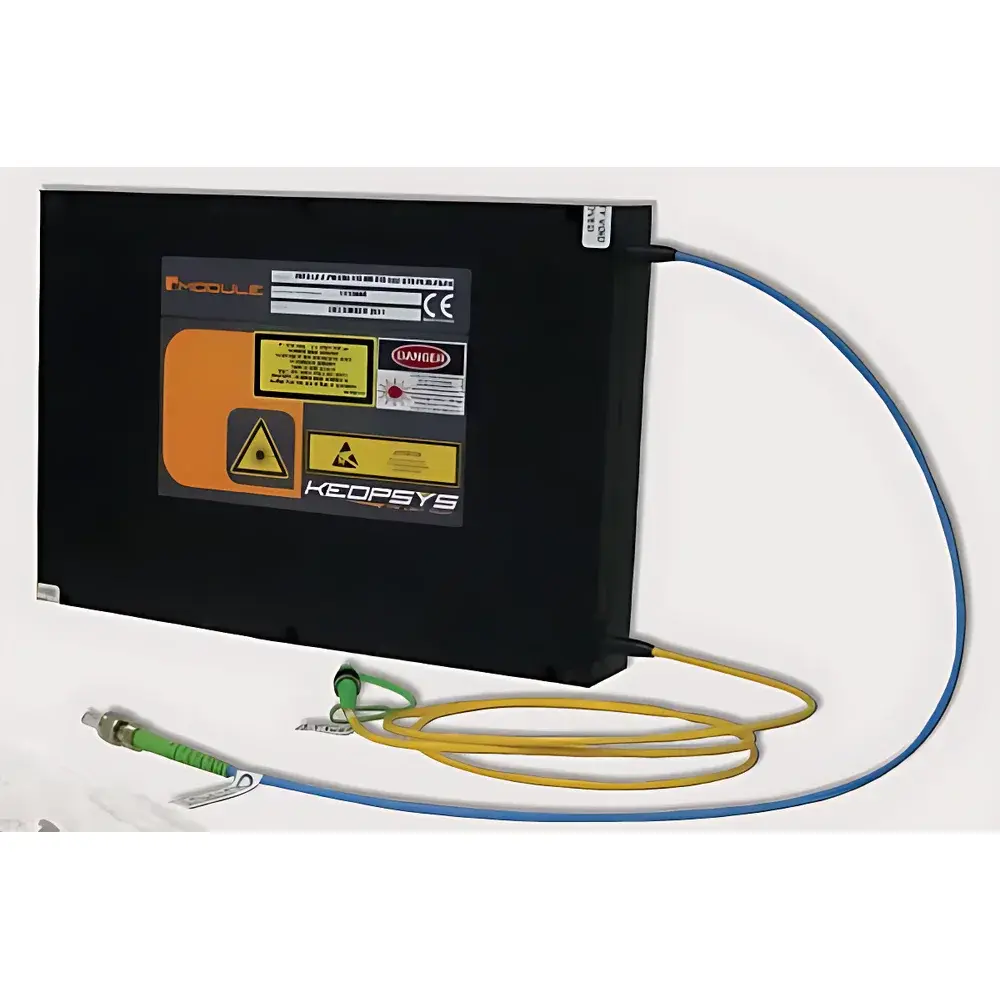
Keopsys PEFA-EOLA Series 1550 nm Pulsed Erbium-Doped Fiber Amplifier
| Brand | Keopsys |
|---|---|
| Origin | France |
| Model | PEFA-EOLA |
| Wavelength | 1550 nm |
| Pulse Energy | up to 110 µJ |
| Peak Power | up to 360 W |
| Pulse Width | 200–400 ns |
| Repetition Rate | 10–20 kHz |
| Beam Quality (M²) | <1.5 |
| Type | Pulsed Erbium-Doped Fiber Amplifier (EDFA) Module |
Overview
The Keopsys PEFA-EOLA Series is a high-performance, compact pulsed erbium-doped fiber amplifier (EDFA) module engineered for demanding applications requiring eye-safe, high-peak-power laser pulses at 1550 nm. Operating on the principle of stimulated emission in erbium-doped single-mode fiber, the PEFA-EOLA amplifies low-energy seed pulses—typically generated by semiconductor laser diodes or microchip lasers—into high-fidelity, diffraction-limited output beams with M² < 1.5. Its design integrates pump laser diodes, isolators, wavelength-selective couplers, and polarization-maintaining (PM) fiber components into a robust, thermally stabilized OEM module. The 1550 nm emission falls within the Class 1M safety classification per IEC 60825-1, enabling safe operation in industrial, medical, and field-deployable environments without stringent enclosure requirements.
Key Features
- Eye-safe 1550 nm output compliant with IEC 60825-1 Class 1M laser safety standards
- High single-pulse energy up to 110 µJ with excellent shot-to-shot stability (typical RMS fluctuation < 2.5% over 8 hours)
- Peak optical power exceeding 360 W, suitable for nonlinear frequency conversion and time-resolved spectroscopy
- Adjustable pulse width from 200 ns to 400 ns, optimized for LIDAR ranging, laser-induced breakdown spectroscopy (LIBS), and optical time-domain reflectometry (OTDR)
- Repetition rate tunable between 10 kHz and 20 kHz, supporting high-throughput scanning and gated detection schemes
- Integrated polarization-maintaining (PM) output fiber with extinction ratio >20 dB, ensuring consistent polarization state for interferometric and coherent detection systems
- Compact, conduction-cooled module architecture (120 × 80 × 25 mm) with industry-standard electrical interfaces (TTL sync input, analog modulation input, RS-232/UART control)
Sample Compatibility & Compliance
The PEFA-EOLA is designed for integration with seed sources emitting in the C-band (1530–1565 nm), including distributed feedback (DFB) laser diodes, fiber-coupled microchip lasers, and mode-locked fiber oscillators. It accepts free-space or fiber-pigtailed inputs via FC/APC or PM-FC/APC connectors. All units undergo full environmental qualification per MIL-STD-810G (vibration, thermal shock, humidity) and comply with CE marking requirements under the EU Electromagnetic Compatibility (EMC) Directive 2014/30/EU and Low Voltage Directive 2014/35/EU. For regulated laboratory environments, the module supports traceable calibration documentation and is compatible with GLP/GMP workflows when integrated with validated host systems.
Software & Data Management
Control and monitoring are implemented via ASCII-based serial protocol over RS-232 or UART, enabling seamless integration into LabVIEW, Python (PySerial), MATLAB, or custom C++ applications. Real-time parameters—including output energy (via internal photodiode monitor), repetition rate, pump current, and case temperature—are accessible and loggable. Optional firmware supports external trigger synchronization with jitter < 500 ps RMS and provides programmable pulse burst modes (e.g., burst trains of 2–16 pulses at user-defined intra-burst intervals). Audit trails and configuration logs can be exported to support FDA 21 CFR Part 11 compliance when deployed in pharmaceutical or clinical research settings.
Applications
- Coherent and direct-detection LIDAR systems for atmospheric sensing, wind profiling, and autonomous vehicle navigation
- Laser-induced breakdown spectroscopy (LIBS) for elemental analysis in mining, metallurgy, and nuclear safeguards
- Optical time-domain reflectometry (OTDR) for high-resolution fault localization in telecom and aerospace fiber networks
- Pump source for optical parametric amplifiers (OPAs) and difference-frequency generation (DFG) in mid-IR spectroscopy
- Time-of-flight (ToF) mass spectrometry requiring precisely timed, high-energy IR pulses
- Nonlinear microscopy techniques such as stimulated Raman scattering (SRS) and coherent anti-Stokes Raman scattering (CARS)
FAQ
What seed laser specifications are required to drive the PEFA-EOLA?
The amplifier requires a linearly polarized, C-band seed pulse with peak power ≥10 mW, pulse width matching the target output range (200–400 ns), and repetition rate within 10–20 kHz. Input polarization must align with the slow axis of the PM input fiber.
Can the output pulse width be adjusted externally?
No—pulse width is determined by the seed laser; the PEFA-EOLA preserves temporal fidelity with minimal pulse broadening (<5% FWHM increase typical). Pulse shaping must occur at the seed stage.
Is cooling water required?
No—thermal management is achieved via passive conduction cooling through the aluminum housing; ambient operating temperature range is 15–35 °C with derating above 30 °C.
Does Keopsys provide OEM integration support?
Yes—Keopsys offers mechanical drawings, electrical interface schematics, firmware documentation, and application engineering consultation for system integrators under NDA.
How is output energy calibrated and verified?
Each unit ships with a NIST-traceable calibration certificate referencing a calibrated photodiode (Thorlabs S142C) and integrating sphere measurement at 1550 nm; recalibration services are available annually.



