
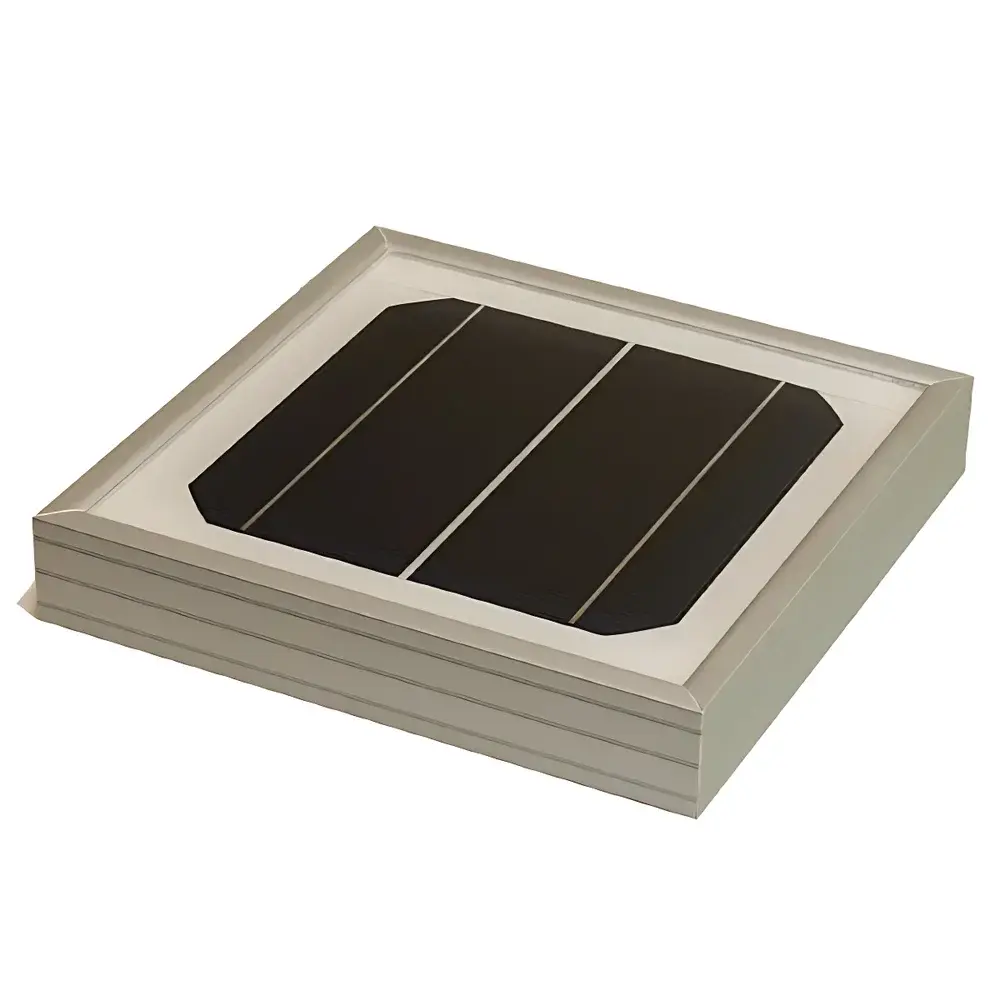
PV Measurements Outdoor Photovoltaic Reference Cell
| Brand | PV Measurements |
|---|---|
| Origin | USA |
| Product Type | Imported Reference Solar Cell |
| Model | Outdoor Photovoltaic Reference Cell |
| Certification | Compliant with IEC 60904-2 |
| Effective Area | 1 cm² |
| Open-Circuit Voltage (Voc) Temperature Coefficient (TCR) | < 25 ppm/K |
| Voc Tolerance | ±1% |
| Shunt Resistance | 0.004 Ω (for split 156-cell configuration) or 0.13 Ω (for 20 mm × 40 mm shunt resistor, adjustable) |
| Integrated Sensor | Class A RTD-Pt100 (4-wire) |
| Electrical Interface | Amphenol Eco-Mate connectors (X2) for Voc (2-wire), Isc (2-wire), RTD (4-wire), and optional auxiliary cells (2-wire each) |
| Calibration Traceability | NREL (USA) or NIM (China) |
Overview
The PV Measurements Outdoor Photovoltaic Reference Cell is a rigorously engineered, fully encapsulated silicon-based reference device designed for high-fidelity outdoor photovoltaic performance validation and field calibration of solar modules and IV curve tracers. It operates on the fundamental principle of photovoltaic current generation under standardized spectral irradiance (AM1.5G) and temperature conditions, serving as a primary transfer standard traceable to the National Renewable Energy Laboratory (NREL) in the United States or the National Institute of Metrology (NIM) in China. Unlike bare reference cells, this unit integrates hermetic glass-glass lamination, weather-resistant junction box, and precision-matched thermal response—enabling stable, long-term outdoor deployment without degradation in responsivity or linearity. Its design strictly adheres to IEC 60904-2:2020 requirements for reference solar cells, including the critical electrical constraint Isc × Rcal / Voc < 0.03, ensuring minimal shunt-induced measurement error during short-circuit current monitoring.
Key Features
- Hermetically sealed, dual-glass encapsulation rated for continuous outdoor exposure (IP67 equivalent), compliant with IEC 61215 mechanical load and humidity freeze test prerequisites
- Integrated Class A Pt100 resistance temperature detector (RTD), 4-wire configured for <±0.1 °C absolute accuracy across –40 °C to +85 °C operational range
- Dual Amphenol Eco-Mate connectors: one dedicated to Voc/Isc/RTD signal routing; second reserved for auxiliary reference cells or user-defined sensors
- Low-thermal-drift open-circuit voltage output with temperature coefficient (TCR) better than 25 ppm/K and ±1% initial tolerance at STC (25 °C, 1000 W/m², AM1.5G)
- Configurable shunt resistance options: 0.004 Ω for split-cell 156-format integration or 0.13 Ω for 20 mm × 40 mm discrete shunt resistor—optimized for low-impedance IV measurement systems
- Modular mounting interface compatible with standard solar tracker rails, tilt-angle brackets, and albedo-reflection platforms
Sample Compatibility & Compliance
This reference cell is optimized for use with crystalline silicon (c-Si), heterojunction (HJT), and passivated emitter rear cell (PERC) technologies. Its 1 cm² active area enables direct substitution into commercial IV testers, portable solar analyzers, and custom-built outdoor monitoring stations without optical re-scaling. The device satisfies all mandatory criteria in IEC 60904-2:2020—including spectral mismatch correction factor (CMF) reporting, spatial uniformity (>98%), and linearity deviation (<±0.25% from 10% to 100% of full-scale irradiance). It supports GLP-compliant field audits when paired with NREL-traceable calibration certificates, and its construction meets UL 1703 and IEC 61730-1 fire and electrical safety prerequisites for integrated photovoltaic instrumentation.
Software & Data Management
While the reference cell itself is analog-output only, it is fully interoperable with industry-standard IV data acquisition platforms—including those compliant with IEEE 1547.1, IEC 62446-1, and ASTM E2848-13 test protocols. When connected to a calibrated DAQ system with synchronized irradiance and temperature logging, the Voc and Isc outputs enable real-time normalization of module-level IV curves per IEC 61853-1. Optional calibration reports include full uncertainty budgets (k=2), temperature coefficient matrices (α, β, δ), and spectral responsivity curves measured at NREL’s Spectral Irradiance Calibration Laboratory. All documentation conforms to ISO/IEC 17025:2017 requirements for calibration laboratories and supports FDA 21 CFR Part 11–compliant electronic record retention when used in GMP-aligned PV manufacturing environments.
Applications
- Field validation of ground-mounted and rooftop PV plant performance ratio (PR) calculations
- Calibration anchor for portable IV curve tracers deployed in O&M inspections
- Benchmarking of bifacial gain measurements using rear-side irradiance references
- Temperature coefficient derivation for module-level energy yield modeling (e.g., PVsyst, SAM)
- Inter-laboratory comparison studies under IEA-PVPS Task 13 and IEC TC82 working group protocols
- Supporting Type Approval testing for new PV technologies seeking IEC 61215-2 or UL 61215 certification
FAQ
Is this reference cell certified for use in accredited calibration laboratories?
Yes—when supplied with an NREL- or NIM-issued calibration certificate, it fulfills the “transfer standard” requirement defined in ISO/IEC 17025:2017 Clause 6.6 for photovoltaic metrology labs.
Can multiple reference cells be mounted together to simulate module-level behavior?
Yes—the mechanical housing and connector layout support parallel installation of up to four units on a single mounting plate, enabling spatial averaging and reduced albedo-induced measurement variance.
What is the recommended recalibration interval?
PV Measurements recommends biennial recalibration for field-deployed units; annual recalibration is advised for units used in certification testing or regulatory submissions.
Does the device support simultaneous Voc, Isc, and temperature logging?
Yes—via the dedicated 4-wire RTD and dual 2-wire terminals, all three signals can be acquired synchronously using any 6-channel or higher DAQ system with isolated inputs.
Are custom spectral filters or anti-reflective coatings available?
Yes—custom AR coatings (e.g., MgF₂ broadband) and narrowband interference filters (e.g., 350–1100 nm bandpass) can be integrated upon request, subject to NREL traceability verification.





