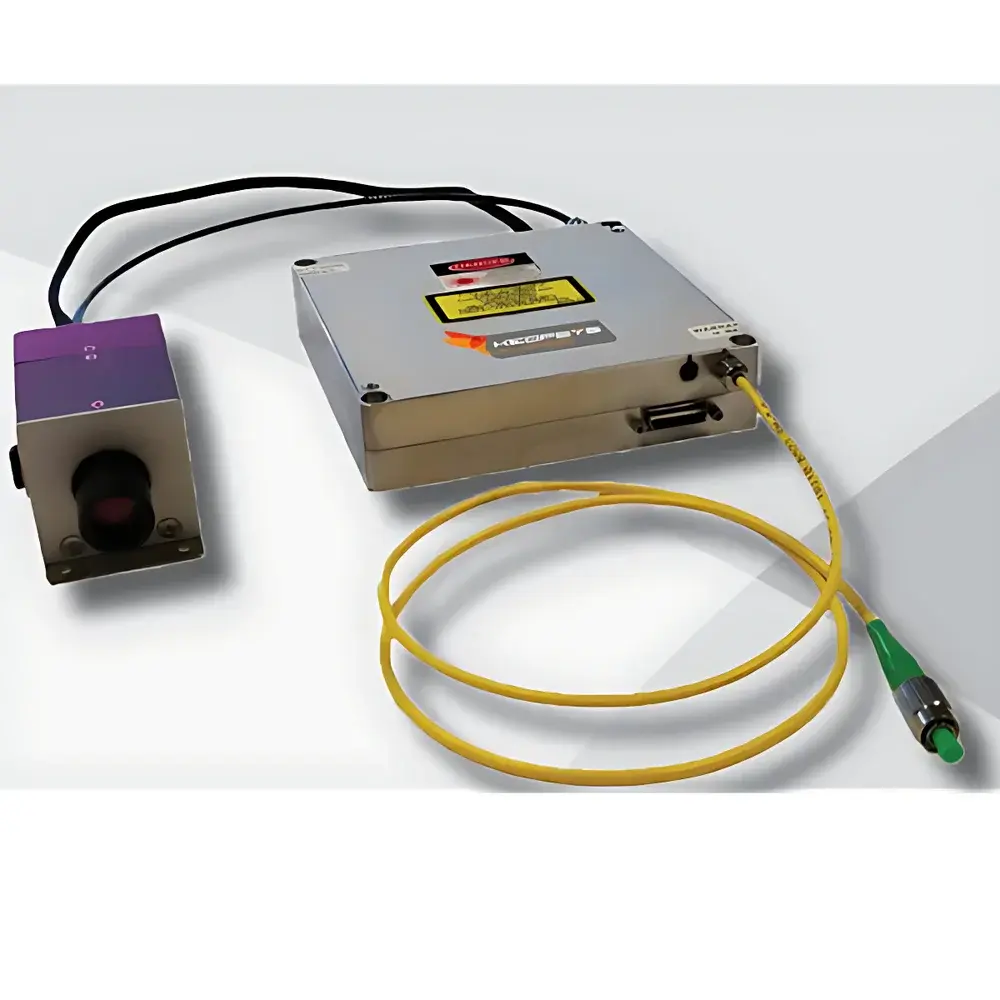
Keopsys PUFL Series Pulsed UV Fiber Laser at 355 nm
| Brand | Keopsys |
|---|---|
| Origin | France |
| Model | PUFL |
| Wavelength | 355 nm |
| Output Type | Free-space, collimated beam |
| Pulse Energy | up to 1.6 µJ |
| Peak Power | up to 1.6 kW |
| Average Power | up to 80 mW |
| Repetition Rate | 50 kHz |
| Beam Quality (M²) | < 1.3 |
| Power Consumption | Low |
| Package | Compact and rugged |
| Application Fields | Aerosol detection, fluorescence excitation, Raman spectroscopy, biological experimentation, wafer inspection |
Overview
The Keopsys PUFL Series is a high-performance pulsed ultraviolet fiber laser system engineered for precision scientific and industrial applications requiring stable, narrow-linewidth 355 nm radiation. Based on intracavity second-harmonic generation (SHG) of a master-oscillator power-amplifier (MOPA) Yb-doped fiber laser operating at 1064 nm, the PUFL delivers transform-limited nanosecond pulses with excellent temporal stability and spatial coherence. Its all-fiber architecture—combined with a hermetically sealed, temperature-stabilized nonlinear crystal module—ensures long-term wavelength fidelity and minimal thermal drift. Unlike lamp-pumped or diode-pumped solid-state (DPSS) UV lasers, the PUFL avoids flashlamp degradation and alignment sensitivity, offering superior reliability in continuous-duty laboratory and OEM integration environments. The output beam is free-space, collimated, and exhibits near-Gaussian intensity distribution (M² < 1.3), enabling efficient coupling into spectrometers, microscopes, or fiber delivery systems without additional beam-shaping optics.
Key Features
- Stable 355 nm output via intracavity frequency doubling of a robust Yb-fiber MOPA platform
- Pulse energy up to 1.6 µJ with sub-10 ns pulse width and jitter < 100 ps (RMS)
- High peak power (up to 1.6 kW) and average power (up to 80 mW) at 50 kHz repetition rate
- Integrated thermal management: active crystal temperature stabilization within ±0.1 °C
- Low electrical power consumption (< 25 W typical), suitable for benchtop and portable instrumentation
- Compact, shock-resistant aluminum housing (120 × 80 × 35 mm) with standard SMA905 or FC/PC optical output interface
- RS-232 and TTL-compatible digital control interface for seamless integration into automated platforms
- No warm-up time required; full-spec output achieved within 30 seconds of power-on
Sample Compatibility & Compliance
The PUFL laser is designed for use with optically transparent, UV-grade materials including fused silica cuvettes, quartz substrates, CaF₂ lenses, and borosilicate glass flow cells. It complies with IEC 60825-1:2014 Class 4 laser safety requirements when operated with appropriate interlocks and beam enclosures. For regulated environments—including GLP-compliant analytical labs and semiconductor metrology facilities—the system supports optional audit-trail-enabled firmware (via RS-232 logging) and meets electromagnetic compatibility standards per EN 61326-1:2013. While not inherently FDA 21 CFR Part 11 compliant, its deterministic digital control architecture allows integration into validated software frameworks that implement electronic signature, user access control, and data integrity protocols required under pharmaceutical QA/QC workflows.
Software & Data Management
The PUFL operates via a simple ASCII command protocol over RS-232, enabling direct integration with LabVIEW, Python (PySerial), MATLAB, or custom C++ control suites. No proprietary drivers or runtime dependencies are required. Optional OEM firmware includes real-time monitoring of diode current, crystal temperature, and pulse energy feedback (via internal photodiode calibration traceable to NIST standards). All operational parameters—including repetition rate, pulse enable/disable state, and interlock status—are readable and writable during runtime. For high-throughput applications such as wafer scanning or multi-well plate fluorescence assays, the laser supports external TTL triggering with < 500 ns latency and jitter < 20 ns, ensuring synchronization with gated detectors or galvo scanners.
Applications
- Aerosol detection: High peak power enables efficient Mie scattering and LIDAR-based particle sizing in atmospheric monitoring systems
- Fluorescence excitation: Optimal 355 nm wavelength matches absorption maxima of common UV fluorophores (e.g., DAPI, Hoechst, tryptophan), minimizing photobleaching while maximizing signal-to-noise ratio
- Raman spectroscopy: Resonant enhancement for UV-Raman of aromatic biomolecules and carbon nanomaterials; reduced fluorescence background compared to visible excitation
- Biological experimentation: Used in confocal microscopy, flow cytometry, and optogenetic stimulation where precise, low-heat UV pulses are critical
- Wafer inspection: Enables defect detection in photoresist layers and subsurface void analysis via UV reflectometry and time-resolved luminescence mapping
FAQ
Is the PUFL laser air-cooled or water-cooled?
The PUFL is fully air-cooled and requires no external chiller or liquid cooling loop. Its thermally optimized design maintains crystal temperature stability using integrated Peltier elements and passive heatsinking.
Can the repetition rate be adjusted in real time?
Yes—repetition rate is digitally tunable from single-shot up to 50 kHz in 1 kHz increments via RS-232 commands, with full pulse-to-pulse energy stability maintained across the range.
What is the polarization extinction ratio (PER) of the output beam?
The free-space output exhibits linear polarization with PER > 100:1 (typical), oriented parallel to the mounting base plane, and remains stable over ambient temperature variations from 15–35 °C.
Does the laser include built-in pulse energy monitoring?
An internal calibrated photodiode provides analog voltage output proportional to pulse energy (0–5 V = 0–2 µJ), enabling closed-loop power stabilization when paired with external feedback controllers.
Is OEM integration support available?
Keopsys provides mechanical drawings, electrical interface specifications, firmware documentation, and application engineering support for volume OEM deployments, including custom labeling, firmware branding, and extended temperature-range variants.