
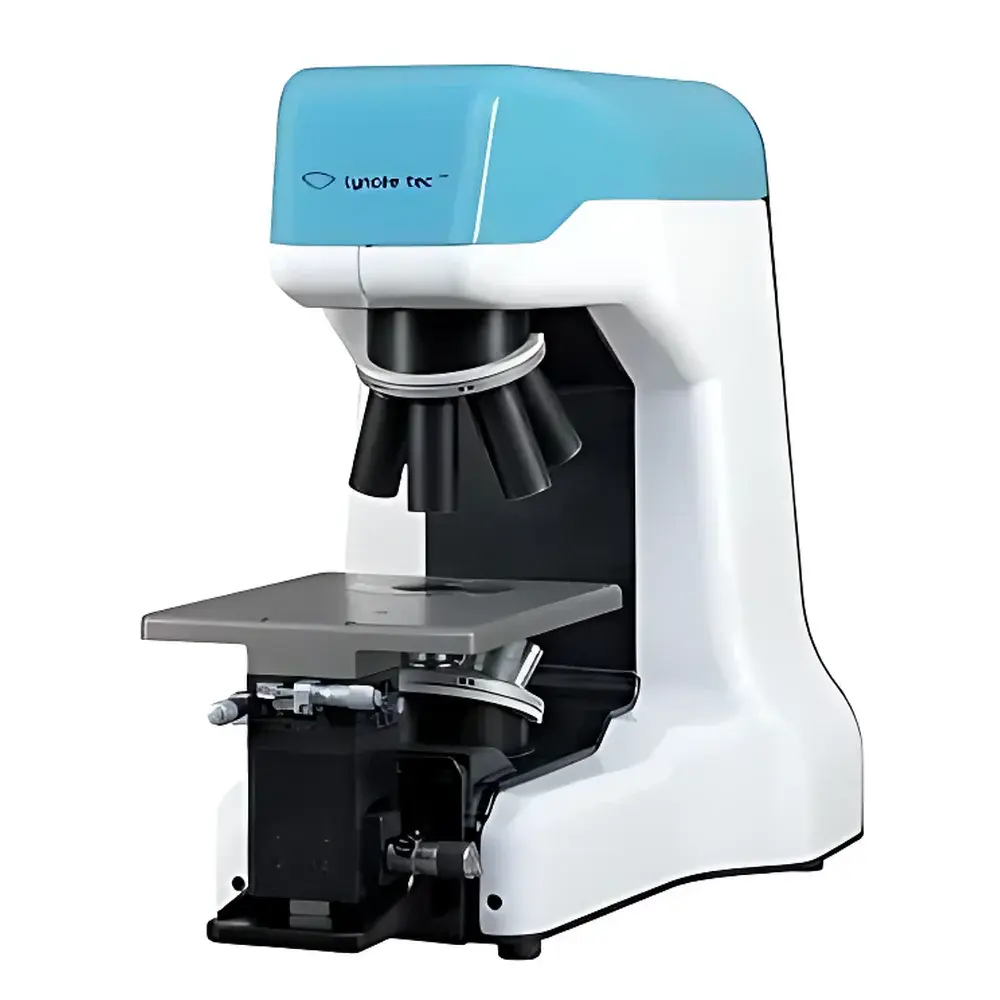
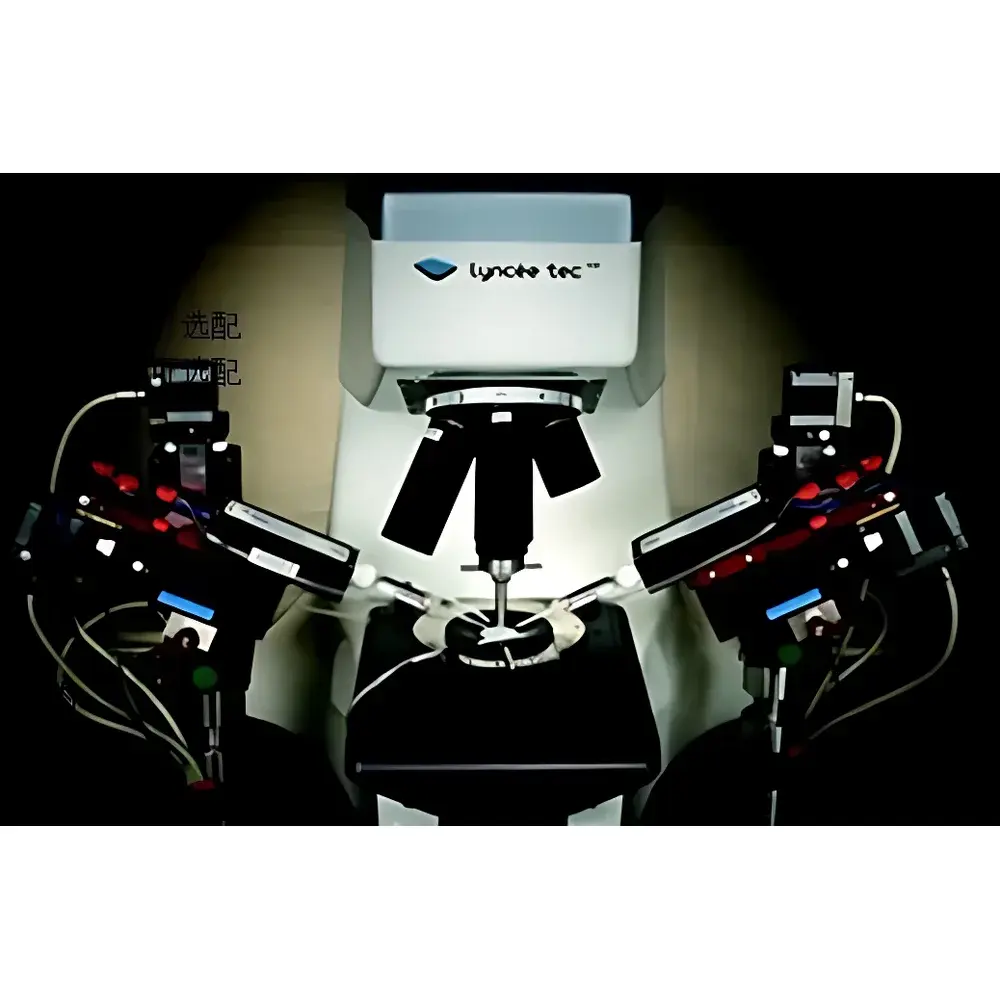
Lyncee Tec DHM™ R2100 Digital Holographic Microscope
| Brand | Lyncee Tec |
|---|---|
| Origin | Switzerland |
| Model | DHM™ R2100 |
| Vertical Resolution | 10 nm |
| Lateral Resolution | 300 nm (at 1.4 NA) |
| Field of View | 4.4 mm |
| Camera | 1392 × 1040 pixels, 8-bit |
| Frame Rate | 15 fps (1024 × 1024), up to 10,000 fps (region-of-interest) |
| Light Intensity on Sample | <1 µW/cm² |
| Maximum Sample Size | 200 mm × 200 mm |
| XYZ Stage Travel | 200 mm × 100 mm × 15 mm |
| Digital Refocusing Range | Up to 50× depth of field |
| Exposure Time | <1 µs |
| Power Supply | 85–260 VAC, 50/60 Hz, 480 W |
| Dimensions | 500 × 500 × 500 mm |
| Weight | 34.5 kg |
Overview
The Lyncee Tec DHM™ R2100 is a high-precision, transmission-mode digital holographic microscope engineered for non-invasive, quantitative 3D topography and phase imaging of transparent and semi-transparent materials in real time. Unlike conventional optical microscopy techniques that rely on mechanical focusing or scanning, the DHM™ R2100 employs single-wavelength laser interferometry to record full-field holograms in a single exposure—enabling instantaneous acquisition of both amplitude and quantitative phase information across the entire field of view. This principle eliminates the need for z-scanning, making it uniquely suited for dynamic metrology applications where sample stability cannot be guaranteed (e.g., MEMS actuation, thermal expansion, fluid interface dynamics, or in-line industrial inspection). The system delivers sub-nanometer axial resolution (≤10 nm) and diffraction-limited lateral resolution (300 nm at 1.4 NA), with no physical contact, no phototoxicity, and minimal thermal load (<1 µW/cm² illumination intensity), ensuring integrity of sensitive specimens during prolonged observation.
Key Features
- Real-time quantitative phase imaging (QPI) and 3D topography reconstruction without mechanical scanning or focus adjustment
- Single-shot hologram acquisition with <1 µs exposure time, enabling vibration-insensitive operation—even on production floors without active isolation
- Digital refocusing over up to 50× the optical depth of field, allowing retrospective focus optimization from a single hologram
- Auto-coherent compensation algorithm to maintain measurement stability under environmental drift or thermal fluctuations
- Modular optical design compatible with standard microscope objectives—including long-working-distance, oil-immersion, and water-immersion lenses (NA up to 1.4)
- High-speed imaging capability: 15 fps at full resolution (1024 × 1024); up to 10,000 fps in region-of-interest mode for transient event capture
- Integrated XYZ motorized stage (200 × 100 × 15 mm travel) with programmable positioning for automated multi-site inspection
Sample Compatibility & Compliance
The DHM™ R2100 supports a broad range of optically accessible samples, including silicon wafers, glass substrates, polymer films, microfluidic devices, biological cells (unstained), and thin-film coatings. Its low-intensity, coherent illumination ensures compatibility with light-sensitive materials and live-cell assays where photodamage must be avoided. The system conforms to ISO 25178-601 (areal surface texture parameters) and supports traceable calibration via NIST-traceable step-height standards. For regulated environments, Koala Software provides audit-trail logging, user access control, and electronic signature support aligned with FDA 21 CFR Part 11 and EU Annex 11 requirements—making it suitable for GLP/GMP-compliant quality control laboratories and R&D facilities engaged in medical device or semiconductor process validation.
Software & Data Management
Data acquisition, reconstruction, and analysis are managed through Koala Software—a dedicated, Windows-based platform developed by Lyncee Tec. Koala enables real-time hologram processing, quantitative phase-to-height conversion, surface roughness calculation (Sa, Sq, Sz per ISO 25178), and time-series tracking of nanoscale displacements. All raw holograms and processed datasets are stored in open-format HDF5 containers, ensuring long-term archival integrity and interoperability with MATLAB, Python (via h5py), or third-party metrology software. Batch processing scripts, report generation (PDF/CSV), and API-driven automation (COM/.NET) support integration into automated test benches and SPC workflows.
Applications
- MEMS/NEMS characterization: Real-time actuation profiling, out-of-plane deformation mapping, and resonant mode analysis
- Semiconductor QA: Defect detection (scratches, particles, delamination) on patterned wafers and reticles without contrast agents
- Thin-film metrology: Thickness uniformity, stress-induced buckling, and interfacial adhesion assessment
- Micro-optics inspection: Surface figure error, wavefront distortion, and coating homogeneity evaluation
- Life sciences: Label-free quantitative phase imaging of adherent and suspended cells—monitoring dry mass, membrane fluctuations, and mitotic progression
- In-line manufacturing: High-throughput 3D inspection of coated glass, display panels, and precision-machined components on conveyor systems
FAQ
How does DHM differ from confocal or white-light interferometry?
DHM acquires full-field 3D data in a single shot using interference patterns, eliminating scanning artifacts and enabling true real-time volumetric imaging—whereas confocal and white-light interferometers require sequential z-stack acquisition, limiting speed and sensitivity to vibration.
Can the DHM™ R2100 measure opaque or highly scattering samples?
It is optimized for transmission-mode imaging of semi-transparent or transparent samples; reflective-mode DHM configurations are available separately but not included in the R2100 base system.
Is calibration required before each measurement?
No—auto-coherent compensation and built-in reference channel stabilization ensure long-term repeatability without daily recalibration; however, periodic verification with certified step standards is recommended for metrology-grade compliance.
What computing resources are needed to run Koala Software?
A workstation with Intel Core i7 (or equivalent), 32 GB RAM, SSD storage, and NVIDIA GPU (≥4 GB VRAM) is recommended for real-time 1024×1024 reconstruction at 15 fps.
Does the system support custom scripting or integration with LabVIEW or Python?
Yes—Koala provides COM/.NET interfaces and documented APIs for programmatic control, data export, and synchronization with external triggers or motion controllers.




