
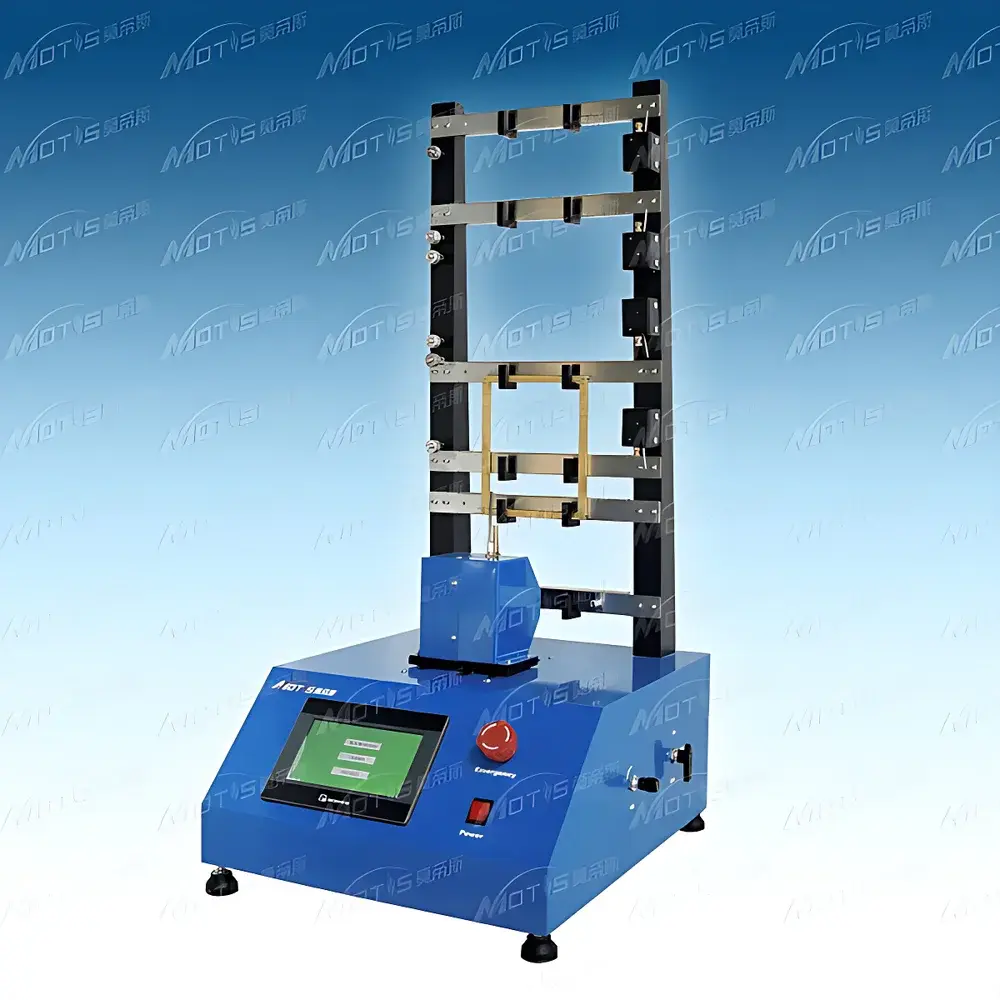
MOTIS VFT ISO 15025 Flame Spread Tester for Protective Clothing
| Brand | MOTIS |
|---|---|
| Model | VFT |
| Standard Compliance | ISO 15025, AQ 6103–2007 |
| Ignition Source | Propane burner |
| Ignition Duration | Adjustable (default 10 s) |
| Sample Orientation | Vertical |
| Measured Parameters | Afterflame time, afterglow time, char length |
| Burner Control | Stepper motor–actuated angular positioning for bottom-edge and edge ignition |
| Display | Integrated LCD interface |
| Power Supply | 220 V, 50 Hz |
| Ambient Conditions | 20 ± 2 °C, 65 ± 5 % RH |
| Dimensions (W × H × D) | 410 × 900 × 380 mm |
| Gas Supply | Propane |
Overview
The MOTIS VFT ISO 15025 Flame Spread Tester is a precision-engineered vertical combustion test apparatus designed to evaluate the flame resistance performance of protective clothing fabrics in accordance with ISO 15025:2016 — *Clothing for protection against heat and flame — Determination of flame spread behaviour — Method using a small flame source*. It also satisfies the requirements of AQ 6103–2007, the Chinese standard for flammability testing of welders’ protective gloves. The instrument operates on the principle of controlled, standardized impingement of a calibrated propane flame onto vertically mounted textile specimens. A defined flame (height and flow rate per ISO 15025 Annex A) is applied for a precise duration—typically 10 seconds—at either the bottom edge or side edge of the specimen. Post-ignition behavior—including afterflame time (duration of visible flaming combustion after flame removal), afterglow time (duration of glowing combustion without flame), and char length (maximum extent of thermal degradation along the specimen)—is quantitatively recorded to assess fabric integrity and flame propagation resistance. This method provides repeatable, comparative data essential for regulatory compliance, material qualification, and R&D validation in occupational PPE development.
Key Features
- Automated dual-mode ignition: stepper motor–driven burner positioning enables precise, repeatable switching between bottom-edge and side-edge ignition configurations per ISO 15025 Clause 6.2 and 6.3.
- Modular specimen mounting system: interchangeable needle frames accommodate varying specimen dimensions and allow future adaptation to additional standards including ISO 6940 (ignitability), ISO 6941 (flame spread), and EN ISO 11612 (heat and flame protection).
- Dedicated control interface: integrated LCD display with intuitive menu navigation supports real-time monitoring and manual logging of afterflame and afterglow durations; timer resolution ≤ 0.1 s.
- Calibrated propane delivery system: mass-flow regulated gas supply ensures consistent flame geometry and thermal flux across test cycles; burner tip conforms to ISO 15025 specifications (inner diameter 0.17 ± 0.02 mm, nozzle height 15 ± 1 mm).
- Robust safety architecture: includes flame-out detection, emergency gas cutoff valve, ventilated test chamber with transparent polycarbonate shield, and fail-safe interlock circuitry compliant with IEC 61000-6-2/6-4 EMC requirements.
Sample Compatibility & Compliance
The VFT accommodates standard textile specimens measuring 160 mm × 50 mm (length × width), cut parallel to warp/weft directions as specified in ISO 15025. Specimens are mounted taut on stainless-steel needle frames and suspended vertically within the test chamber at a defined distance from the burner tip (40 ± 2 mm). Preconditioning follows ISO 139 (standard atmosphere: 20 ± 2 °C, 65 ± 5 % RH) prior to testing. Results are reported per ISO 15025 classification criteria (Class 1–3), supporting conformity assessment for CE marking under EU PPE Regulation (EU) 2016/425 and ANSI/ISEA 105–2016. The system is routinely validated using certified reference materials traceable to NIST SRM 2671a (flame-resistant cotton) and meets internal QA protocols aligned with ISO/IEC 17025:2017 clause 7.2.2 for method verification.
Software & Data Management
While the base VFT configuration employs embedded firmware with local LCD-based data capture, optional PC-connected software (VFT-Link v2.1) enables automated timestamped logging, CSV export, statistical trend analysis (mean, SD, CV%), and audit-ready reporting. Software modules support 21 CFR Part 11–compliant user authentication, electronic signatures, and immutable audit trails for GLP/GMP environments. All raw timing events—including ignition start, flame-off signal, flame extinction, and glow cessation—are logged with millisecond resolution and synchronized to system clock. Data files include metadata: operator ID, ambient conditions, specimen ID, frame type, ignition mode, and calibration certificate expiry.
Applications
- Qualification of flame-resistant (FR) workwear fabrics used in oil & gas, electrical utilities, firefighting, and welding applications.
- Comparative evaluation of fiber blends (e.g., modacrylic/aramid, FR viscose/polyester) during material development.
- Batch release testing per internal quality specifications or customer technical data packages (TDPs).
- Root-cause analysis of FR performance failures, including effects of laundering, coating degradation, or seam construction.
- Supporting documentation for third-party certification bodies (e.g., UL, SGS, TÜV) requiring ISO 15025 test reports.
FAQ
Does the VFT comply with both ISO 15025 and AQ 6103–2007?
Yes—the mechanical configuration, flame parameters, and measurement methodology fully satisfy the normative requirements of both standards. Minor procedural differences (e.g., specimen conditioning duration) are managed via configurable test templates in the control firmware.
Can the instrument be upgraded for ISO 6941 testing?
Yes—by installing the optional ISO 6941-specific needle frame and updating firmware to v3.0+, the system executes the horizontal flame spread protocol with automatic post-ignition observation timing.
What propane pressure and flow rate are required?
The system operates at 30 ± 2 kPa inlet pressure with a nominal flow rate of 35 ± 2 mL/min (measured at STP), verified using a calibrated rotameter traceable to national gas flow standards.
Is third-party calibration certification available?
Yes—MOTIS offers annual calibration services with NIST-traceable certificates covering burner geometry, timer accuracy, thermocouple response, and gas flow verification per ISO/IEC 17025.
What maintenance intervals are recommended?
Burner nozzle cleaning every 50 tests; full optical alignment and gas path leak check every 6 months; annual verification of stepper motor positioning accuracy and LCD response latency.



