
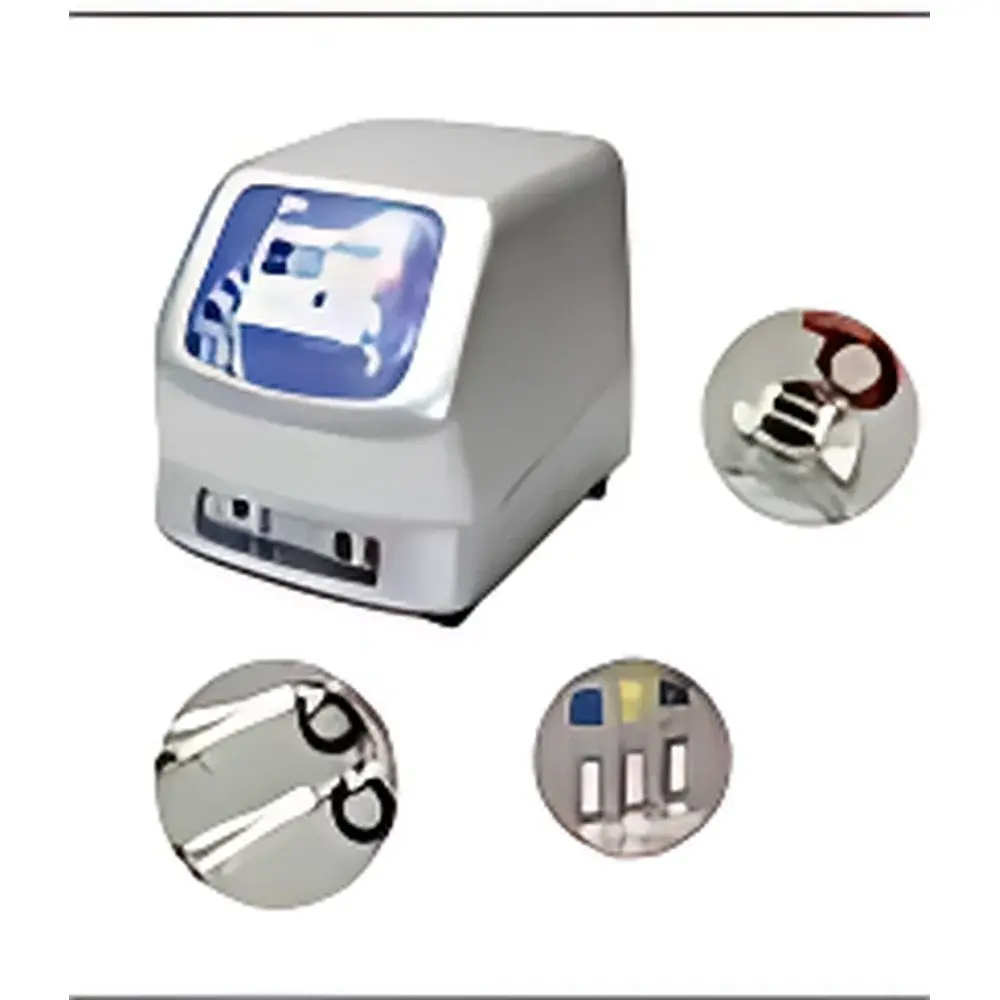
BTX Gemini X2 Dual-Wave Electroporator
| Brand | Harvard Apparatus |
|---|---|
| Origin | USA |
| Model | Gemini X2 |
| Waveforms | Square Wave & Exponential Decay Wave |
| Voltage Range (LV) | 5–500 V (1 V step), 505–3000 V (5 V step) |
| Voltage Range (HV) | 505–3000 V (5 V step) |
| Pulse Duration (Square, LV) | 10 µs–999 µs (1 µs), 1 ms–999 ms (1 ms) |
| Pulse Duration (Square, HV) | 10 µs–600 µs (1 µs) |
| Pulse Duration (Exponential, LV) | 1 ms–5.158 s |
| Pulse Duration (Exponential, HV) | 0.5 ms–133.875 ms |
| Pulse Count (Square) | 1–10 (LV), 1–3 (HV) |
| Pulse Count (Exponential) | 1–12 (R < 100 Ω), 1–24 (R > 100 Ω) |
| Inter-Pulse Interval | 0.1–10 s (Square), 5–30 s (Exponential) |
| Capacitance (LV) | 3775 µF |
| Capacitance (HV) | 85 µF |
| Capacitance (Exponential, LV) | 25–3275 µF (25 µF step) |
| Capacitance (Exponential, HV) | 10, 25, 35, 50, 60, 75, 85 µF |
| Resistance Measurement Range | 25–1575 Ω (25 Ω step, LV), 50–1575 Ω (25 Ω step, HV) |
| Electrode Compatibility | BTX standard cuvettes, in vivo electrodes, MOS 96-well electroporation plates, footswitch |
| Software Control | USB and Ethernet interface for protocol download, storage, and remote execution |
| Safety Features | Arc suppression, short-circuit protection, real-time impedance monitoring |
Overview
The BTX Gemini X2 Dual-Wave Electroporator is an engineered platform for high-fidelity nucleic acid, protein, and small-molecule delivery into diverse biological systems—spanning adherent and suspension mammalian cells, primary isolates, bacteria, yeast, plant protoplasts, and intact tissues. Unlike legacy single-wave electroporators, the Gemini X2 implements two independent, non-interfering pulse generation circuits: one optimized for precise square-wave delivery (ideal for mammalian transfection and in vivo applications), and another for tunable exponential decay waveform output (optimized for microbial transformation and delicate plant cell electroporation). This architectural separation ensures waveform integrity—eliminating cross-coupling artifacts that compromise reproducibility in dual-mode instruments. The system operates on the fundamental principle of transient membrane permeabilization via controlled electric field application, where pulse amplitude, duration, number, and inter-pulse interval are calibrated to balance electrophoretic cargo transport with post-pulse membrane resealing kinetics. Real-time resistance measurement (25–1575 Ω, ±2% accuracy) provides critical feedback on sample conductivity—enabling detection of buffer molarity deviations, electrode contact anomalies, or tissue heterogeneity prior to pulse delivery—thereby safeguarding experimental consistency across in vitro, ex vivo, and in vivo workflows.
Key Features
- Dual independent pulse generators: Fully isolated square-wave and exponential decay circuits prevent waveform crosstalk and ensure parameter fidelity.
- Real-time impedance monitoring: Measures sample resistance before and during pulse delivery to validate electroporation conditions and prevent arcing or cell lysis.
- Comprehensive voltage and timing resolution: LV mode supports 1-V/1-µs increments (5–500 V; 10 µs–999 ms); HV mode enables fine-tuned high-voltage pulses (505–3000 V; 10 µs–600 µs).
- Configurable exponential decay parameters: Adjustable capacitance (25–3275 µF, 25 µF steps) and voltage (5–3000 V) allow precise tailoring of time constant (τ = R × C) for species-specific optimization.
- Integrated safety architecture: Active arc suppression, hardware-based short-circuit protection, and impedance-triggered fault shutdown comply with IEC 61010-1 safety standards.
- Touchscreen interface with local protocol storage: Pre-loaded protocols for common cell lines (e.g., HEK293, CHO-K1, Jurkat, E. coli DH5α) reduce setup time and operator variability.
Sample Compatibility & Compliance
The Gemini X2 accommodates a broad spectrum of electroporation formats: standard 0.1–4 mm gap cuvettes, specialized in vivo needle and plate electrodes, and high-throughput BTX MOS 96-well electroporation plates. Its resistance monitoring capability ensures robust performance across variable-conductivity samples—including low-ionic-strength plant buffers, high-salt bacterial recovery media, and heterogeneous tissue explants. The instrument meets essential regulatory requirements for research-use-only (RUO) instrumentation under FDA 21 CFR Part 11 guidelines when paired with validated software control (e.g., BTX Manager v4.x), supporting audit trails, electronic signatures, and protocol versioning for GLP-compliant studies. All electrical design conforms to UL 61010-1 and CE EN 61010-1 for laboratory equipment safety.
Software & Data Management
Control and protocol management are executed via BTX Manager software (Windows-compatible), accessible through USB 2.0 or Ethernet. Users may download and import peer-reviewed, literature-validated protocols from the BTX Protocol Library—a curated repository aligned with publications in journals such as Nature Protocols and Molecular Therapy. Protocols are stored locally on the Gemini X2’s internal flash memory (≥1000 entries), enabling fully autonomous operation without host PC dependency. Software logging captures timestamped pulse parameters, measured resistance, and user ID—facilitating traceability in multi-user core facilities. Export options include CSV and PDF reports compatible with LIMS integration.
Applications
- Mammalian cell transfection: High-efficiency plasmid DNA, siRNA, and CRISPR RNP delivery into hard-to-transfect primary T cells, neurons, and stem cells using square-wave protocols.
- In vivo electroporation: Targeted gene expression or silencing in muscle, skin, tumor, and embryonic tissues using insulated needle electrodes and optimized HV square pulses.
- Microbial transformation: Efficient plasmid uptake in Gram-negative (E. coli), Gram-positive (B. subtilis), and yeast (S. cerevisiae) using exponential decay waveforms calibrated to cell wall dielectric properties.
- Plant protoplast transfection: Delivery of editing reagents into Arabidopsis or rice protoplasts under low-conductivity PEG-based buffers, leveraging extended exponential time constants.
- High-throughput screening: Parallel electroporation of 96 samples using the MOS plate system—fully synchronized with robotic liquid handlers via TTL trigger input.
FAQ
Can the Gemini X2 deliver both square and exponential waveforms within a single protocol sequence?
Yes—the instrument supports sequential waveform execution (e.g., square pulse followed by exponential pulse) with independent parameter control for each phase, enabling hybrid protocols for complex delivery strategies.
Is resistance measurement performed automatically before every pulse?
Yes—impedance is measured immediately prior to each pulse train and displayed in real time; if resistance falls outside user-defined thresholds, the system halts execution and alerts the operator.
Does the Gemini X2 support FDA 21 CFR Part 11 compliance?
When operated with BTX Manager software configured for electronic signatures, audit trail logging, and role-based access control, the system satisfies key technical controls required for Part 11 adherence in regulated environments.
What electrode types are natively supported?
All BTX-branded electrodes are fully compatible—including standard cuvettes (0.1–4 mm), in vivo needle and tweezer electrodes, calvarial and ear clip arrays, and the MOS 96-well plate system.
Can protocols be edited directly on the device touchscreen?
Yes—users may modify voltage, pulse duration, count, and interval values on-device; changes are saved as new protocol entries with version timestamps.






