
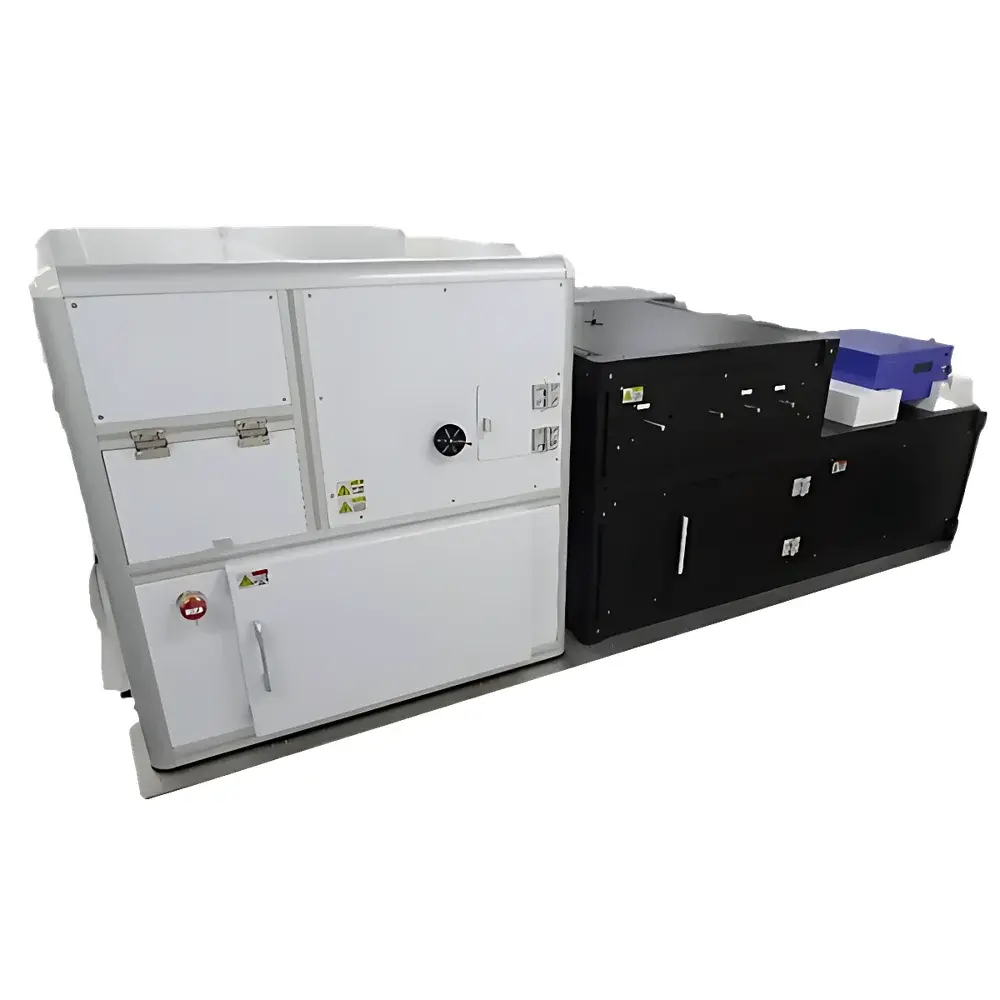
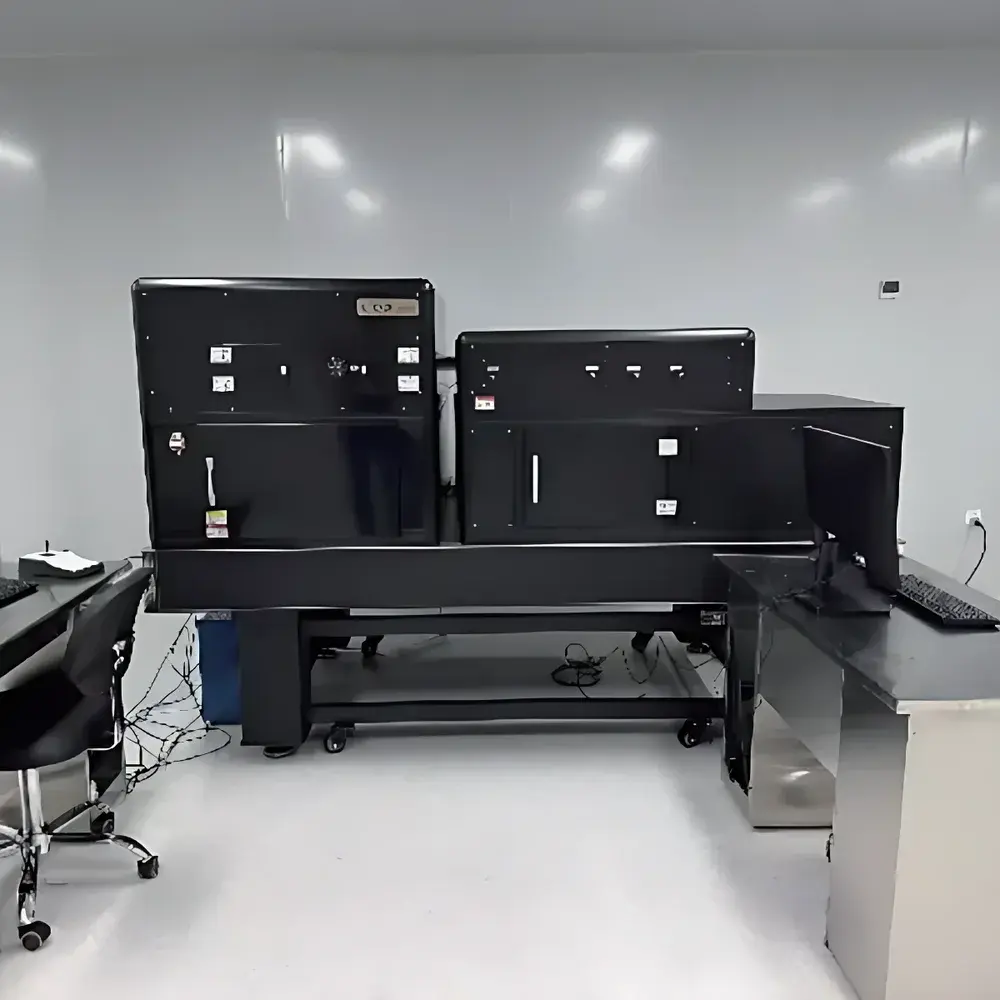
SHNTI Industrial Confocal Micro-Raman Spectroscopy System
| Brand | SHNTI |
|---|---|
| Origin | Shanghai, China |
| Manufacturer Type | Authorized Distributor |
| Product Category | Domestic |
| Model | Industrial Confocal Micro-Raman System |
| Instrument Type | Confocal Micro-Raman Spectrometer |
| Spectral Range | 224–1350 nm (18 laser lines: 224, 266, 325, 355, 375, 405, 442, 458, 473, 514, 532, 632.8, 671, 785, 808, 830, 1064, 1350, 1650 nm) |
| Spectral Resolution | < 0.1 cm⁻¹ per pixel (measured at 632.8 nm with 1800 gr/mm grating and 1000 mm focal length spectrometer) |
Overview
The SHNTI Industrial Confocal Micro-Raman Spectroscopy System is a high-precision, research-grade confocal Raman platform engineered for non-destructive molecular characterization in industrial and advanced materials laboratories. Based on inelastic light scattering (Raman effect), the system probes vibrational, rotational, and other low-frequency modes of molecules and crystal lattices through monochromatic laser excitation. Its core architecture integrates a motorized confocal microscope with a high-throughput, high-resolution Czerny–Turner spectrograph and deep-cooled back-illuminated CCD or EMCCD detector. The confocal optical design enables axial sectioning with sub-micron spatial resolution—achieving lateral resolution down to <1 µm and axial resolution of ~1–2 µm depending on objective NA and excitation wavelength—making it suitable for depth-resolved analysis of multilayer films, semiconductor devices, battery electrodes, and encapsulated microstructures without physical sectioning.
Key Features
- Multi-wavelength excitation flexibility: 18 discrete laser lines spanning 224 nm (deep UV) to 1650 nm (short-wave IR), enabling resonance enhancement, fluorescence suppression, and optimal penetration for diverse sample classes—including wide-bandgap semiconductors, carbon allotropes, and hydrated biological matrices.
- Ultra-high spectral resolution: <0.1 cm⁻¹ per pixel under standard calibration conditions (632.8 nm + 1800 gr/mm grating + 1000 mm focal length), supporting fine-structure analysis of phonon modes, stress-induced peak shifts, and isotopic splitting.
- True confocal geometry with motorized Z-stage and pinhole alignment: Enables optical sectioning, 3D spectral mapping, and quantitative depth profiling with reproducible axial positioning accuracy of ±0.1 µm.
- Zero-sample-prep operation: Compatible with solids (powders, wafers, thin films), liquids, gels, and irregularly shaped specimens—no coating, embedding, or vacuum required.
- Extended low-wavenumber capability: Reliable detection down to <100 cm⁻¹, critical for lattice mode analysis in transition metal oxides, layered materials (e.g., MoS₂, h-BN), and strain-sensitive phonons in SiGe and GaN heterostructures.
- Robust environmental immunity: Optical path sealed against ambient humidity; insensitive to atmospheric water vapor absorption bands that compromise FTIR or mid-IR Raman systems.
Sample Compatibility & Compliance
The system accommodates samples ranging from silicon wafers and polymer composites to pharmaceutical tablets, catalyst pellets, and forensic trace evidence. It supports ASTM E1840 (Standard Guide for Raman Shift Standards), ISO/IEC 17025-compliant calibration protocols, and optional integration with GLP/GMP audit trails via time-stamped metadata logging. All laser safety interlocks comply with IEC 60825-1:2014 Class 3B/4 requirements. Optional accessories include temperature-controlled stages (−190 °C to +600 °C), electrochemical cells, and gas-tight reaction chambers for in situ and operando studies.
Software & Data Management
Control and analysis are performed via SHNTI’s proprietary RamanSuite™ software—a modular platform supporting real-time spectral acquisition, multivariate chemometrics (PCA, cluster analysis), spectral library matching (80,000+ reference spectra across polymers, minerals, APIs, explosives, and carbon nanomaterials), and automated defect mapping. Data files conform to HDF5 format with embedded metadata (laser power, integration time, objective, grating, pinhole size, stage coordinates). Export options include CSV, JCAMP-DX, and vendor-neutral .spc formats. For regulated environments, optional 21 CFR Part 11-compliant modules provide electronic signatures, user role management, and immutable audit logs.
Applications
- In-line process monitoring: Real-time tracking of chemical conversion during catalysis, electrodeposition, or thermal curing—enabling closed-loop feedback control.
- Stress and strain metrology: Quantitative mapping of residual stress in CMOS interconnects, MEMS devices, and laser-cut glass substrates via Raman peak shift calibration (e.g., Si at 520 cm⁻¹).
- Carbon material characterization: D/G band ratio analysis, layer count determination in graphene, defect density estimation in CNTs, and sp²/sp³ quantification in DLC films.
- Pharmaceutical solid-state analysis: Polymorph identification, hydrate/anhydrate differentiation, and API-excipient interaction assessment directly through blister packaging.
- Failure analysis: Identification of contaminants, oxidation products, or phase segregation in failed electronic components, battery cathodes, or composite laminates using hyperspectral Raman imaging.
- Forensic and regulatory screening: Rapid identification of illicit substances, pigments, and adulterants with library-match confidence scoring and false-positive rejection algorithms.
FAQ
Is this system compatible with vacuum or controlled-atmosphere chambers?
Yes—optional vacuum-compatible stages and hermetic optical coupling interfaces support operation under inert gas, reducing atmosphere, or high-vacuum conditions (down to 10⁻⁶ mbar).
Can the system perform automated line scans and depth profiling?
Yes—motorized XYZ stages with programmable trajectories enable fully automated 1D/2D/3D spectral mapping, including step-scan confocal Z-series and lateral line profiles with sub-pixel interpolation.
What spectral libraries are included, and can users add custom references?
The system ships with an industry-curated library of 80,000+ spectra covering >1,200 compound classes. Users may import, annotate, and version-control proprietary spectra using built-in library manager tools.
Does the software support multivariate statistical analysis for classification tasks?
Yes—RamanSuite™ includes PCA, hierarchical clustering, PLS-DA, and SVM-based classifiers, with cross-validation and confusion matrix reporting for method validation.
How is calibration traceability maintained across instruments and over time?
Each system includes NIST-traceable Raman shift standards (silicon, cyclohexane, sulfur) and automated daily calibration routines with drift compensation. Calibration logs are embedded in every spectrum file and exportable for audit review.




