
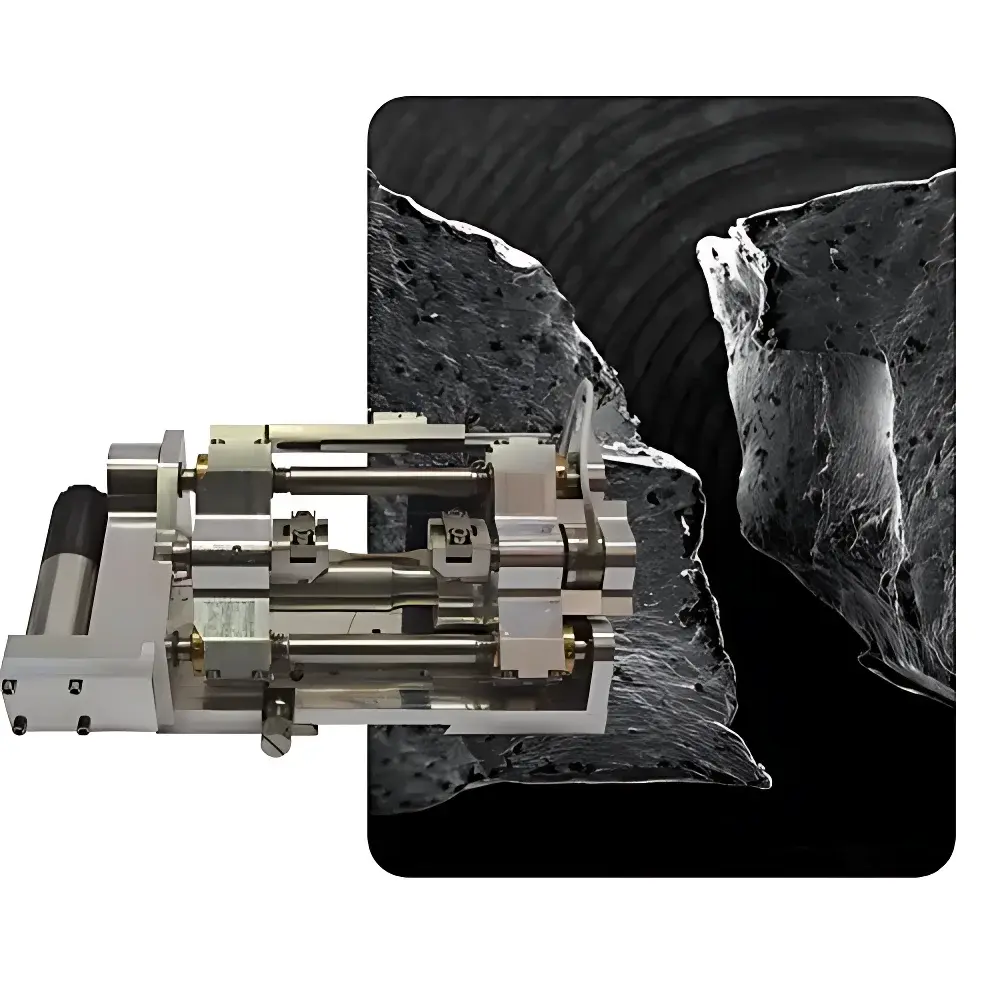
Appo SWIFT In Situ Tensile Stage
| Brand | Appo |
|---|---|
| Origin | United Kingdom |
| Model | SWIFT |
| Max Load Capacity | 10 kN |
| Temperature Range | –120 °C to +1000 °C |
| Stroke Range | 16–26 mm |
| Compatibility | SEM, TEM, Optical Microscope, Confocal Microscope, EBSD, Raman, XRD, AFM, Metallographic Microscope |
| Control Interface | Windows 10–compatible PC-based controller with drag-and-drop test sequencing software |
Overview
The Appo SWIFT In Situ Tensile Stage is an engineered electromechanical platform designed for real-time mechanical testing inside high-resolution imaging and analytical instruments. Built upon a precision piezoelectric or servo-motor-driven actuation architecture, it operates on quasi-static loading principles—enabling sub-micron displacement resolution and force-controlled ramp-hold cycles under vacuum, inert atmosphere, or ambient conditions. Its core function is to apply calibrated uniaxial tension, compression, shear, or combined multiaxial loads to microscale specimens while synchronously acquiring structural, crystallographic, and topographic data from co-located detectors (e.g., secondary electron, backscattered electron, EBSD patterns, Raman shifts, or diffraction peaks). Unlike conventional ex situ mechanical testers, the SWIFT stage integrates directly into the specimen chamber of scanning electron microscopes (SEM), transmission electron microscopes (TEM), and optical platforms—eliminating post-test reconstruction artifacts and enabling direct correlation between macroscopic load response and nanoscale deformation mechanisms.
Key Features
- Modular design supporting three standard configurations: SWIFT-A (rotating/tilting stage for EBSD-compatible 0°/70° orientation), SWIFT-B (low-profile variant optimized for compact SEM chambers), and SWIFT-C (miniaturized version for benchtop SEMs with 2 kN max load)
- Load capacity scalable up to 10 kN with integrated load cell and closed-loop force feedback; displacement resolution < 100 nm over full stroke range (16–26 mm)
- Thermal control module enabling in situ heating and cooling from –120 °C to +1000 °C, compatible with cryo-SEM and high-temperature EBSD workflows
- Vacuum-rated construction (≤10⁻⁷ mbar) with non-magnetic, low-outgassing materials (e.g., titanium alloys, ceramic insulators) ensuring electromagnetic compatibility and minimal interference with electron beams or sensitive detectors
- Integrated strain measurement via high-precision linear variable differential transformers (LVDTs) or optical encoders, synchronized with load acquisition at ≥1 kHz sampling rate
Sample Compatibility & Compliance
The SWIFT stage accommodates standardized tensile specimens (e.g., ASTM E8/E9 microspecimens, ISO 6892-1 miniaturized coupons) as well as custom geometries—including thin films, freestanding nanowires, electroplated layers, solder joints, and brittle ceramics. All variants comply with SEM chamber dimensional constraints (e.g., ≤50 mm diameter insertion envelope, ≤300 mm working distance clearance) and meet ISO 14644-1 Class 5 cleanroom handling requirements for contamination-sensitive applications. The system supports GLP-compliant test documentation through audit-trail-enabled software logging (aligned with FDA 21 CFR Part 11 principles), and its mechanical calibration traceability follows ISO/IEC 17025 guidelines when used with certified reference load cells.
Software & Data Management
Control is executed via Swift Instruments’ proprietary Windows 10–based software suite, featuring a graphical drag-and-drop test sequence builder. Users define multi-step protocols combining force ramps, dwell periods, temperature profiles, and trigger events for external detectors (e.g., initiate EBSD map acquisition upon reaching 0.5% plastic strain). Real-time data streams—including load (N), displacement (µm), temperature (°C), and user-defined analog inputs—are logged with timestamped metadata and exported in CSV, HDF5, or MATLAB .mat formats. The software supports automated stress–strain curve generation using cross-sectional area corrections and elastic modulus fitting via linear regression of initial slope segments. Raw binary logs retain full bit-depth fidelity for post hoc reprocessing under third-party analysis environments (e.g., Python-based SciPy pipelines or Thermo Scientific Avizo).
Applications
The SWIFT stage enables quantitative structure–property linkage across diverse material systems. In semiconductor research, it characterizes interfacial delamination kinetics in Cu/low-k stacks under thermal cycling. For additive-manufactured alloys, it reveals dislocation nucleation sites during early-stage yielding via simultaneous TEM–DIC correlation. In polymer composites, time-resolved Raman mapping tracks molecular chain alignment evolution under monotonic load. Other validated use cases include: fatigue crack initiation mapping in Ni-based superalloys (using cyclic loading mode), grain rotation dynamics in Mg alloys (via in situ EBSD), creep strain partitioning across ceramic–metal interfaces, and shear-induced phase transformation in shape-memory alloys. Its compatibility with correlative microscopy workflows makes it suitable for multi-modal studies required by ISO/IEC 17025-accredited laboratories.
FAQ
What vacuum levels are supported?
The SWIFT stage is rated for continuous operation at pressures ≤10⁻⁷ mbar, with bake-out capability up to 150 °C.
Is EBSD-compatible sample tilting integrated?
Yes—SWIFT-A and SWIFT-B models include motorized tilt axes enabling precise 0° and 70° orientations relative to the electron beam, with angular repeatability ±0.1°.
Can the stage be used outside electron microscopes?
Yes—standalone mechanical testing is supported via optional load frame mounting kits and external environmental chambers (e.g., humidity-controlled enclosures or laser-heated stages).
How is thermal drift compensated during long-duration tests?
Active thermal compensation algorithms adjust displacement setpoints in real time using dual-point thermocouple feedback and pre-characterized thermal expansion coefficients of the stage’s structural components.
Does the software support automated pass/fail criteria for quality control?
Yes—customizable threshold logic (e.g., “fail if yield strength deviates >3% from nominal”) can be embedded into test sequences and exported with QC reports compliant with ISO 9001 Annex SL documentation frameworks.




