
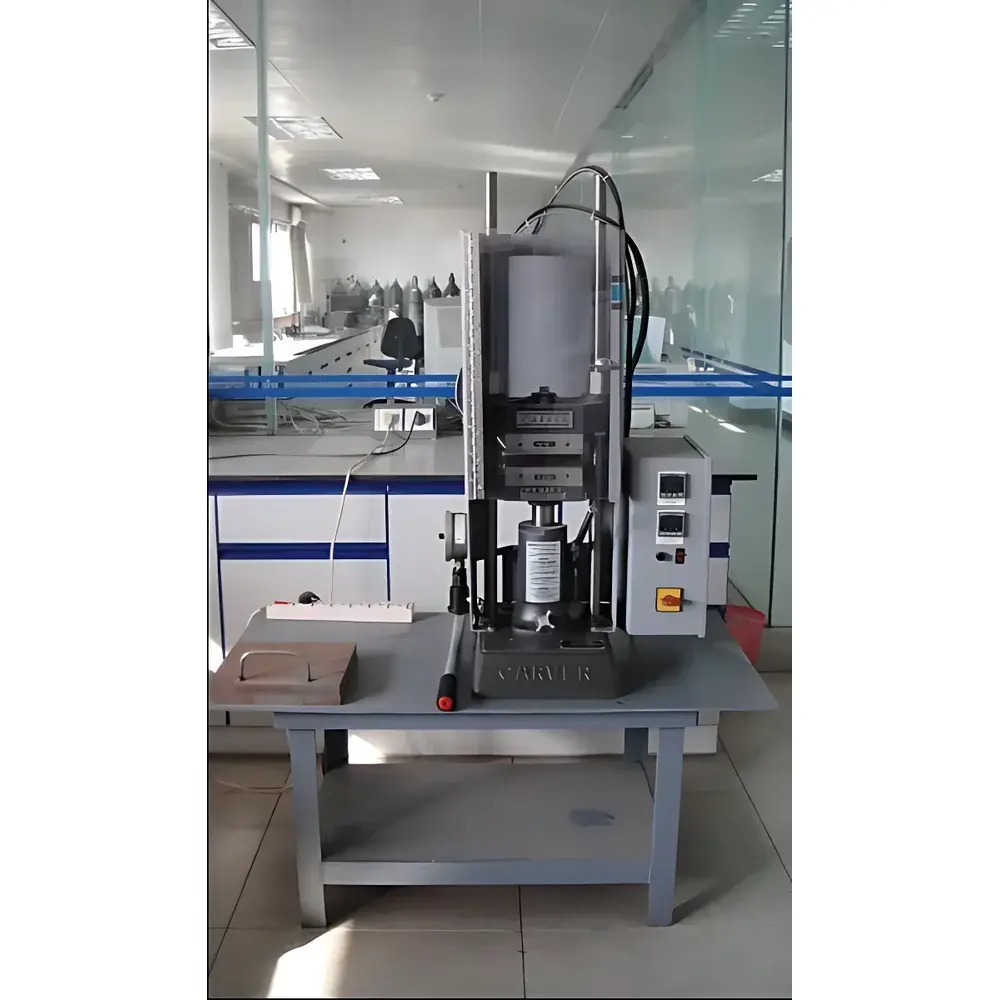
Carver 4128 Hydraulic Pellet Press
| Brand | Carver |
|---|---|
| Origin | USA |
| Model | 4128 |
| Maximum Working Pressure | 30 tons (267 kN) |
| Maximum Temperature | 343 °F (173 °C) |
| Platen Dimensions | 12 in × 12 in (305 mm × 305 mm) |
| Platen Stroke | 6 in (152 mm) |
| Base Footprint | 32 in × 27 in (813 mm × 686 mm) |
| Type | C-frame Hydraulic Press |
| Compliance | ASTM E10, ASTM E384, ISO 20501, USP <1059>, GLP-ready architecture |
Overview
The Carver 4128 Hydraulic Pellet Press is a precision-engineered C-frame laboratory press designed for reproducible, high-force sample compaction and pellet formation in analytical, materials science, and quality control laboratories. Built upon Carver’s 85+ years of hydraulic press engineering heritage, the 4128 integrates robust mechanical architecture with thermally stable platens to support both ambient and elevated-temperature pressing protocols. Its operation is grounded in uniaxial hydraulic compression—applying controlled, calibrated force perpendicular to parallel platens—to achieve uniform density distribution within powdered or granular specimens. This principle ensures compliance with standardized test methods requiring consolidated samples for X-ray fluorescence (XRF), Fourier-transform infrared (FTIR), near-infrared (NIR), and elemental analysis by inductively coupled plasma (ICP) techniques. The system is not a benchtop mini-press; rather, it is a full-scale, floor-standing instrument engineered for long-term stability, load repeatability (< ±0.5% FS per ASTM E4), and thermal integrity across extended dwell cycles.
Key Features
- Heavy-duty C-frame construction fabricated from stress-relieved A36 steel, providing rigidity under sustained 30-ton (267 kN) compressive loads without frame deflection or platen tilt.
- Electro-hydraulic dual-stage pressure control system enabling precise ramp-and-hold profiles, with analog pressure transducer feedback and digital setpoint adjustment via front-panel interface.
- Heated platens capable of stable temperature maintenance from ambient to 343 °F (173 °C), certified to ASTM E220 traceable calibration standards, with independent thermocouple monitoring at each platen surface.
- Adjustable platen stroke (6 in / 152 mm) with mechanical limit stops and hydraulic overload protection—preventing over-compression of dies and safeguarding die sets during routine use.
- Large 12 in × 12 in (305 mm × 305 mm) parallel platens machined to ≤ 0.001 in (25 µm) flatness tolerance, ensuring uniform pressure transmission across oversized pellets (e.g., 40 mm diameter XRF discs or multi-cavity tablet compaction tooling).
- Integrated safety interlock system compliant with ANSI B11.1 and ISO 13857, including light curtain integration capability, emergency stop circuitry, and guarded hydraulic reservoir access.
Sample Compatibility & Compliance
The 4128 accommodates a broad spectrum of sample matrices—including metal oxides, geological powders, polymer blends, pharmaceutical actives, catalyst precursors, and ceramic precursors—when paired with standard or custom die sets (e.g., Carver 31-12, 32-12, or third-party ISO/USP-compliant tooling). It supports preparation workflows aligned with ASTM E10 (Brinell hardness test specimen conditioning), ASTM E384 (microindentation sample mounting), ISO 20501 (powder compaction for spectroscopic analysis), and USP (pharmaceutical tablet compaction validation). All mechanical and thermal operating parameters are logged with timestamped metadata, satisfying GLP documentation requirements and enabling full audit trails for FDA 21 CFR Part 11–aligned environments when interfaced with validated LIMS or ELN platforms.
Software & Data Management
While the 4128 operates as a stand-alone instrument with analog/digital hybrid controls, it features RS-232 and optional Ethernet (Modbus TCP) connectivity for external data acquisition. Compatible with Carver’s optional PressLink™ software (v3.2+), users can define multi-step pressing protocols—including force ramp rate (ton/sec), dwell time (0.1–9999 s), temperature ramp profile, and cooling hold sequences—and export CSV-formatted logs containing force, temperature, stroke position, and elapsed time at 100 ms intervals. Audit trail functionality includes user login tracking, parameter change history, and electronic signature capture—fully supporting 21 CFR Part 11 Subpart B implementation when deployed with qualified IT infrastructure.
Applications
- XRF and XRD sample preparation: Producing homogeneous, binder-free pressed pellets from soil, ore, cement, or slag powders with minimal preferred orientation effects.
- Pharmaceutical QA/QC: Compacting placebo and active pharmaceutical ingredient (API) blends into tablets for content uniformity testing per USP and dissolution method development.
- Materials research: Densifying battery electrode slurries (e.g., NMC, LFP), fuel cell catalyst layers, or metal injection molding (MIM) feedstocks prior to sintering trials.
- Environmental testing: Forming standardized sediment or fly ash pellets for leaching studies (TCLP, SPLP) requiring mechanically stable, low-porosity substrates.
- Calibration standard manufacturing: Fabricating certified reference material (CRM) discs with certified mass thickness and elemental homogeneity for spectrometer calibration.
FAQ
What is the maximum recommended operating pressure for routine use?
Rated continuous duty pressure is 30 tons (267 kN); however, for optimal longevity of seals and platen surfaces, Carver recommends limiting sustained operation to ≤ 90% of full scale (27 tons) unless performing certified calibration or short-duration qualification runs.
Can the 4128 be used with automated die ejection systems?
Yes—optional pneumatic or electro-mechanical ejection modules (e.g., Carver Auto-Eject Kit AE-12) integrate directly with the 4128’s auxiliary I/O port and are compatible with standard 12-in platen tooling mounts.
Is temperature calibration performed at the platen surface or inside the heating element?
Calibration is conducted at the platen working surface using NIST-traceable contact thermocouples; internal heater thermistors serve only as secondary feedback and are not used for certification-grade reporting.
Does the system meet CE marking requirements for EU deployment?
Yes—the 4128 carries CE marking per Machinery Directive 2006/42/EC and EMC Directive 2014/30/EU, with full technical documentation available upon request for conformity assessment.
How often does hydraulic fluid require replacement under standard lab usage?
Carver specifies 2,000 hours of operational runtime or biennial replacement—whichever occurs first—with ISO 46 anti-wear hydraulic oil (AW 46) meeting DIN 51524 Part 2 specifications.



