
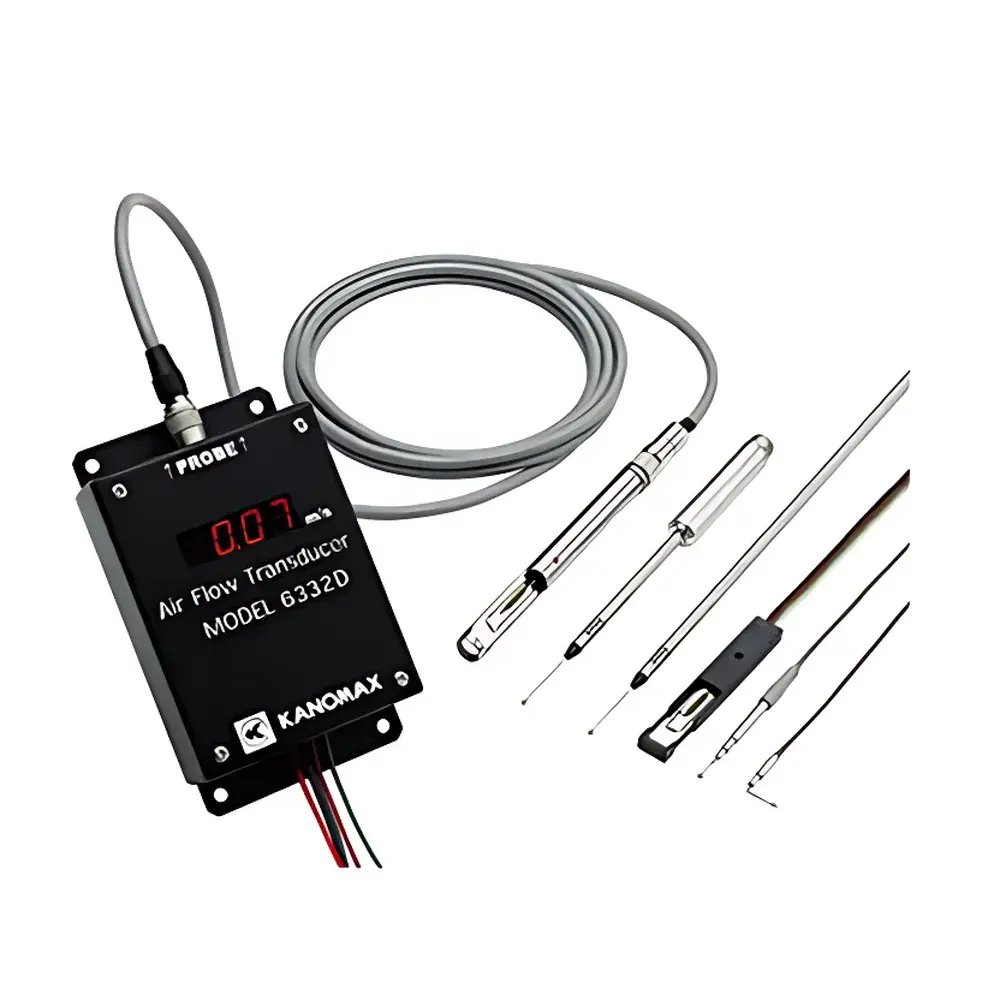
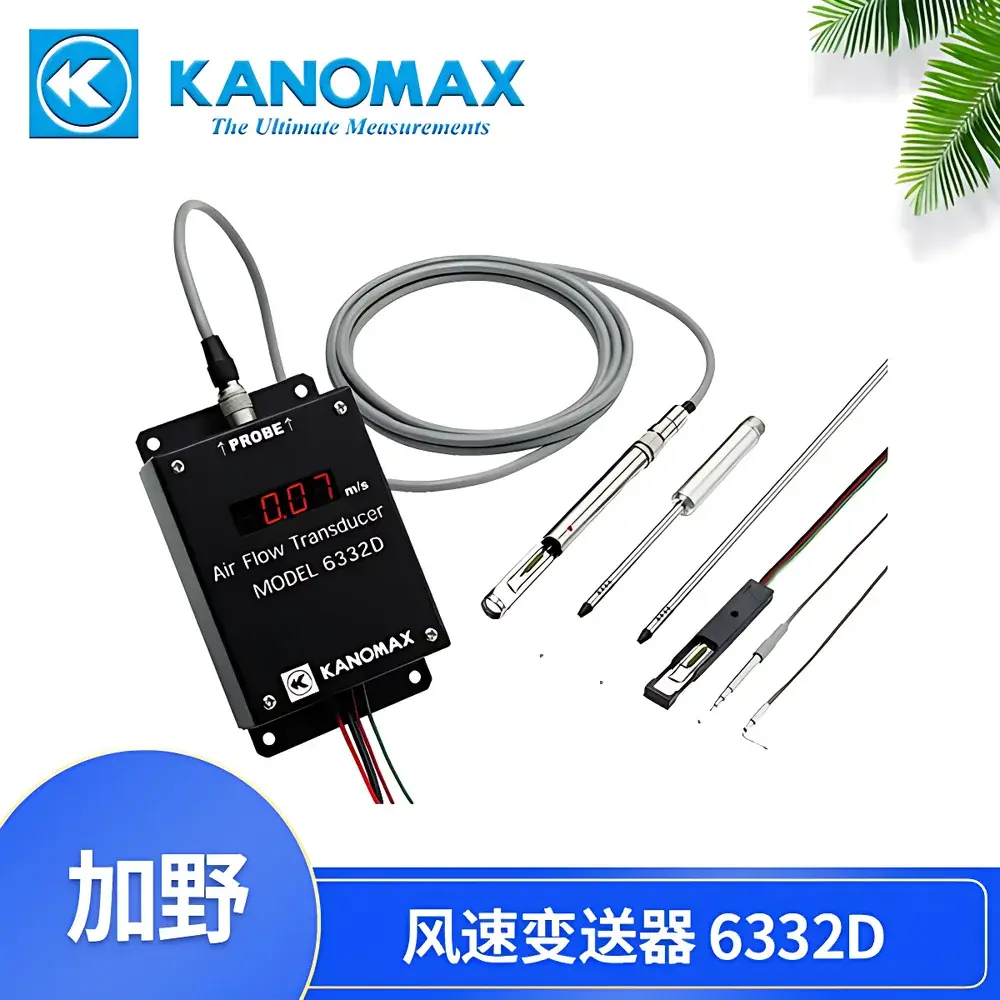
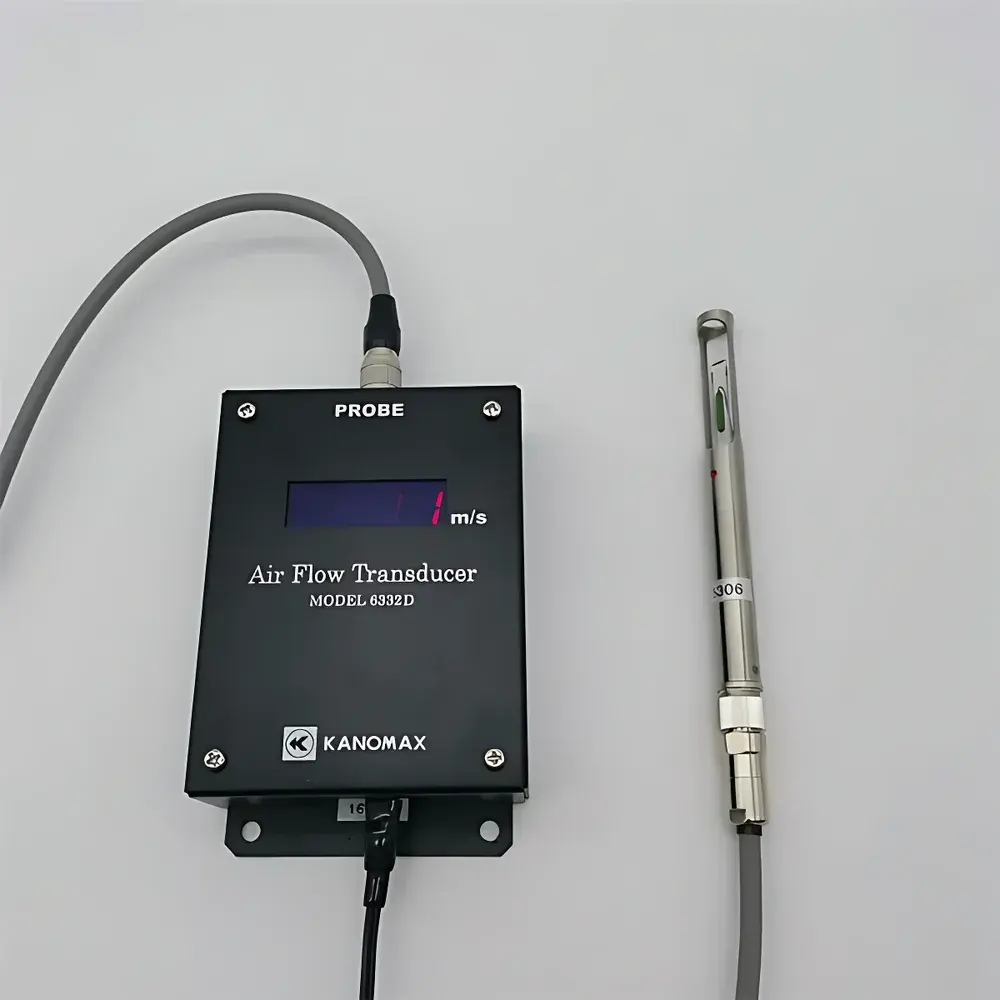
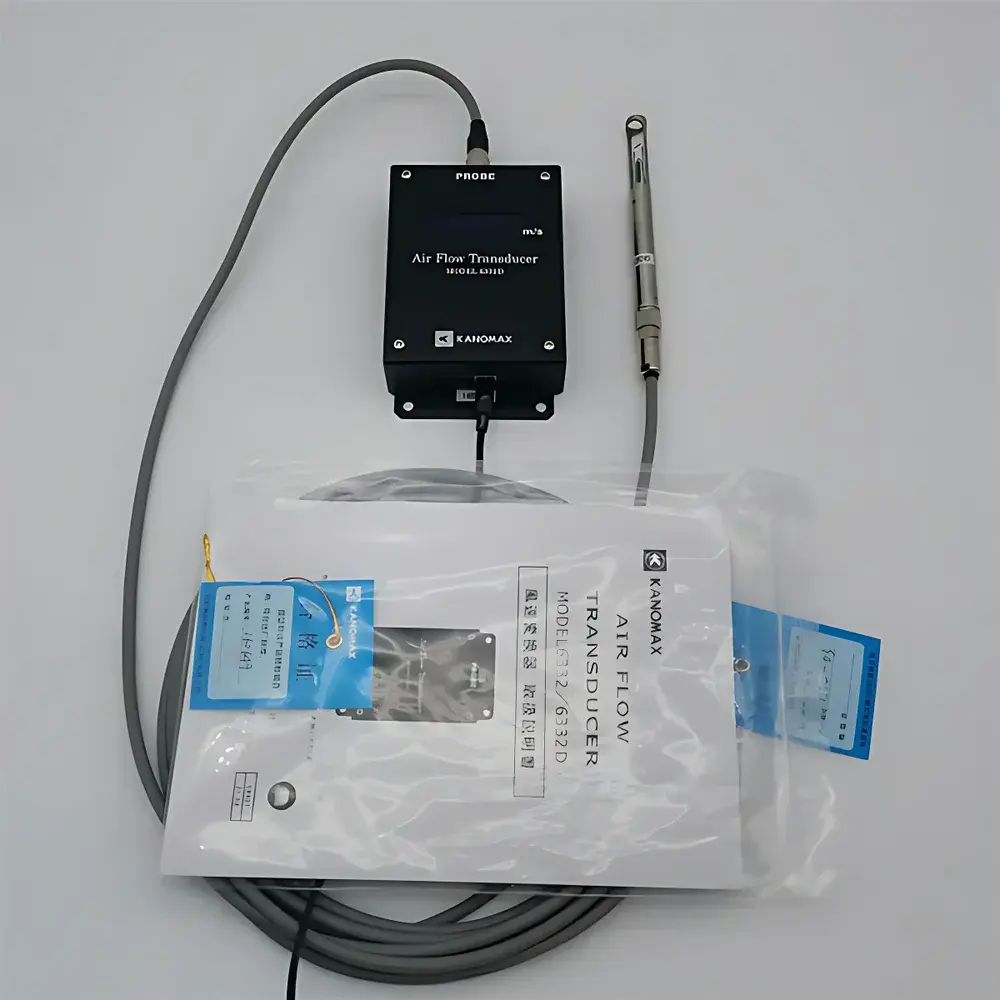
KANOMAX 6332D Thermal Anemometer Transmitter
| Brand | KANOMAX |
|---|---|
| Origin | Japan |
| Manufacturer Type | Authorized Distributor |
| Product Category | Imported Instrument |
| Model | 6332D |
| Instrument Type | Thermal Anemometer |
| Resolution | 0.1 m/s |
| Measurement Range | 0.1–50 m/s (9–8,400 fpm), probe-dependent |
| Accuracy | ±3% of reading ±0.1 m/s (±20 fpm) |
| Operating Ambient Temperature | 5–40 °C (41–104 °F) |
| Output Options | 0–5 V DC or 4–20 mA analog output |
| Display | Integrated LCD with real-time readout |
| Probe Compatibility | Interchangeable with 10 standardized KANOMAX thermal probes (e.g., 6332-01 to 6332-10) |
| System Integration | Supports daisy-chained multi-channel configuration via analog output synchronization |
Overview
The KANOMAX 6332D Thermal Anemometer Transmitter is a precision-engineered environmental monitoring instrument designed for continuous, stable air velocity measurement in HVAC commissioning, cleanroom qualification, laboratory ventilation validation, and industrial airflow auditing. It operates on constant-temperature anemometry (CTA) principles: a heated sensing element—typically a platinum-coated thermistor or thin-film resistor—is maintained at a fixed temperature differential above ambient; convective heat loss from airflow is quantified and linearly converted into velocity data. This method delivers high sensitivity at low velocities (<1 m/s) and robust performance across turbulent and laminar flow regimes. Unlike cup or vane anemometers, the 6332D exhibits negligible mechanical inertia and no moving parts, ensuring long-term stability and minimal drift under repeated thermal cycling. Its compact transmitter architecture integrates signal conditioning, analog output conversion, and local visualization—all housed in an IP54-rated enclosure suitable for controlled indoor environments.
Key Features
- Integrated backlit LCD display providing real-time wind speed (m/s or fpm), unit toggle, and status indicators (e.g., probe connection, output mode, battery level)
- Dual analog output configuration: user-selectable 0–5 V DC or 4–20 mA current loop, both calibrated to full-scale range (0.1–50 m/s), enabling seamless integration with PLCs, SCADA systems, and data loggers
- Modular probe interface supporting ten standardized KANOMAX thermal probes—including straight, bent, retractable, and high-temperature variants—each with unique calibration coefficients stored in probe EEPROM and auto-recognized upon insertion
- Daisy-chain capability: up to 16 units can be synchronized via shared analog reference voltage and ground, allowing coordinated multi-point velocity mapping without external multiplexers
- Stable thermal compensation across 5–40 °C ambient, validated per ISO 17025-accredited calibration procedures; factory calibration traceable to NMIJ (National Metrology Institute of Japan)
- Low-power design with optional AC adapter or internal rechargeable Li-ion battery (operational life ≥12 h at continuous display + analog output)
Sample Compatibility & Compliance
The 6332D is optimized for gaseous media—primarily air and non-corrosive industrial gases (e.g., nitrogen, CO₂, dry compressed air)—at atmospheric pressure ±10%. It is not rated for use in explosive atmospheres (ATEX/IECEx), high-humidity condensing environments (>95% RH), or particulate-laden ducts without upstream filtration. Probe selection determines application suitability: e.g., 6332-03 (stainless steel sheath) supports cleanroom ISO Class 5–8 airflow verification per ISO 14644-3; 6332-07 (high-temp probe) extends operational limit to 120 °C at sensor tip. The instrument complies with EMC Directive 2014/30/EU and Low Voltage Directive 2014/35/EU. While not intrinsically safe, its analog outputs meet IEC 61000-4 immunity standards for industrial environments. Documentation includes Declaration of Conformity and calibration certificate with uncertainty budget (k=2).
Software & Data Management
The 6332D operates as a standalone transmitter and does not require proprietary PC software for basic operation. However, KANOMAX provides optional Windows-based configuration utility (KANOMAX ConfigTool v2.1) for advanced setup: output scaling, zero offset adjustment, damping time (0.1–10 s), and probe-specific linearization tables. All analog outputs support 16-bit resolution equivalent when digitized by compatible DAQ systems. For GxP-regulated applications (e.g., pharmaceutical HVAC monitoring), users may implement 21 CFR Part 11-compliant audit trails externally via third-party SCADA platforms that record timestamped output values, configuration changes, and operator login events. No onboard data storage or wireless transmission is included—consistent with deterministic, low-latency industrial instrumentation design philosophy.
Applications
- HVAC system balancing and TAB (Testing, Adjusting, Balancing) per ASHRAE Guideline 1
- Cleanroom airflow uniformity and velocity profiling in ISO 14644-1 certified spaces
- Lab fume hood face velocity verification (ANSI/AIHA Z9.5)
- Filter leakage scanning support (when paired with KANOMAX particle counters)
- Industrial dryer and oven air curtain validation
- Environmental chamber airflow homogeneity assessment
- Educational fluid dynamics labs requiring repeatable, low-inertia velocity feedback
FAQ
Does the 6332D support digital communication protocols such as Modbus or BACnet?
No. The 6332D provides only analog voltage or current outputs. Digital protocol support requires external signal converters.
Can the device be calibrated in-house using NIST-traceable standards?
Yes—users may perform field zero and span adjustments using certified reference anemometers or wind tunnels meeting ISO/IEC 17025 requirements; however, full recalibration must be performed by KANOMAX-authorized service centers or accredited metrology labs.
Is the LCD display visible under low-light cleanroom conditions?
Yes—the monochrome STN LCD features adjustable backlight intensity with three brightness levels, optimized for ISO Class 5–7 gowning rooms.
What is the maximum cable length between probe and transmitter?
Up to 30 meters using shielded twisted-pair cable (AWG24, 100 Ω characteristic impedance); longer runs require signal repeaters to maintain accuracy.
Are replacement probes supplied with individual calibration certificates?
Yes—each probe ships with a unique calibration report referencing NMIJ-traceable standards, including velocity points at 0.5, 2, 10, 25, and 50 m/s with expanded uncertainty (k=2).
Related Products







