
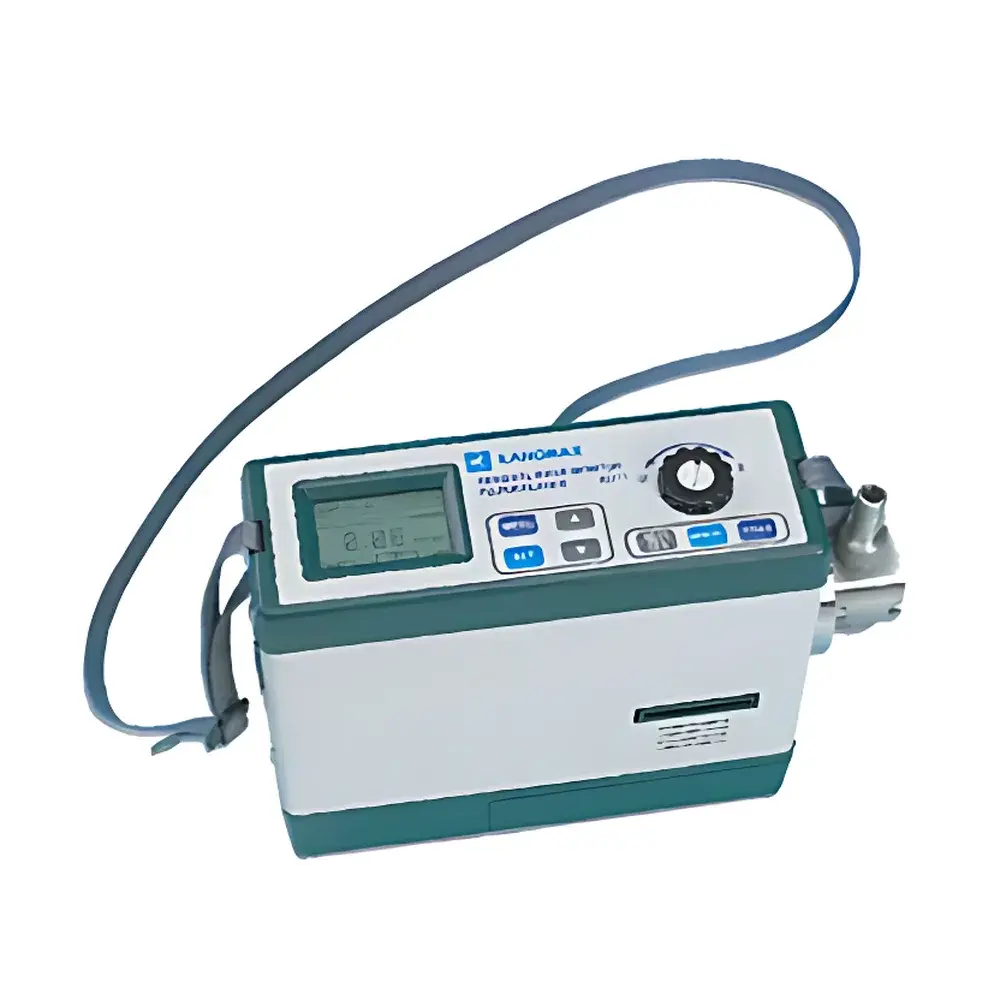
Kanomax KD11 Piezoelectric Microbalance Dust Monitor
| Brand | Kanomax |
|---|---|
| Origin | Japan |
| Model | KD11 |
| Operating Principle | Tapered Element Oscillating Microbalance (TEOM™-style piezoelectric resonant frequency shift) |
| Measurement Range | 0.01–10.00 mg/m³ |
| Resolution | 0.01 mg/m³ |
| Accuracy | ±10% of reading |
| Relative Error | ≤±2% |
| Particle Size Range | 0.1–10 µm (PM₁₀ mode) |
| Sample Flow Rate | 1.0 L/min |
| Data Storage Capacity | 500 measurement records |
| Communication Interface | RS-232C |
| Power Supply | Rechargeable Ni-MH battery or AC adapter (100–240 V AC) |
| Battery Life | ~4.5 hours continuous operation |
| Charging Time | 5–8 hours |
| Dimensions | 65 × 182 × 150 mm (W × L × H) |
| Weight | ~1.75 kg |
| Safety Classification | Non-explosion-proof |
| Compliance | Designed for occupational hygiene and environmental monitoring per ISO 7708, ISO/IEC 17025-aligned operational practices, and compatible with OSHA/NIOSH PM sampling protocols |
Overview
The Kanomax KD11 Piezoelectric Microbalance Dust Monitor is a portable, real-time mass concentration analyzer engineered for precise, field-deployable assessment of airborne particulate matter in occupational and ambient environments. It operates on the tapered element oscillating microbalance (TEOM™-principle variant), utilizing a high-stability quartz crystal oscillator whose resonant frequency decreases linearly with mass accumulation on its surface. This frequency shift—measured in Hz—is converted directly into mass concentration (mg/m³) using a calibrated sensitivity factor of 0.005 µg/Hz. Unlike optical or beta-attenuation methods, the KD11 provides gravimetrically traceable, real-time mass readings without reliance on particle optical properties or density assumptions. Its design targets compliance with international standards for respirable dust monitoring—including ISO 7708 (airborne particles definitions), ISO/IEC 17025-relevant measurement traceability frameworks, and U.S. NIOSH/OSHA method requirements for PM₁₀ and PM₂.₅ assessment in workplace air quality management.
Key Features
- Real-time gravimetric measurement via piezoelectric resonant frequency shift, eliminating dependence on particle refractive index or shape assumptions
- Dual-mode particle size selectivity: configurable inlet cyclones enable dedicated PM₁₀ (0.1–10 µm) and PM₂.₅ (0.1–2.5 µm) monitoring
- High-resolution display showing instantaneous mass concentration in mg/m³ with 0.01 mg/m³ resolution
- Flexible sampling duration: preset 24 s and 120 s modes; user-defined intervals from 10 s to 3600 s (1 h)
- Onboard memory stores up to 500 timestamped measurement records with date/time stamping and sampling duration metadata
- Integrated Ni-MH rechargeable battery supports ~4.5 hours of continuous operation; full charge in 5–8 hours
- Compact ergonomic form factor (65 × 182 × 150 mm) and lightweight construction (~1.75 kg) optimized for handheld use in confined or mobile survey applications
- Automatic crystal contamination alert: system monitors frequency drift trends and prompts operator-initiated cleaning when mass loading approaches sensor saturation limits
Sample Compatibility & Compliance
The KD11 is validated for use with ambient and indoor air containing non-volatile, non-reactive aerosols—including mineral dusts, metal fumes, carbonaceous soot, and processed powders typical in manufacturing, pharmaceutical cleanrooms, electronics assembly, and food production facilities. It is not intended for volatile organic compound (VOC)-laden or highly hygroscopic aerosols where evaporation or condensation may occur during sampling. The instrument complies with Japanese Industrial Standards (JIS) B 7990 for dust monitoring equipment and aligns with ISO 7708:1995 definitions of inhalable, thoracic, and respirable fractions. While not certified for intrinsic safety (non-explosion-proof classification), it meets CE marking requirements for electromagnetic compatibility (EMC Directive 2014/30/EU) and low-voltage safety (LVD Directive 2014/35/EU). Data acquisition workflows support GLP-aligned documentation practices, including audit-ready timestamping and operator ID logging when paired with Kanomax-provided RS-232C communication software.
Software & Data Management
The KD11 interfaces via standard RS-232C serial port with Kanomax’s proprietary PC-based data management software (Windows-compatible, no driver installation required). This application enables bidirectional communication: downloading stored datasets (including sampling start time, duration, measured concentration, and unit status flags), exporting CSV or Excel-formatted reports, generating time-series plots, and printing calibration-certified summary sheets. All exported files retain embedded metadata required for laboratory information management systems (LIMS) integration. The software supports batch export and basic statistical analysis (mean, min/max, standard deviation per session). While the device itself does not implement FDA 21 CFR Part 11 electronic signature or audit trail functionality, its data structure and export protocol are compatible with third-party LIMS platforms that enforce such regulatory controls.
Applications
- Occupational health surveillance: real-time evaluation of worker exposure during grinding, sanding, welding, or powder handling operations
- Cleanroom and controlled environment validation: rapid verification of HVAC filtration efficiency and particulate ingress in ISO Class 5–8 spaces
- Pharmaceutical manufacturing: monitoring of active pharmaceutical ingredient (API) handling areas and tablet compression suites per ICH Q5A and EU GMP Annex 1 guidance
- Electronics fabrication: detection of solder flux residues, silicon wafer polishing dust, and die-attach particulates
- Research laboratories: kinetic studies of aerosol deposition, filter efficiency testing, and source characterization experiments
- Environmental baseline surveys: short-term PM₂.₅/PM₁₀ mapping in urban, industrial, or construction-adjacent zones
FAQ
What particle size fractions does the KD11 measure?
The KD11 measures total suspended particulate mass within two selectable aerodynamic diameter ranges: 0.1–10 µm (PM₁₀ mode) and 0.1–2.5 µm (PM₂.₅ mode), achieved through interchangeable impactor inlets.
Is the KD11 suitable for outdoor ambient air monitoring?
Yes—when used with appropriate weather protection and temperature stabilization (e.g., shaded mounting or portable enclosure), it delivers reliable short-term (<1 hr) ambient PM assessments; however, long-term unattended deployment requires external power and environmental conditioning.
How often must the quartz crystal be cleaned?
Cleaning frequency depends on ambient dust load; the instrument triggers an audible and visual alert when accumulated mass approaches the sensor’s dynamic range limit—typically after 1–3 days in high-dust environments or weekly under typical office/industrial conditions.
Does the KD11 require periodic factory calibration?
Yes—Kanomax recommends annual recalibration against NIST-traceable gravimetric standards to maintain ±10% accuracy; field verification using zero-air and reference aerosol challenges is advised before each critical measurement campaign.
Can the KD11 be integrated into a building management system (BMS)?
Not natively—the RS-232C interface supports point-to-point PC connection only; integration with BMS requires a third-party serial-to-Modbus or serial-to-BACnet gateway with custom protocol mapping.







