
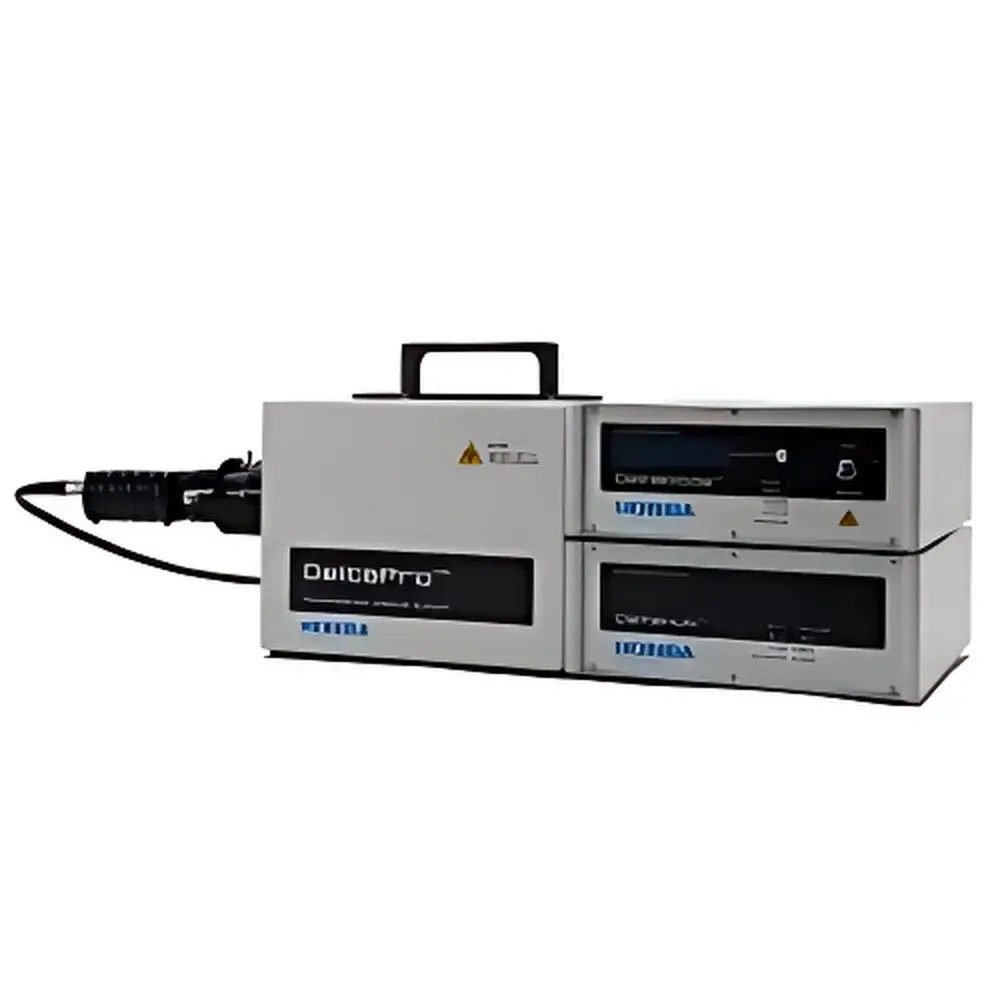
HORIBA Scientific DeltaPro High-Precision Fluorescence Lifetime Spectrometer
| Brand | HORIBA |
|---|---|
| Origin | United Kingdom |
| Model | DeltaPro |
| Dispersion Element | Grating |
| Excitation Sources | NanoLED (up to 1 MHz), DeltaDiode (up to 100 MHz), SpectraLED (for phosphorescence, multi-wavelength) |
| Lifetime Range | 25 ps to >1 s |
| Detection Module | PPD photon counting detector (standard), optional NIR extension to ~1700 nm |
| Data Acquisition | Time-Correlated Single Photon Counting (TCSPC) with DeltaHub core (dead time: 10 ns) |
| Software Control | F-Link USB 2.0 interface, no PCI card required |
| Sample Compatibility | Liquid cuvettes (with temperature control & stirring), solid sample holders, large UV-grade sample chamber |
| Optional Accessories | Monochromators, motorized polarizers, automated optical components, PPD-850C/PPD-900C IR modules |
Overview
The HORIBA Scientific DeltaPro is a modular, high-precision time-correlated single photon counting (TCSPC) fluorescence lifetime spectrometer engineered for quantitative photophysical characterization across ultrafast to long-lived decay regimes. Designed around the proprietary DeltaHub timing electronics—featuring a 10 ns dead time and synchronized operation with high-repetition-rate pulsed excitation sources—the system delivers high temporal resolution without photon loss or pile-up distortion. Unlike conventional analog or gated detection methods, DeltaPro leverages digital TCSPC architecture to directly record arrival times of individual photons relative to laser pulses, enabling rigorous exponential decay analysis with statistical confidence. Its architecture supports both steady-state and time-resolved fluorescence, as well as phosphorescence lifetimes, making it suitable for applications ranging from molecular dynamics in solution to defect-state analysis in solid-state materials.
Key Features
- DeltaHub timing module: 10 ns dead time, <10 ps timing jitter, fully integrated with excitation and detection channels
- Three excitation source options: NanoLED (1 MHz repetition rate, 25 ps–10 µs range), DeltaDiode (100 MHz, same range), and SpectraLED (multi-wavelength, 1 µs–>1 s range for phosphorescence)
- PPD (Photon-Counting Photomultiplier Detector) standard configuration; optional NIR extension via PPD-850C or PPD-900C modules for detection up to ~1700 nm
- F-Link USB 2.0 interface enables full system control—including source selection, delay scanning, and detector gating—without internal PC hardware modifications
- Modular optical path: filter-based wavelength selection (with optional monochromator integration), motorized polarizers, and UV-grade optics housed in a large, accessible sample chamber
- Standard liquid sample holder with integrated Pt100 temperature sensor and magnetic stirring; compatible with solid-sample stages and cryostat interfaces
- No hardware calibration required for timing accuracy—system maintains intrinsic picosecond-level fidelity across lifetime ranges
Sample Compatibility & Compliance
DeltaPro accommodates diverse sample formats including quartz cuvettes (10 mm path length), thin-film substrates, powders, and optically dense suspensions. The large sample compartment allows integration with external environmental chambers (e.g., variable-temperature cryostats or gas-controlled enclosures). All optical components meet UV-grade transmission specifications (185–2000 nm), ensuring minimal spectral distortion. The system operates in full compliance with ISO/IEC 17025 traceability requirements for photometric timing measurements and supports audit-ready data logging per GLP and GMP guidelines. Export-controlled firmware versions include full electronic record retention, user access logs, and FDA 21 CFR Part 11–compliant electronic signatures when paired with validated software configurations.
Software & Data Management
Data acquisition and analysis are performed using HORIBA’s FluoroHub software suite—a platform built on a deterministic real-time kernel for synchronized hardware control and low-latency histogramming. Raw TCSPC datasets (.ptu format) are stored with embedded metadata (excitation wavelength, detector bias, temperature, polarization angle, etc.) and support batch processing via Python API. Decay fitting employs non-linear least-squares algorithms with χ² minimization, offering global analysis across multiple wavelengths or conditions. Built-in models include discrete exponentials, distributed lifetime distributions (e.g., stretched exponentials), and Förster resonance energy transfer (FRET) convolutions. Export formats include ASCII, HDF5, and vendor-neutral .jdx for third-party spectral libraries.
Applications
- Ultrafast solvation dynamics and excited-state proton transfer in organic fluorophores
- Conformational heterogeneity in proteins and nucleic acids via time-resolved anisotropy
- Quantum yield and triplet-state kinetics in OLED emitters and photocatalysts
- Defect-related luminescence lifetimes in perovskites, quantum dots, and wide-bandgap semiconductors
- Binding affinity and stoichiometry determination in ligand-receptor interactions using fluorescence lifetime immunoassays (FLIMIA)
- Photostability assessment under accelerated irradiation protocols per ICH Q5C guidelines
FAQ
What lifetime ranges does DeltaPro support, and how are they determined by excitation source?
DeltaPro achieves 25 ps–10 µs with NanoLED or DeltaDiode sources, and 1 µs–>1 s with SpectraLED. The upper limit is governed by detector dark count rate and acquisition time window; the lower limit is constrained by instrument response function (IRF) width and timing jitter.
Is the system compatible with existing HORIBA spectrofluorometers?
Yes—DeltaPro integrates seamlessly with FluoroLog® and QuantaMaster® platforms via F-Link, enabling hybrid steady-state/time-resolved experiments without signal path reconfiguration.
Can DeltaPro perform anisotropy decay measurements?
Yes—motorized polarizers and dual-channel PPD detection allow simultaneous parallel/perpendicular acquisition for time-resolved fluorescence anisotropy (TRFA) without manual alignment.
Does the software support batch analysis of multi-sample lifetime datasets?
Yes—FluoroHub includes scriptable workflows for automated fitting, parameter mapping, and statistical comparison across hundreds of decay curves.
What validation documentation is provided for regulated environments?
HORIBA supplies IQ/OQ documentation packages, traceable calibration certificates for timing electronics and detector quantum efficiency, and software validation reports compliant with ASTM E2500 and ISO 13485 frameworks.





