
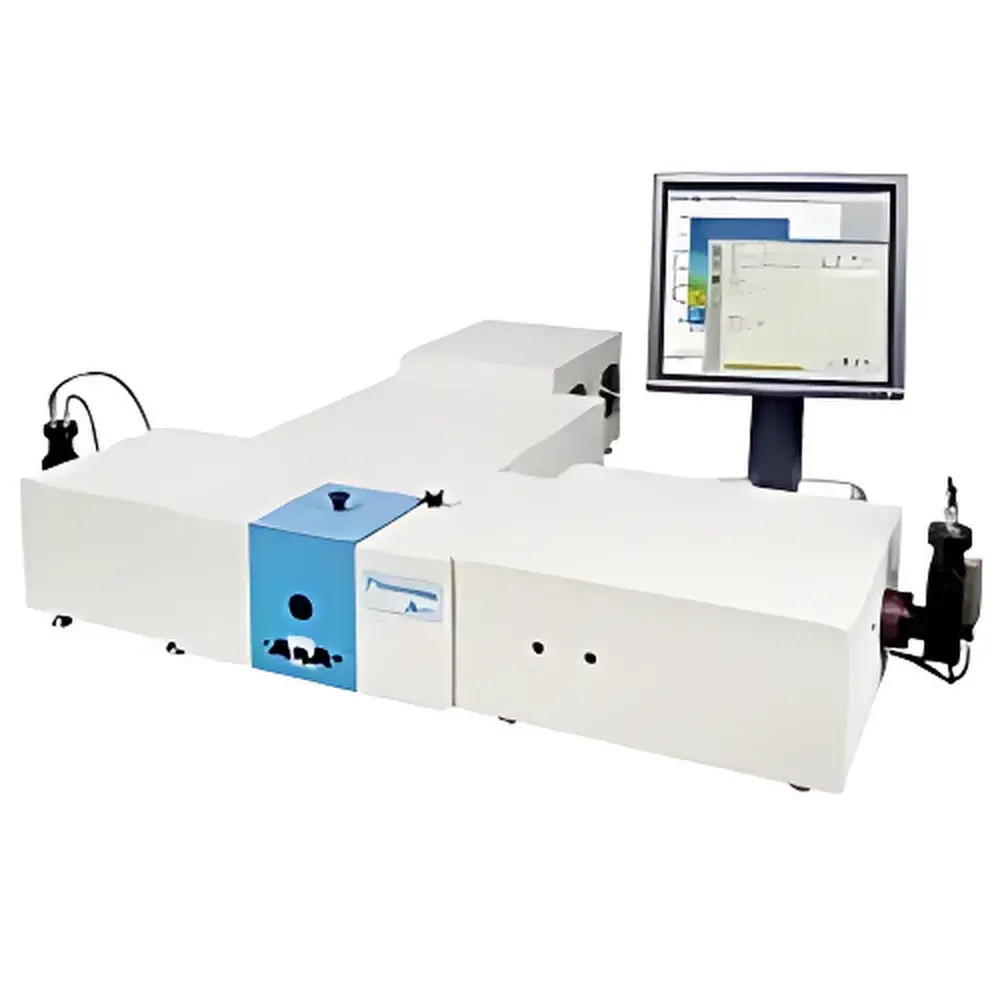
HORIBA Scientific Fluorolog-3 Modular Steady-State and Time-Resolved Fluorescence Spectrometer
| Brand | HORIBA |
|---|---|
| Origin | USA |
| Model | Fluorolog-3 |
| Wavelength Range (Optional) | 185 nm – 14 µm |
| Excitation/Emission Monochromators | Single or Dual Grating |
| Slit Width (Spectral Bandpass) | 0–20 nm |
| Optical Resolution | 0.06 nm |
| Sensitivity | 20,000:1 (Signal-to-Noise Ratio) |
| Wavelength Accuracy | ±0.2 nm |
| Light Source | 450 W Xenon Arc Lamp |
| Detection Method | Photon Counting |
| Data Acquisition | TCSPC (Time-Correlated Single Photon Counting) for Lifetime Measurements |
Overview
The HORIBA Scientific Fluorolog-3 is a high-performance, fully modular fluorescence spectrometer engineered for rigorous academic, pharmaceutical, and industrial research environments. Built upon the legacy of Jobin Yvon optical design excellence, it implements dual-grating monochromators (excitation and emission), photon-counting detection, and TCSPC-based time-resolved capability—enabling simultaneous steady-state intensity, anisotropy, and nanosecond-to-microsecond fluorescence lifetime measurements. Its T-shaped sample compartment accommodates diverse geometries—including cuvettes, solid substrates, fiber-coupled probes, and cryogenic dewars—while maintaining optical alignment integrity across configurations. The system operates across an extended spectral range (185 nm to 14 µm, with detector-dependent coverage), supporting UV-Vis-NIR fluorescence, phosphorescence, and delayed luminescence studies under controlled temperature, polarization, or kinetic sampling conditions.
Key Features
- Modular Architecture: Interchangeable excitation/emission monochromators (single or dual grating), detector modules (PMT, NIR InGaAs, liquid-nitrogen-cooled CCD), and light sources (Xe arc, pulsed lasers, supercontinuum) allow configuration-specific optimization without hardware re-engineering.
- High Spectral Fidelity: 0.06 nm resolution and ±0.2 nm wavelength accuracy meet ISO 17025 traceability requirements for quantitative spectral analysis; slit width continuously adjustable from 0 to 20 nm supports dynamic signal-to-noise balancing.
- Photon-Counting Detection: Achieves detection limits down to 50 fM fluorescein (in standard 1 cm quartz cuvette), with >20,000:1 S/N ratio enabling low-concentration, low-quantum-yield, or scattering-prone samples (e.g., turbid biological media).
- Automated Calibration & Workflow: Onboard wavelength and sensitivity calibration routines eliminate manual alignment drift; pre-stored methods support GLP-compliant batch processing with audit-trail logging compliant with FDA 21 CFR Part 11.
- TCSPC Lifetime Engine: Integrated time-correlated single-photon counting module provides <10 ps instrument response function (IRF) resolution, supporting multi-exponential decay fitting and global analysis of complex photophysical systems.
- Thermal & Mechanical Stability: Precision-machined aluminum frame with passive thermal management ensures sub-pixel spectral registration over 8+ hour acquisitions—critical for long-term kinetics or temperature-ramped experiments.
Sample Compatibility & Compliance
The Fluorolog-3 interfaces with a broad spectrum of sample formats and environmental controls. Standard configurations support 10 mm pathlength cuvettes, while optional accessories enable microvolume (1–250 µL) capillary cells, HPLC flow cells, cryostats (77 K via liquid nitrogen Dewar), Peltier-controlled stages (±0.1 °C stability), and motorized polarizers for dynamic anisotropy. Solid-sample analysis is facilitated by integrating spheres (for absolute quantum yield), microscope coupling optics (for µm-scale spatial resolution), and fiber-optic probes for remote or in-situ measurement (e.g., reactor monitoring). All mechanical and electrical subsystems conform to IEC 61010-1 safety standards; software architecture supports 21 CFR Part 11 electronic signatures and ALCOA+ data integrity principles. System validation documentation aligns with ASTM E275, ISO 12099, and USP for fluorescence-based assay development.
Software & Data Management
HORIBA’s FluoroLogic™ software provides unified control of acquisition, real-time visualization, and advanced post-processing. It natively supports multi-dimensional data sets (λex/λem/time/temperature/polarization), with built-in algorithms for lifetime deconvolution (reconvolution, iterative reweighted least squares), Förster resonance energy transfer (FRET) efficiency mapping, and rotational correlation time calculation. Raw data is stored in HDF5 format with embedded metadata (instrument settings, calibration history, user annotations), ensuring FAIR (Findable, Accessible, Interoperable, Reusable) compliance. Export modules generate CSV, ASCII, and JCAMP-DX files compatible with third-party analysis platforms (MATLAB, Origin, Python SciPy). Audit trails record all parameter changes, user logins, and data exports—fully configurable for GMP/GLP-regulated laboratories.
Applications
- Molecular dynamics studies: protein folding/unfolding kinetics, ligand binding stoichiometry, conformational heterogeneity via time-resolved anisotropy.
- Energy/electron transfer mechanisms: exciton migration in organic semiconductors, charge separation in photocatalysts, triplet–triplet annihilation in OLED materials.
- Biomedical probe development: ratiometric pH/ions sensors, environment-sensitive dyes, nanoparticle–biomolecule interaction thermodynamics.
- Materials characterization: quantum dot surface trap states, perovskite defect passivation, polymer blend phase segregation via lifetime imaging.
- Chemical kinetics: stopped-flow fluorescence, photoinduced electron transfer rates, excited-state proton transfer (ESPT) pathways.
- Regulatory testing: USP quantum yield verification, EP 2.2.25 fluorescence impurity profiling, ICH Q5C stability-indicating assays.
FAQ
What lifetime resolution can the Fluorolog-3 achieve with TCSPC?
The system delivers an instrument response function (IRF) of <10 ps using optimized PMT detectors and fast timing electronics—enabling reliable resolution of sub-nanosecond decays and multi-exponential fitting with χ² ≈ 1.0.
Is the Fluorolog-3 compatible with fiber-optic remote sensing?
Yes—standard SMA905 or FC/PC fiber interfaces support both excitation delivery and emission collection; optional multi-core fiber bundles enable spatially resolved spectroscopy or endoscopic applications.
Can the software comply with FDA 21 CFR Part 11 requirements?
FluoroLogic™ includes role-based access control, electronic signatures, automated audit trails, and data encryption—validated for use in regulated environments requiring full Part 11 compliance.
How does the dual-grating monochromator improve stray light rejection?
Dual-grating designs provide >6 orders of magnitude stray light suppression versus single-grating systems—critical for Raman-scattering background rejection and low-level phosphorescence detection in the visible/NIR.
What cryogenic options are available for low-temperature fluorescence studies?
The system integrates seamlessly with liquid nitrogen Dewars (77 K), closed-cycle helium cryostats (4–300 K), and variable-temperature optical cryostats with magnetic field compatibility (up to 9 T).
Related Products




