
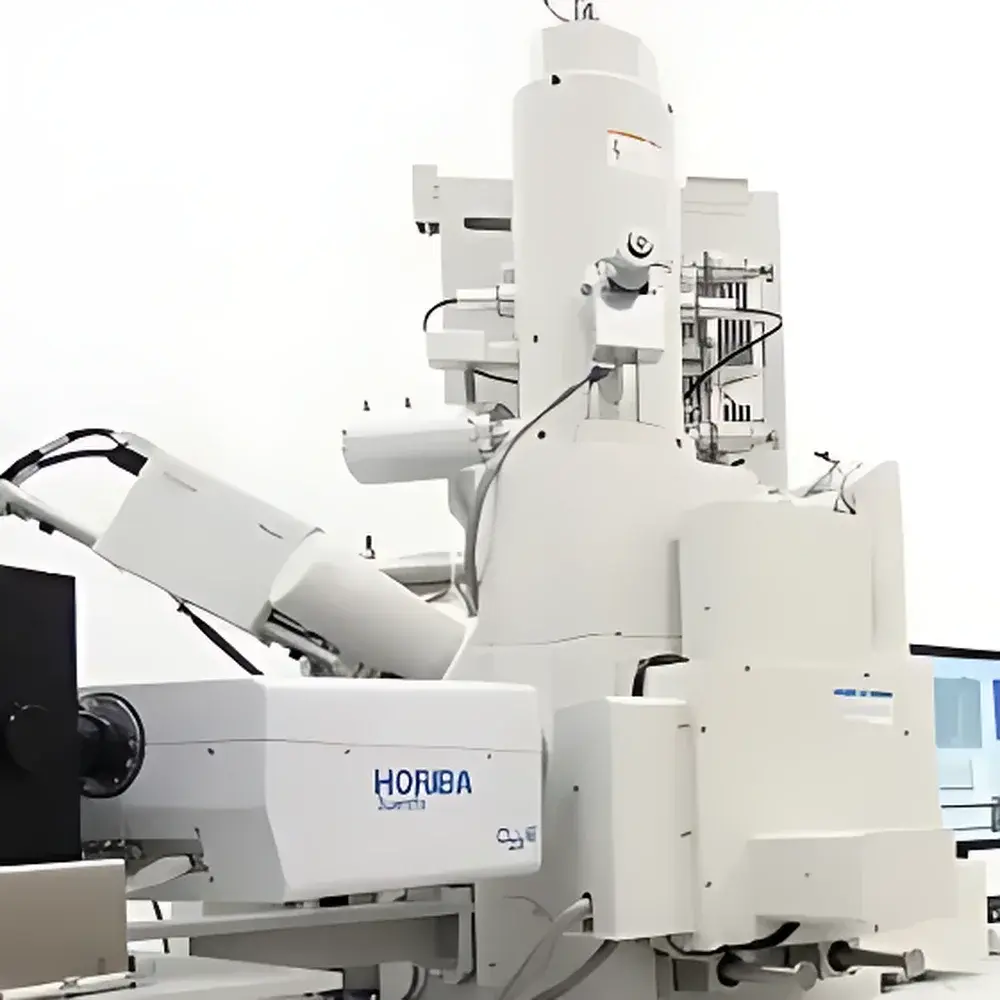
HORIBA Jobin Yvon HCLUE High-Efficiency Cathodoluminescence Spectrometer
| Brand | HORIBA |
|---|---|
| Origin | France |
| Model | HCLUE |
| Spectral Range (with dual detectors) | 185–2500 nm |
| Coupling Method | Mirror-based direct coupling |
| Detector Configuration | Dual-detector compatible |
| Spectrometer Focal Length Options | 320 mm, 500 mm, 550 mm |
| Grating Options | Multiple selectable gratings |
| Measurement Modes | Point spectrum, line scan, hyperspectral mapping |
| Compliance | Designed for integration with SEM/FIB platforms per ISO 16700 (electron probe microanalysis) and ASTM E1508 (quantitative cathodoluminescence) |
Overview
The HORIBA Jobin Yvon HCLUE is a high-efficiency cathodoluminescence (CL) spectrometer engineered for quantitative, spatially resolved optical spectroscopy under electron beam excitation. It operates on the fundamental principle of cathodoluminescence—where incident electrons from a scanning or transmission electron microscope (SEM/TEM/FIB) induce radiative recombination in luminescent materials, emitting photons whose energy distribution reflects local electronic structure, defect states, impurity concentrations, and compositional variations. Unlike conventional photoluminescence techniques, CL provides sub-10 nm spatial resolution when integrated with high-resolution electron optics, enabling correlative analysis of nanoscale morphology and optical response. The HCLUE system employs a mirror-based direct optical coupling architecture to maximize photon collection efficiency—critical for low-yield emitters such as wide-bandgap semiconductors, insulating oxides, and geological minerals. Its modular design allows seamless integration into both field-emission and thermionic SEM platforms, supporting vacuum-compatible operation without signal degradation from fiber losses or alignment drift.
Key Features
- Mirror-coupled optical path: Eliminates fiber transmission losses and preserves étendue, delivering up to 3× higher throughput versus lens- or fiber-coupled alternatives.
- High-sensitivity spectral detection: Based on HORIBA’s iHR series imaging spectrometers (320 mm, 500 mm, or 550 mm focal length), optimized for stray-light suppression and thermal stability.
- Dual-detector capability: Simultaneous UV–VIS (185–1000 nm) and NIR (900–2500 nm) coverage using back-illuminated CCD and InGaAs array detectors—enabling full-band spectral acquisition without mechanical reconfiguration.
- Multi-grating turret: Supports rapid switching between dispersion configurations (e.g., 150–3600 grooves/mm) to balance resolution (down to 0.05 nm @ 500 nm) and throughput across diverse sample types.
- Acquisition flexibility: Native support for point spectroscopy, linear spectral profiling, and hyperspectral CL mapping (up to 1024 × 1024 pixel spectral cubes) synchronized with SEM scan generators.
- SWIFT™ ultrafast imaging mode: Enables real-time spectral acquisition at >100 fps per pixel line, reducing total mapping time by >70% compared to conventional dwell-based methods.
Sample Compatibility & Compliance
The HCLUE system is compatible with electrically conductive and non-conductive solid-state samples—including bulk crystals, thin films, nanostructures, polished mineral sections, and biological mineralized tissues—provided they exhibit measurable CL emission under 1–30 kV electron acceleration. Sample preparation follows standard SEM protocols: carbon or Au/Pd sputter coating may be applied to insulators to prevent charging, though uncoated analysis is feasible for many oxide and nitride systems. The instrument complies with ISO 16700:2016 (guidelines for quantitative CL analysis in electron microscopy) and supports GLP/GMP-aligned workflows through hardware timestamping, detector gain calibration logs, and metadata embedding (including kV, probe current, working distance, and stage coordinates). All spectral data files conform to HDF5 format with embedded NIST-traceable wavelength calibration references.
Software & Data Management
Control and analysis are performed via HORIBA’s LabSpec 6 CL Edition—a dedicated module extending the industry-standard LabSpec platform with CL-specific tools. Key capabilities include real-time spectral preview during acquisition, automatic background subtraction using polynomial or morphological filtering, peak deconvolution with Voigt or Gaussian fitting, RGB pseudo-color mapping of selected emission bands, and export to common formats (ASCII, CSV, TIFF, CDF). The software supports 21 CFR Part 11-compliant audit trails when deployed on validated Windows OS environments, including user authentication, electronic signatures, and immutable acquisition parameter logging. Raw hyperspectral datasets (>10 GB typical) are managed via integrated data compression and ROI-based extraction to streamline downstream analysis in MATLAB, Python (using PySPM or HyperSpy), or commercial packages like ENVI.
Applications
- Semiconductor & optoelectronics: Quantification of dislocation-related DAP emissions in GaN, ZnO, and SiC; identification of dopant activation sites in quantum wells; strain mapping via phonon-sideband shifts.
- Geosciences & mineralogy: Discrimination of carbonate polymorphs (calcite vs. dolomite), U–Pb geochronology in zircon via radiation-damage CL zoning, and trace-element fingerprinting in diamond inclusion studies.
- Advanced ceramics & dielectrics: Defect-state analysis in Al₂O₃, YAG, and h-BN; grain-boundary luminescence heterogeneity in polycrystalline oxides.
- Forensic materials science: Differentiation of synthetic vs. natural gemstones, identification of pigment aging mechanisms in historical artifacts, and microstructural attribution of glass fragments.
- Life sciences: Mapping biomineralization pathways in bone, teeth, and otoliths; correlating calcification stages with local Ca/P ratio via CL intensity ratios.
FAQ
What electron microscopes is the HCLUE compatible with?
The HCLUE is designed for integration with JEOL, Thermo Fisher Scientific (FEI), Zeiss, and Hitachi SEM/FIB platforms. Custom flange adapters and differential pumping solutions are available for UHV TEM-CL configurations.
Can the system operate in variable pressure or ESEM modes?
Yes—when equipped with a differential pumping stage and vacuum-compatible mirror housing, the HCLUE maintains optical performance at chamber pressures up to 100 Pa.
Is spectral calibration traceable to NIST standards?
All grating calibrations are performed using Hg/Ar/Ne lamp lines referenced to NIST SRM 2036, with certificate-of-calibration provided per installation.
How is spatial resolution determined in CL mapping?
Effective resolution is governed by electron beam spot size, scattering volume in the sample, and optical collection geometry—not by the spectrometer itself. Sub-5 nm resolution is routinely achieved on crystalline GaN using 1 kV landing energy and low-current probes.
Does HORIBA provide application support for method development?
Yes—dedicated CL application scientists offer remote and on-site assistance for experimental design, spectral interpretation, and compliance documentation, including SOP generation for regulated laboratories.





