
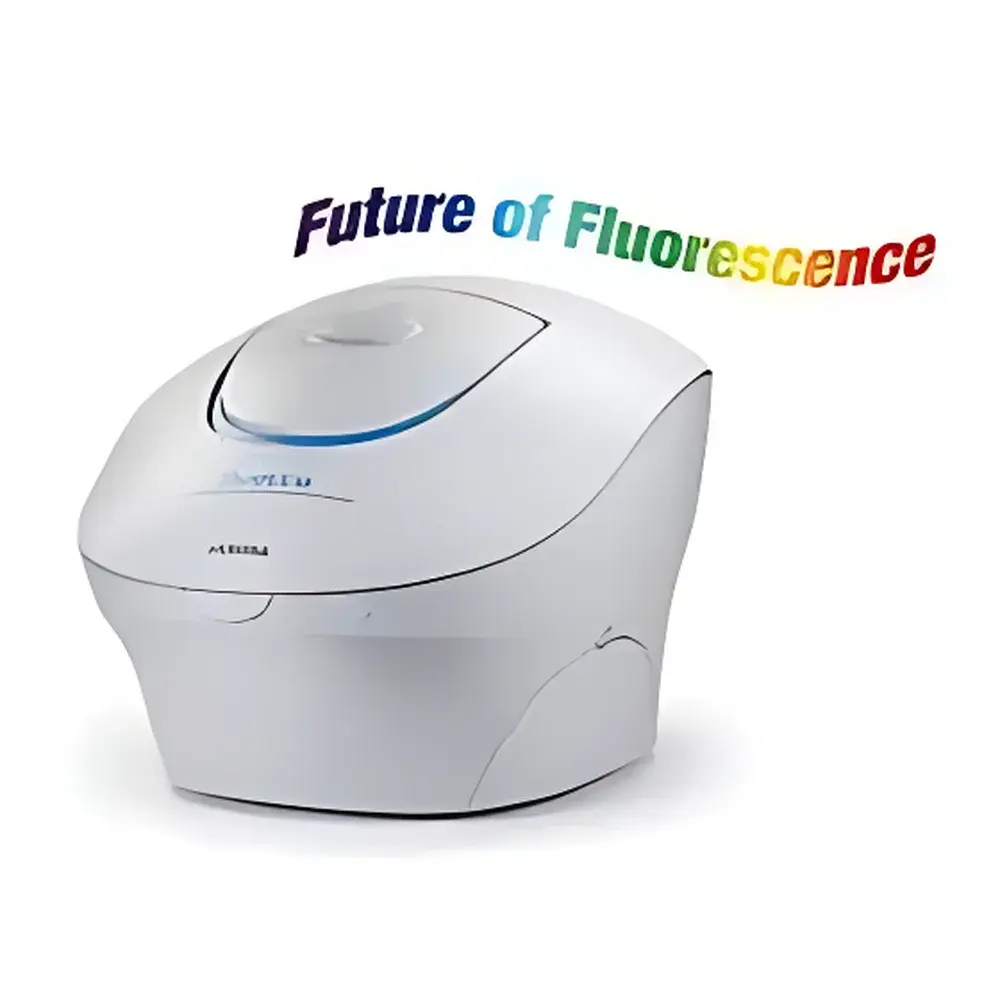
HORIBA Duetta Dual-Mode Fluorescence and Absorption Spectrometer
| Brand | HORIBA |
|---|---|
| Origin | USA |
| Model | Duetta |
| Wavelength Range (Fluorescence) | 250–1100 nm |
| Spectral Bandwidth (Slit) | 1–20 nm |
| Optical Resolution | 1 nm |
| Sensitivity (Water Raman RMS) | 6000:1 |
| Wavelength Accuracy | ±1 nm |
| Dispersion Element | Grating |
| Detector | CCD |
| Measurement Modes | Simultaneous Fluorescence & Absorbance |
| A-TEEM™ Capability | Yes |
| Auto Inner-Filter Correction | Yes |
Overview
The HORIBA Duetta Dual-Mode Fluorescence and Absorption Spectrometer is an engineered solution for concurrent molecular characterization via fluorescence emission, excitation, and UV-Vis-NIR absorbance spectroscopy. Unlike conventional sequential instruments, the Duetta employs a single optical platform with a high-throughput Czerny–Turner monochromator and back-illuminated CCD detector to acquire full two-dimensional fluorescence spectra (excitation vs. emission) and absorbance spectra in a single measurement cycle—without mechanical reconfiguration or detector switching. Its core architecture leverages dual-beam referencing and real-time inner-filter effect correction, enabling quantitative analysis of complex, absorbing, or scattering samples—including biological fluids, humic substances, pharmaceutical formulations, and nanomaterial dispersions. Designed for laboratories requiring compliance with method validation frameworks (e.g., ICH Q2(R2), USP <857>, ASTM E275), the Duetta delivers traceable, reproducible spectral data across the 250–1100 nm range—extending beyond standard PMT-based fluorometers limited to ~850 nm.
Key Features
- Simultaneous acquisition of corrected fluorescence and absorbance spectra within ≤100 ms per scan—enabled by a thermoelectrically cooled, low-noise CCD array with >95% quantum efficiency at 600 nm
- A-TEEM™ (Absorbance-Transmittance Excitation-Emission Matrix) fingerprinting: generates high-fidelity, chemometric-ready 3D datasets that resolve overlapping fluorophores and correct for inner-filter artifacts without user intervention
- Automated wavelength calibration using internal Hg/Ar reference lines; drift compensation ensures long-term stability (±0.1 nm over 8 h)
- Variable slit width (1–20 nm) for dynamic control of spectral bandwidth and signal-to-noise ratio—optimized for both high-resolution mapping and high-sensitivity screening
- Optical resolution of 1 nm (FWHM) across the full UV-Vis-NIR range, validated per ISO 17025-accredited procedures using NIST-traceable holmium oxide and didymium filters
- Integrated dual-beam optics with real-time reference channel monitoring, minimizing baseline drift during kinetic or temperature-controlled experiments
Sample Compatibility & Compliance
The Duetta accommodates standard 1 cm quartz cuvettes (including microvolume and stopped-flow configurations), capillary cells, and fiber-optic probes for non-invasive or in-situ measurements. It supports liquid, colloidal, and semi-transparent solid samples—with automatic pathlength normalization and scatter correction algorithms compliant with ASTM D5542 (fluorescent dissolved organic matter) and EPA Method 445.0 (blue-green algae quantification). Instrument firmware and EzSpec™ software are designed to meet GLP/GMP documentation requirements, including full audit trails, electronic signatures (21 CFR Part 11 ready), and IQ/OQ/PQ protocol templates. All spectral metadata—including lamp intensity, grating position, slit settings, and detector gain—are embedded in exported .spc and .csv files for regulatory traceability.
Software & Data Management
EzSpec™ is a touch-optimized, Windows-based application supporting intuitive gesture-driven operation on integrated or external displays. It provides real-time preview of excitation-emission matrices (EEMs), overlay comparison of up to 16 spectra, and built-in chemometric tools (PARAFAC, PCA, cluster analysis) for multivariate interpretation. Raw data are stored in vendor-neutral HDF5 format with embedded calibration history and instrument configuration logs. The software includes export modules for MATLAB, Python (via PyHDF), and LIMS integration via ASTM E1384-compliant XML schema. Optional modules include kinetic assay builder, temperature ramp control (with Peltier accessory), and pharmacopeial compliance packs (USP <185>, EP 2.2.25).
Applications
- Environmental analysis: Quantification of CDOM (colored dissolved organic matter), PAHs, and microplastic leachates in natural waters using A-TEEM™ fingerprint libraries
- Biopharmaceutical development: Higher-order structure assessment of monoclonal antibodies via intrinsic tryptophan fluorescence, coupled with secondary absorbance-based concentration determination
- Food authenticity: Discrimination of botanical adulterants in olive oil, honey, or wine using EEM pattern recognition and supervised machine learning models
- Nanomaterial characterization: Real-time monitoring of quantum dot surface ligand exchange kinetics through synchronous fluorescence shift tracking
- Academic research: Time-resolved studies of photoinduced electron transfer in donor–acceptor systems using multi-wavelength detection and global decay analysis
FAQ
Can the Duetta perform time-resolved fluorescence measurements?
No—the Duetta is optimized for steady-state and synchronous scanning; time-resolved applications require pulsed laser excitation and TCSPC hardware not integrated into this platform.
Is the CCD detector nitrogen-cooled?
No—it uses thermoelectric (Peltier) cooling to –15 °C, sufficient for low-dark-current operation across the specified spectral range without cryogenic infrastructure.
Does the system support fiber-optic coupling for remote sampling?
Yes—optional SMA-905 fiber interfaces enable measurements in hazardous, confined, or high-temperature environments while maintaining spectral fidelity.
How is absorbance accuracy validated across the NIR range?
Using NIST SRM 2036 (neutral density filters) and certified holmium oxide solutions, with linearity verified to ±0.002 AU from 250 to 1100 nm per ISO 9001-certified calibration reports.
Can A-TEEM™ data be imported into third-party chemometrics software?
Yes—exported EEMs retain full wavelength-axis metadata and are natively readable by MATLAB, R (with drLUM package), and commercial tools such as Unscrambler X and SIMCA.





