
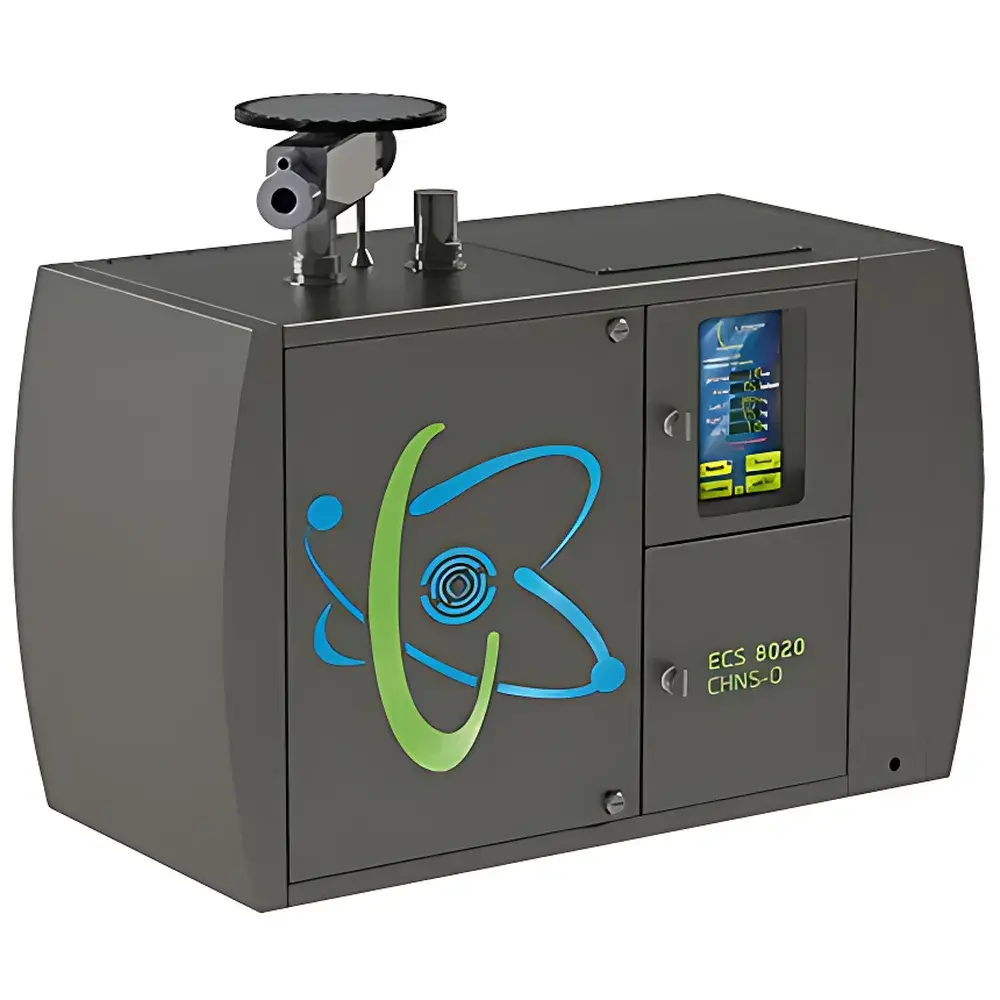
NC Technologies ECS 8020 CHNSO Elemental Analyzer
| Brand | NC Technologies |
|---|---|
| Origin | Italy |
| Model | ECS 8020 |
| Instrument Type | CHNSO Elemental Analyzer |
| Analysis Principle | Dumas Combustion Method |
| Measurable Elements | C, H, N, S, O |
| Sample Throughput | Up to 147 samples (pneumatic autosampler) |
| Analysis Time | C/N: 5 min |
| C/H/N | 8 min |
| C/H/N/S | 13–25 min |
| O | 4 min |
| Measurement Range | C: 0.002–20 mg |
| H | 0.002–5 mg |
| N | 0.002–2 mg |
| S | 0.002–6 mg |
| O | 0.002–2 mg |
| Accuracy | <0.2% (certified reference materials, purity >99.9%) |
| Precision | <0.1% RSD (certified reference materials, purity >99.9%) |
| Detection Sensitivity | <0.3% |
| Furnace Temperature | Dual-zone combustion furnace, up to 1100 °C per zone |
| Separation Oven Temp | Up to 110 °C |
| Carrier Gas | Helium (99.999%), 3–5 bar |
| Oxygen Supply | High-purity O₂ (99.999%), 3–5 bar |
| Auxiliary Gas | Oil-free compressed air |
| GC Column | 0.8–4 m packed capillary column |
| Detector | Self-calibrating high-sensitivity TCD |
| Software | EAS Clarity v5.x with linear, quadratic, and cubic calibration algorithms |
| Sample Form | Solid or liquid |
| Sample Mass | 0.1–500 mg (up to 1000 mg for soil matrices) |
| Sample Containers | High-purity tin or silver crucibles |
| Power Supply | 230 V, 50/60 Hz, 5 A, 1100 W |
| Dimensions | 81 × 50 × 37 cm |
| Weight | 68 kg |
Overview
The NC Technologies ECS 8020 CHNSO Elemental Analyzer is a high-performance, fully automated combustion-based instrument engineered for quantitative determination of carbon, hydrogen, nitrogen, sulfur, and oxygen in organic and inorganic solid and liquid samples. It operates on the validated Dumas combustion principle: samples are flash-combusted in a high-temperature dual-furnace system under controlled oxygen flow, converting elemental constituents into gaseous oxides (CO₂, H₂O, SO₂, NOₓ) and molecular nitrogen (N₂). These combustion products undergo precise separation via thermostatically regulated gas chromatography (GC) columns (0.8–4 m length), followed by detection using a self-calibrating thermal conductivity detector (TCD). Unlike conventional systems requiring external reference gases, the ECS 8020’s proprietary TCD maintains baseline stability and long-term drift compensation without calibration gas dependency—enhancing operational robustness and reducing consumable overhead.
Key Features
- Dual-zone combustion furnace with independent temperature control (up to 1100 °C per zone), enabling optimized thermal decomposition for diverse sample matrices including refractory organics and heterogeneous geological materials.
- Integrated pneumatic autosampler supporting up to 147 positions, complemented by optional electronic (32/50/100-position) and manual sampling modules—ensuring flexibility across throughput requirements and laboratory workflows.
- Intelligent oxygen dosing system that dynamically calculates and delivers stoichiometric O₂ volume based on sample mass and estimated composition, minimizing excess consumption and extending catalyst lifetime.
- Automated leak-check protocol and real-time gas-flow monitoring via electronic mass flow controllers, ensuring method reproducibility and compliance with ISO 17025 and ASTM D5291/D5623 validation frameworks.
- Self-diagnostic hardware architecture with status monitoring for critical consumables (e.g., CO₂ absorbent, water trap, catalyst beds), triggering user alerts prior to performance degradation.
- Modular interface design supporting direct coupling to isotope ratio mass spectrometers (IRMS) for δ¹³C, δ¹⁵N, δ³⁴S, and δ¹⁸O analysis—fully compatible with Thermo Scientific, Elementar, and IsoPrime platforms.
Sample Compatibility & Compliance
The ECS 8020 accommodates a broad spectrum of sample types: pharmaceutical intermediates, polymer additives, coal and coke, soils, sediments, biomass, foodstuffs, and catalyst supports. Sample mass ranges from 0.1 mg (microanalysis of precious compounds) to 1000 mg (high-moisture soils), with compatibility for both tin and silver crucibles depending on halogen or metal content. All analytical protocols adhere to internationally recognized standards—including ASTM D5291 (petroleum products), ASTM D5623 (sulfur in fuels), ISO 14852 (biodegradability testing), and USP (elemental impurities in drug substances). Data integrity is ensured through audit-trail-enabled software compliant with FDA 21 CFR Part 11 requirements for electronic records and signatures.
Software & Data Management
EAS Clarity v5.x provides a unified environment for method development, instrument control, peak integration, calibration modeling (linear, quadratic, cubic), and report generation. The software supports multi-point calibration curves with residual error mapping, outlier rejection algorithms, and batch processing with automatic QC flagging. All raw chromatograms, system logs, and user actions are timestamped and stored in encrypted SQLite databases. Export options include CSV, PDF, XML, and LIMS-ready formats (ASTM E1384, ANSI/NIST ITL 10-1). Remote diagnostics and firmware updates are facilitated via secure HTTPS-based connectivity, with role-based access control (administrator, analyst, reviewer) aligned with GLP/GMP operational governance.
Applications
The ECS 8020 serves as a core analytical platform across regulated and research-intensive domains. In pharmaceutical QA/QC, it verifies elemental composition of active pharmaceutical ingredients (APIs) per ICH Q5D guidelines. Environmental labs apply it to quantify total organic carbon (TOC) and nitrogen in wastewater sludge per EPA Method 440.1. Geological surveys rely on its oxygen determination capability for mineral stoichiometry and redox state assessment in oxide ores. Food safety laboratories use it to validate protein content (via nitrogen-to-protein conversion) and detect adulteration in dairy and cereal products. Energy sector users deploy it for sulfur speciation in biofuels and hydrogen content profiling in hydrogenated polymers.
FAQ
What combustion principle does the ECS 8020 employ?
It uses the Dumas method—flash combustion in oxygen-rich atmosphere followed by gas-phase separation and TCD detection.
Can the ECS 8020 analyze oxygen independently from CHNS?
Yes—oxygen is determined via pyrolysis in graphite-packed reactor under helium, with CO detection; analysis time is 4 minutes.
Is the TCD detector truly reference-gas-free?
Yes—the detector employs internal thermal compensation and zero-drift correction algorithms, eliminating need for periodic span gas calibration.
How does the system ensure consistent oxygen dosing across variable sample loads?
An integrated gravimetric feedback loop cross-references sample mass (from optional integrated balance) with empirical stoichiometric models to calculate optimal O₂ volume in real time.
Does EAS Clarity support 21 CFR Part 11 compliance?
Yes—full electronic signature workflow, audit trail logging, and data encryption are enabled by default; validation documentation packages are available upon request.





