
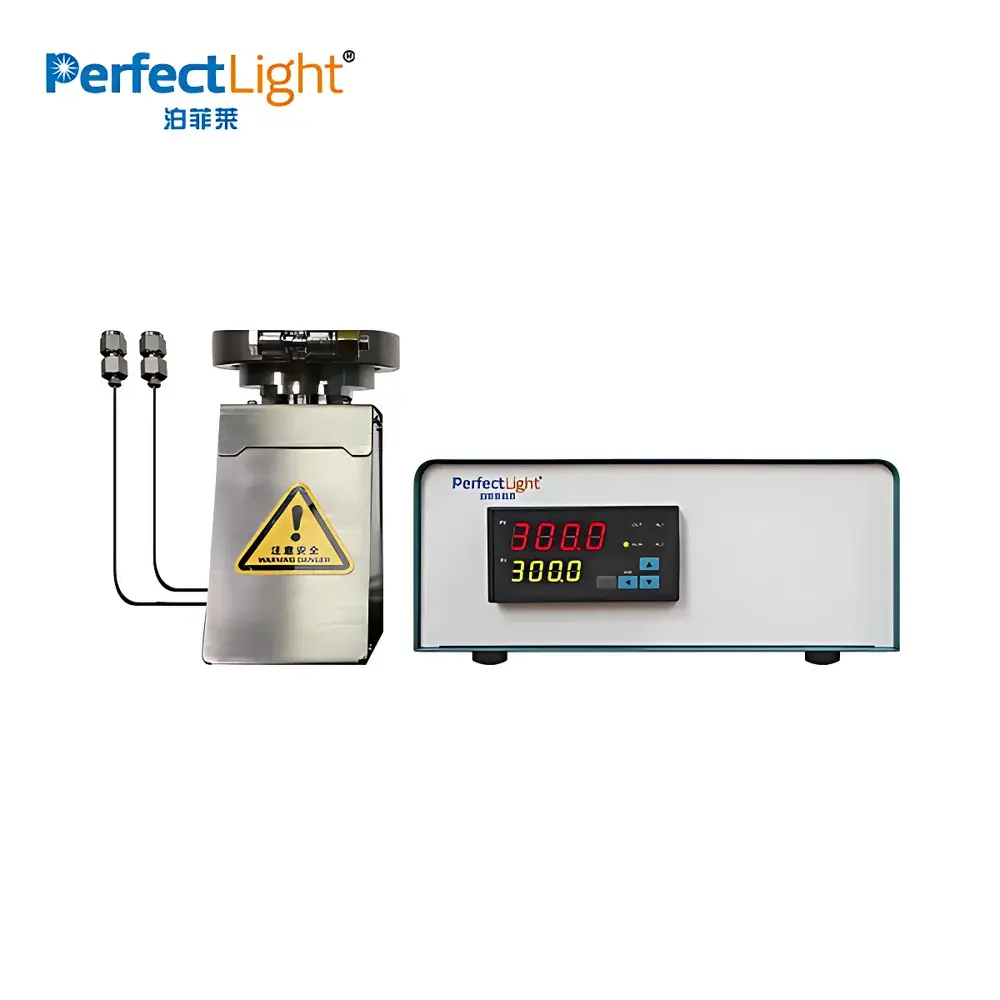
PLR-HTSR Photothermal Synergistic Reaction Reactor
| Brand | PerfectLight (Perfetlight) |
|---|---|
| Origin | Beijing, China |
| Model | PLR-HTSR |
| Heating Range | Ambient to 300 °C |
| Temperature Accuracy | ±0.5 °C |
| Max Working Pressure (gauge) | 0–1.6 MPa |
| Reactor Volume (gas phase) | ~18 mL (integral mode: ~27 mL |
| differential mode | ~35 mL) |
| Liquid Fill Capacity | ≤6.5 mL |
| Reactor Body Material | 304 Stainless Steel |
| Optical Window | Sapphire, Ø30 mm, >90% Transmittance in UV-Vis-NIR (200–2500 nm) |
| Gas Inlet/Outlet Fitting | Standard Ø3 mm Swagelok-compatible Compression Fitting |
| Heating Element | Embedded Ni-Chrome Resistive Heater on 96% Al₂O₃ Ceramic Substrate |
| Temperature Sensor | Integrated K-Type Thermocouple with PID Feedback Control |
| Catalyst Support Options | Quartz Fiber Membrane (Ø37–50 mm, active area Ø35 mm), SiC Porous Ceramic Disc |
| Internal Insulation | Glass Fiber–Phenolic Resin Composite |
| Sealing | Fluoroelastomer (FKM) O-Ring |
Overview
The PLR-HTSR Photothermal Synergistic Reaction Reactor is an engineered benchtop system designed for controlled, quantitative investigation of heterogeneous photocatalytic and photothermal catalytic processes under simultaneous irradiation and thermal activation. It operates on the principle of integrated photon–phonon energy coupling: high-intensity broadband or monochromatic light (UV–Vis–NIR) passes through a large-diameter sapphire optical window directly onto catalyst-coated substrates housed within a pressurized, temperature-regulated gas-phase reaction chamber. Unlike conventional batch photoreactors, the PLR-HTSR enables precise decoupling and independent modulation of photonic flux (via external light source integration) and thermal energy input (via embedded resistive heating and closed-loop PID control), facilitating mechanistic studies of synergistic effects in CO₂ reduction, H₂ production, selective oxidation, and VOC abatement.
Key Features
- Flat-bottomed cylindrical reactor geometry optimized for uniform light penetration and enhanced gas–solid contact efficiency via through-flow configuration.
- High-transmittance sapphire optical window (Ø30 mm, >90% transmission from 200 nm to 2500 nm) enabling full-spectrum photochemical excitation without spectral distortion or thermal lensing.
- Embedded 96% alumina ceramic heater with Ni–Cr resistive trace, supporting 10-segment programmable temperature ramping from ambient to 300 °C with ±0.5 °C stability over extended operation (≥24 h).
- Real-time monitoring of both catalyst bed temperature (via K-type thermocouple embedded at catalyst support plane) and internal chamber pressure (0–1.6 MPa gauge range) with analog/digital output interfaces.
- Modular internal architecture: interchangeable catalyst supports—including quartz fiber membranes (active diameter Ø35 mm), SiC porous ceramic discs, and custom-configured thermal barriers—allowing systematic variation of mass transfer resistance and thermal conductivity.
- Standardized Ø3 mm Swagelok-compatible gas ports facilitate seamless integration with mass flow controllers, online GC/TCD/FID systems, FTIR gas cells, and vacuum manifolds.
Sample Compatibility & Compliance
The PLR-HTSR maintains chemical inertness across aggressive reaction environments through its 304 stainless steel body, FKM elastomer seals, and high-purity ceramic and sapphire components. It is compatible with corrosive gases (e.g., Cl₂, NH₃, H₂S), oxidizing atmospheres (O₂, O₃), and reducing mixtures (H₂, CO, CH₄). The reactor meets ISO 10816-3 mechanical vibration thresholds for laboratory instrumentation and conforms to IEC 61000-6-3 electromagnetic compatibility standards. Its pressure containment design adheres to ASME BPVC Section VIII, Division 1 guidelines for Class I pressure vessels operating below 2 MPa. All materials comply with USP for extractables profiling in catalytic material screening applications.
Software & Data Management
Temperature and pressure signals are routed to an external control box housing a microprocessor-based PID controller with RS-485 Modbus RTU interface. Optional LabVIEW™ or Python-based acquisition scripts enable synchronized logging of thermal transients, pressure drift, and external light source duty cycles. Audit trails—including setpoint history, calibration timestamps, and operator ID tags—are exportable in CSV/Excel format. When deployed in regulated environments, the system supports 21 CFR Part 11-compliant electronic signatures and role-based access control when interfaced with validated LIMS or ELN platforms.
Applications
- Kinetic modeling of tandem photo–thermal CO₂ hydrogenation over Cu/TiO₂ catalysts under 1 bar–10 bar CO₂:H₂ mixtures.
- In situ DRIFTS-coupled studies of surface intermediates during plasmonic Au/TiO₂-mediated methane oxidation under 365 nm LED irradiation and 150 °C thermal bias.
- Quantitative quantum yield determination for NOₓ decomposition over g-C₃N₄ under polychromatic solar-simulated illumination (AM1.5G) and variable thermal offsets (25–200 °C).
- Accelerated catalyst aging protocols involving cyclic thermal shock (25 ↔ 250 °C) combined with pulsed UV irradiation to assess structural resilience.
- Screening of doped perovskite oxides for selective ethylene epoxidation under visible-light-driven conditions with simultaneous O₂ partial pressure control (0.01–0.5 MPa).
FAQ
Can the PLR-HTSR be operated under vacuum or inert glovebox conditions?
Yes—the reactor is rated for full vacuum (≤10⁻³ mbar) and may be mounted inside nitrogen- or argon-purged gloveboxes using standard flange adapters. All electrical feedthroughs are hermetically sealed.
Is the sapphire window suitable for deep-UV (e.g., 185 nm) irradiation?
No—standard sapphire exhibits strong absorption below 190 nm. For VUV applications, optional MgF₂ or CaF₂ windows (with appropriate cooling provisions) can be specified at time of order.
What catalyst loading formats are supported beyond membrane-based configurations?
Custom inserts for packed-bed, monolith, or fluidized-bed geometries are available as OEM options, subject to geometric constraints and thermal expansion matching.
Does the system include integrated light source or spectral filtering?
No—the PLR-HTSR is a reactor-only platform. External light sources (Xe lamps, LED arrays, laser diodes) and bandpass filters must be selected and aligned separately per experimental requirements.
Are calibration certificates provided for temperature and pressure sensors?
Factory calibration reports (traceable to NIST standards) are included with each unit. On-site recalibration services and ISO/IEC 17025-accredited certification are available upon request.



