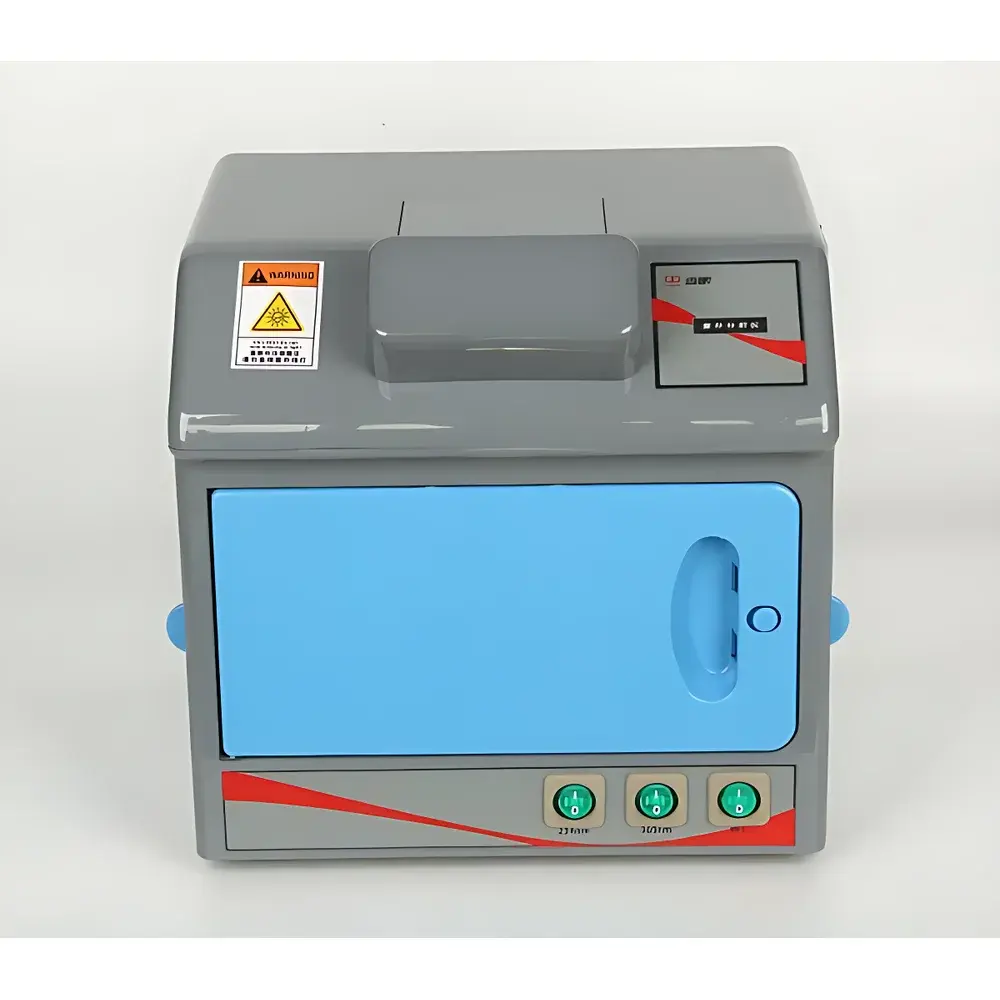
Jiapeng ZF-7 Darkroom-Style Triple-Function UV Transilluminator
| Brand | Jiapeng |
|---|---|
| Origin | Shanghai, China |
| Model | ZF-7 |
| Instrument Type | Darkroom-style |
| Wavelengths | 254 nm & 365 nm (dual-band) |
| Visible Light Source | 4 W white LED |
| UV Transillumination Area | 200 × 50 mm |
| UV Lamp Configuration | Two 8 W low-pressure mercury lamps (254 nm & 365 nm) |
| UV Filter Dimensions | 200 × 50 mm |
| Adjustable UV Lamp Angle | Yes |
| Viewing Window | UV-blocking acrylic (99% UVC/UV-A attenuation) |
| Operating Distance | 20 cm |
| UV Intensity at 20 cm | 20 µW/cm² |
| Power Input | AC 220 V, 50/60 Hz |
| External Dimensions (L×W×H) | 280 × 330 × 330 mm |
| Internal Cavity Dimensions | 280 × 245 × 220 mm |
| Net Weight | 2.65 kg |
| Compliance | JJF 1936–2021 (National Verification Regulation for UV Analyzers) |
| Patents | ZL201920792756.2, ZL202221777391.4, ZL202222383825.9 |
Overview
The Jiapeng ZF-7 Darkroom-Style Triple-Function UV Transilluminator is a compact, benchtop fluorescence visualization system engineered for routine nucleic acid and protein gel analysis in molecular biology laboratories. It operates on the principle of ultraviolet-induced fluorescence: when DNA, RNA, or fluorescently stained proteins (e.g., ethidium bromide, SYBR Safe, or Coomassie dyes) are exposed to short- or long-wave UV radiation, they absorb photons and re-emit visible light—enabling direct visual detection and documentation of electrophoretic bands. The ZF-7 integrates dual-wavelength UV excitation (254 nm and 365 nm), visible white-light illumination, and a fully enclosed darkroom cavity to eliminate ambient light interference—ensuring high-contrast imaging under controlled conditions. Its design adheres to JJF 1936–2021, China’s national metrological verification regulation for UV analyzers, and incorporates patented optical and mechanical features—including adjustable lamp orientation and certified UV-blocking viewing windows—to support reproducible, operator-safe workflows.
Key Features
- Triple-mode illumination: Independent activation of 254 nm (optimal for nucleic acid visualization and UV crosslinking), 365 nm (lower-energy excitation for reduced photodamage and safer handling of ethidium bromide-stained gels), and 4 W visible white light (for non-fluorescent sample inspection or documentation without UV exposure).
- Adjustable UV lamp assembly: Dual 8 W low-pressure mercury lamps mounted on pivot joints allow precise angular alignment—ensuring uniform irradiance across the entire 200 × 50 mm transillumination area, even with irregularly shaped or stacked gels.
- Operator-safe darkroom architecture: Molded from high-impact, UV-resistant ABS polymer; includes side-mounted flexible access ports for manual gel manipulation and a front-facing observation window with >99% attenuation of 254 nm and 365 nm radiation (verified per ISO 21542:2021 requirements for UV shielding materials).
- Integrated microcontroller interface: Backlit LCD display supports real-time mode selection, lamp status indication, and system diagnostics—designed for readability under low-light laboratory conditions without requiring external monitors or software.
- Calibrated UV output: Delivers 20 µW/cm² irradiance at 20 cm working distance (per JJF 1936–2021 reference geometry), enabling consistent fluorescence excitation across repeated experiments and facilitating semi-quantitative band intensity comparison.
Sample Compatibility & Compliance
The ZF-7 accommodates standard vertical and horizontal electrophoresis gels (agarose, polyacrylamide, SDS-PAGE) up to 200 mm wide and 50 mm deep, including mini-gels, multi-well comb formats, and thin-layer chromatography plates. Its UV transmission geometry is compatible with common nucleic acid stains (EtBr, GelRed, SYBR Gold) and protein stains (Coomassie Brilliant Blue R-250, Silver Nitrate). The instrument meets JJF 1936–2021 verification criteria for spectral purity, irradiance stability, and spatial uniformity. While not certified to IEC 61000-6-3 (EMC) or FDA 21 CFR Part 11, its operational parameters align with GLP-aligned lab practices for qualitative gel documentation—particularly where audit trails are maintained via external camera systems or notebook-based annotation.
Software & Data Management
The ZF-7 operates as a standalone hardware platform with no embedded firmware or network connectivity. All control is executed via physical button interface and local LCD feedback; no proprietary drivers, cloud services, or data export protocols are implemented. For digital documentation, optional accessory kits include a fixed-position camera mount frame compatible with consumer-grade DSLR or USB microscopes (sold separately). Users retain full ownership of acquired images and metadata, enabling integration into LIMS or ELN platforms via standard file import (JPEG, TIFF). No automated image analysis, thresholding, or molecular weight calibration is performed onboard—preserving analytical transparency and method flexibility.
Applications
- Routine agarose and polyacrylamide gel visualization for PCR product verification, restriction digest analysis, and cloning validation.
- Preparative gel excision (‘gel cutting’) under 365 nm illumination to minimize DNA damage during downstream cloning or sequencing library preparation.
- Fluorescence-based detection of labeled antibodies, aptamers, or metabolites in dot-blot or slot-blot assays.
- Forensic sample screening (e.g., latent biological fluid traces on fabrics or surfaces) using UV-induced autofluorescence.
- Educational laboratory instruction in molecular biology techniques—where safety, simplicity, and repeatability are prioritized over high-throughput automation.
FAQ
Is the ZF-7 suitable for UV crosslinking applications?
No—the 254 nm output is optimized for fluorescence excitation, not nucleic acid immobilization. Crosslinking typically requires higher irradiance (>100 µW/cm²) and extended exposure times not supported by this instrument.
Can I use ethidium bromide with the 254 nm setting?
Yes, but 365 nm is strongly recommended for EtBr-stained gels to reduce DNA strand breakage and improve band resolution.
Does the ZF-7 include a built-in camera or image capture software?
No—imaging requires an external camera mounted via the optional frame accessory; no proprietary acquisition software is bundled.
What safety certifications does the viewing window meet?
The acrylic window complies with optical density requirements for >99% attenuation at 254 nm and 365 nm per JJF 1936–2021 Annex B, though formal EN 62471 (Photobiological Safety) classification is not claimed.
Is the unit compatible with international power standards (e.g., 110 V / 60 Hz)?
No—it is configured exclusively for AC 220 V, 50/60 Hz input; voltage conversion is required for use outside mainland China.