
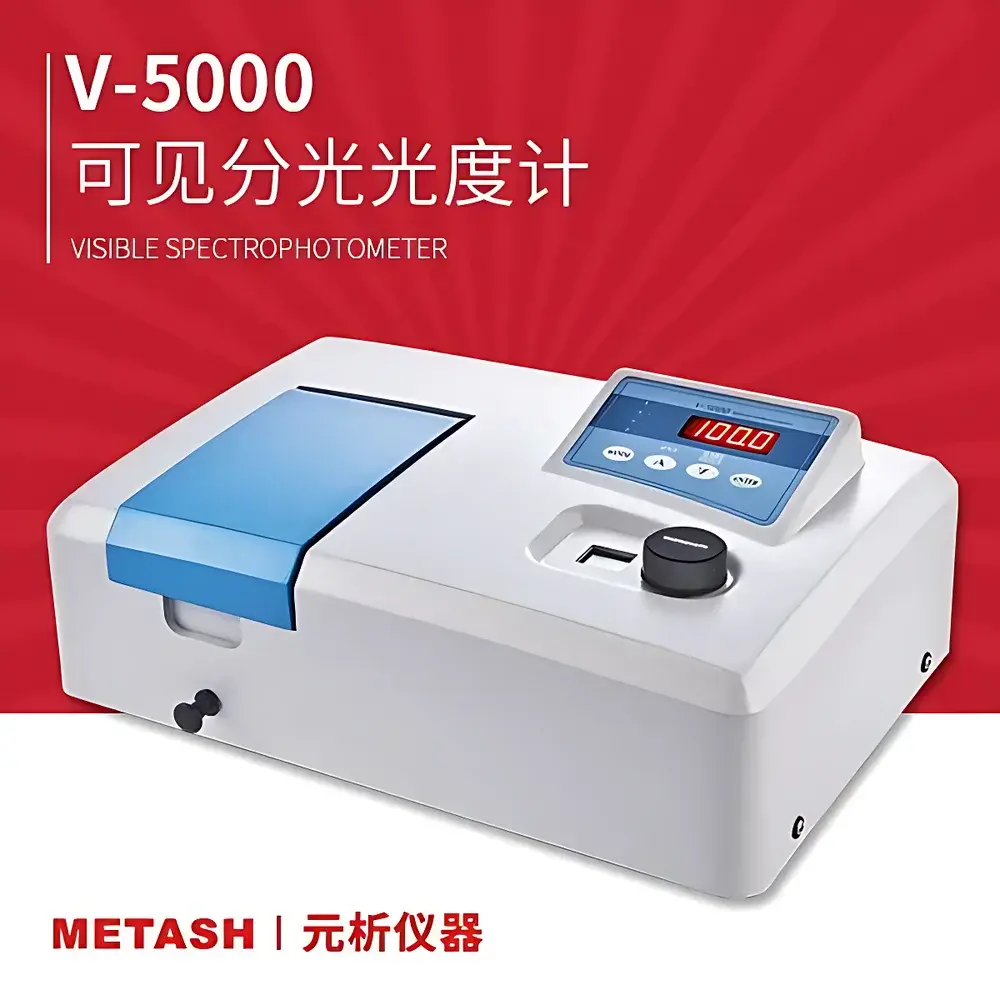
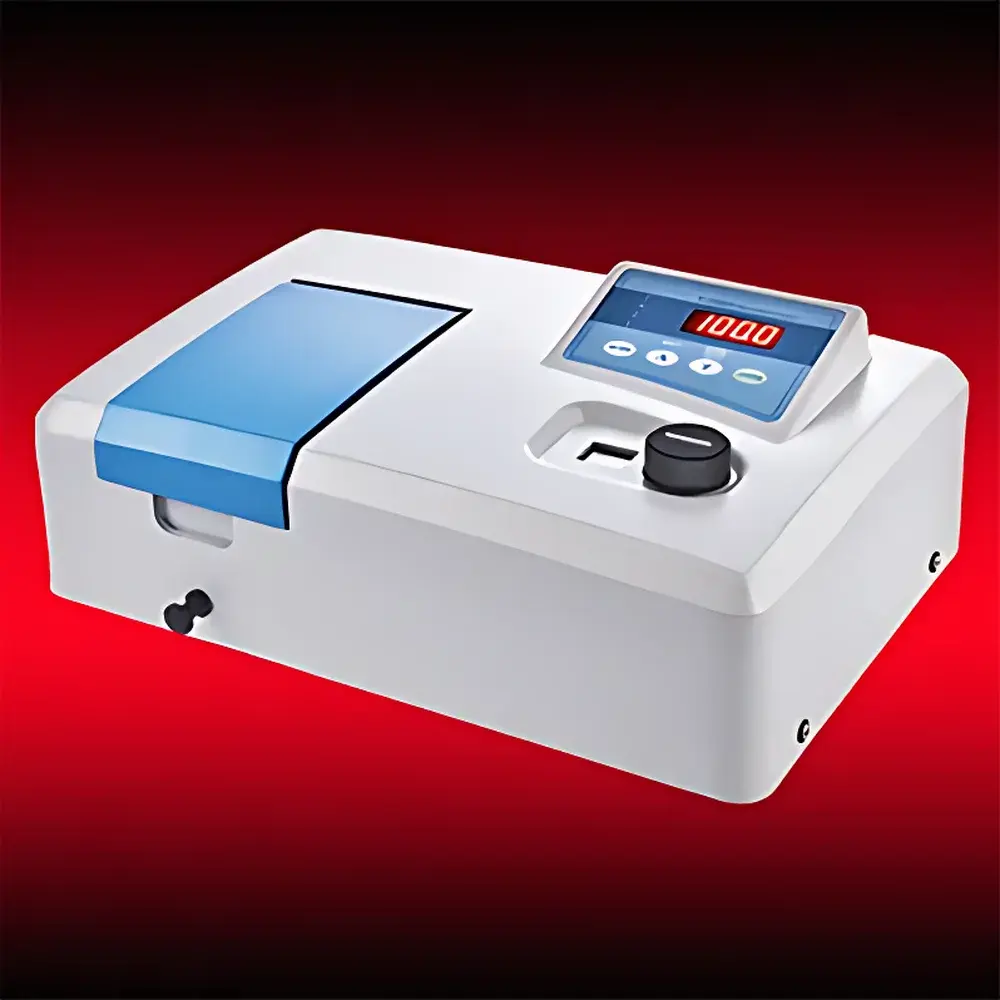
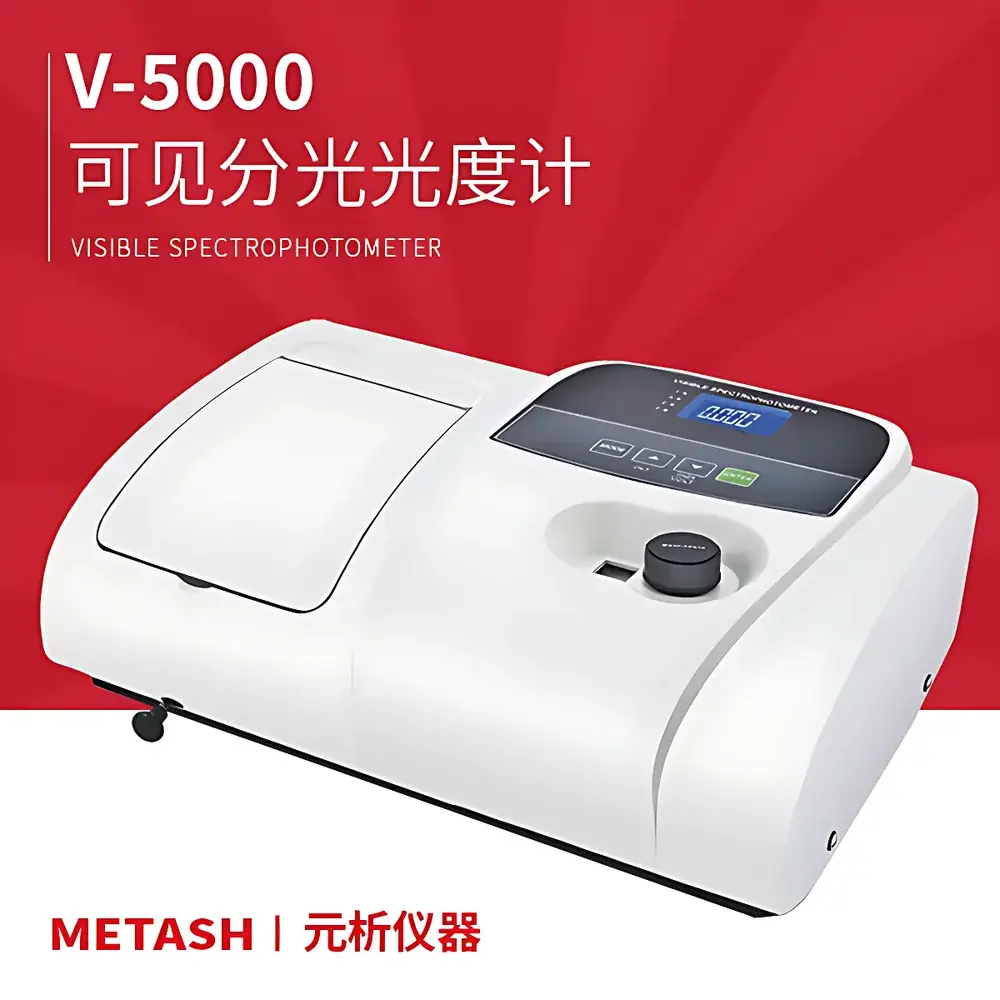
Metash V-5000 Single-Beam UV-Visible Spectrophotometer
| Brand | Metash Instruments |
|---|---|
| Origin | Shanghai, China |
| Manufacturer Type | Original Equipment Manufacturer (OEM) |
| Product Category | Domestic |
| Model | V-5000 |
| Price Range | USD 150–750 (FOB Shanghai) |
| Optical System | Single-beam |
| Detector Type | Silicon Photocell |
| Wavelength Range | 325–1000 nm |
| Wavelength Selection | Manual via Rotary Knob |
| Spectral Bandwidth | 4 nm |
| Wavelength Accuracy | ±2 nm |
| Wavelength Repeatability | ≤0.5 nm |
| Stray Light | ≤0.2% T |
| Data Interfaces | USB 2.0 port, Parallel Printer Port |
| Lamp Type | Plug-in Tungsten-Halogen Lamp |
Overview
The Metash V-5000 is a single-beam ultraviolet-visible (UV-Vis) spectrophotometer engineered for routine quantitative and qualitative analysis in academic teaching laboratories, quality control environments, and small-scale industrial R&D settings. It operates on the fundamental principle of Beer–Lambert law-based absorbance measurement, where sample concentration is determined by monitoring the attenuation of monochromatic light transmitted through a solution at user-selected wavelengths across the 325–1000 nm spectral range. Its robust single-beam architecture—featuring a high-stability tungsten-halogen lamp, precision-blazed diffraction grating, and silicon photocell detector—delivers consistent photometric performance with minimal drift under standard ambient conditions. Designed for operational simplicity and long-term reliability, the V-5000 avoids complex optical alignment procedures through its plug-in lamp module and factory-calibrated wavelength drive mechanism.
Key Features
- Manual wavelength selection via precision-machined rotary encoder, enabling intuitive navigation across the full 325–1000 nm range with tactile feedback and visual LED confirmation.
- Dual-mode photometric display: real-time simultaneous readout of transmittance (%T), absorbance (A), concentration (C), and factor (F) values on a high-contrast 4-digit LED screen.
- Integrated auto-zero and auto-100%T calibration routines—executed with a single key press—to eliminate baseline drift and ensure repeatability between sample batches.
- Plug-in tungsten-halogen lamp assembly requiring no optical re-alignment upon replacement, reducing maintenance downtime and technician dependency.
- Standard USB 2.0 interface compliant with HID-class protocols, enabling direct connection to Windows-based PCs without proprietary drivers; parallel printer port supports legacy dot-matrix or thermal label printers for hard-copy documentation.
- Optimized optical path design incorporating imported high-efficiency grating and low-noise silicon photocell, achieving ≤0.2%T stray light specification—critical for accurate low-absorbance measurements near detection limits.
Sample Compatibility & Compliance
The V-5000 accommodates standard 10 mm rectangular quartz or glass cuvettes (pathlength: 10 mm) and supports both liquid and clear solid samples compatible with transmission geometry. It meets core requirements for educational laboratory instrumentation per ISO/IEC 17025:2017 Annex A3 (general instrument verification criteria) and aligns with ASTM E275–22 guidelines for spectrophotometer performance verification. While not certified for regulated GMP/GLP environments, its stable photometric output, traceable wavelength accuracy (±2 nm), and documented repeatability (≤0.5 nm) support internal method validation under ISO 8466-1 for calibration curve linearity and ICH Q2(R2)-aligned precision assessment. The instrument does not incorporate 21 CFR Part 11-compliant audit trails or electronic signature functionality.
Software & Data Management
The V-5000 operates as a standalone unit but integrates seamlessly with Metash’s optional QuantSoft™ quantitative analysis software (Windows 10/11, x64). QuantSoft enables creation and storage of multi-point calibration curves (linear, quadratic, or polynomial), automatic concentration calculation from absorbance readings, batch data export in CSV and Excel-compatible formats, and customizable report generation with embedded instrument metadata (model, serial number, date/time stamp). All USB-transmitted datasets retain native timestamping and include raw %T/A values alongside derived C/F results. No cloud synchronization or remote access capabilities are provided; all data reside locally on the host PC.
Applications
- Routine determination of analyte concentrations in pharmaceutical excipients, water quality parameters (e.g., nitrate, phosphate), and food additives using validated single-wavelength or multi-point calibration methods.
- Educational demonstrations of absorption spectroscopy principles, including spectral scanning (via manual stepwise acquisition), Beer’s law verification, and comparative analysis of chromophore behavior across UV-Vis regions.
- QC testing of dye lots, pigment dispersions, and colored solutions where moderate resolution (4 nm bandwidth) and reproducible endpoint measurements suffice.
- Supporting ASTM D1209 (platinum-cobalt color scale), ISO 6271 (water turbidity by absorbance), and USP (spectrophotometric absorbance verification) when operated within defined environmental controls (20–25 °C, <60% RH).
FAQ
Is the V-5000 compliant with FDA 21 CFR Part 11?
No. The instrument lacks electronic signature capability, audit trail logging, and user-access controls required for Part 11 compliance.
Can it perform spectral scanning?
No. As a manually tuned single-beam system, it does not support automated wavelength scanning; users must adjust wavelength stepwise and record data point-by-point.
What cuvette materials are supported?
Standard 10 mm pathlength quartz cuvettes (for UV use down to 325 nm) and optical glass cuvettes (recommended for >350 nm only) are compatible.
Does it include wavelength calibration verification tools?
Yes—users may verify wavelength accuracy using NIST-traceable holmium oxide or didymium filters; procedure details are included in the operator manual.
Is firmware upgradeable in the field?
No. The embedded microcontroller firmware is fixed at time of manufacture and not user-upgradable.
Related Products







