
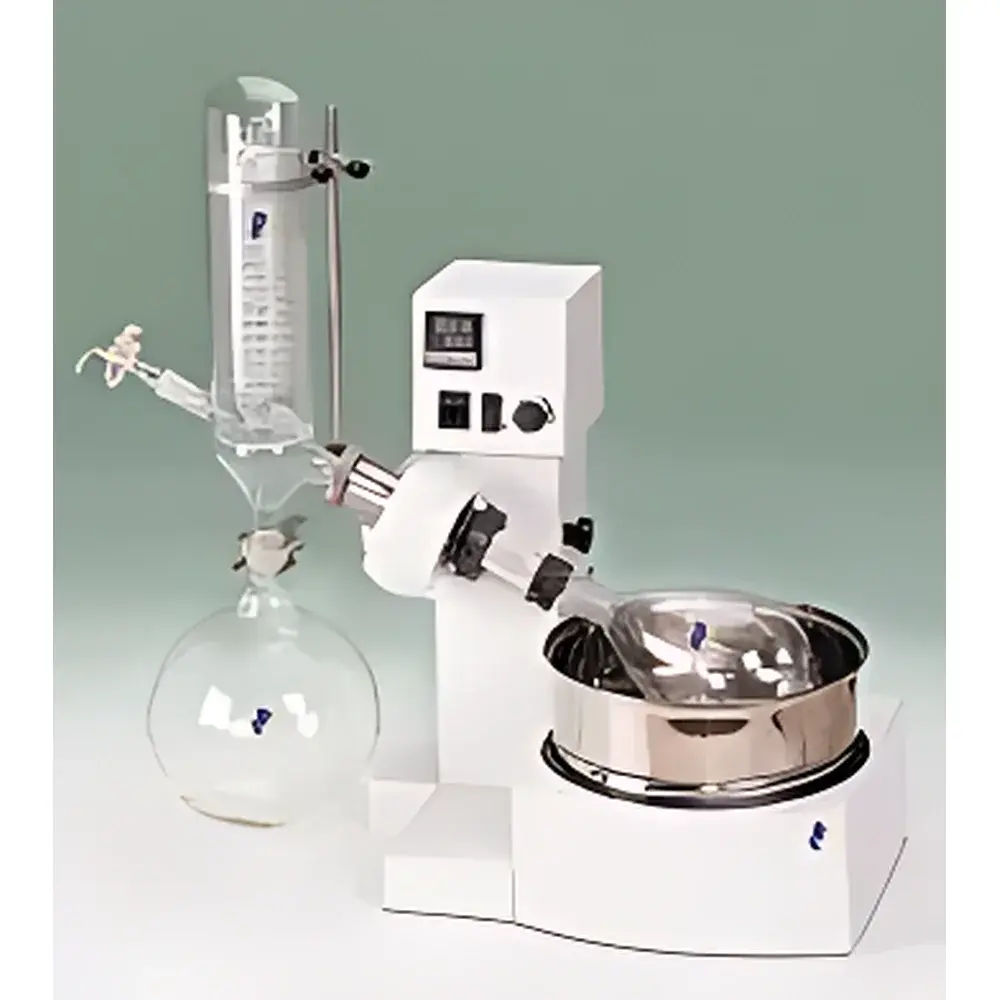
Shanghai Yarong RE5203A Rotary Evaporator
| Origin | Shanghai, China |
|---|---|
| Manufacturer Type | Authorized Distributor |
| Origin Category | Domestic (PRC) |
| Model | RE5203A |
| Price | USD 1,240 (FOB Shanghai) |
| Rotation Speed Range | 0–150 rpm |
| Heating Temperature Range | Ambient to 100 °C |
| Condenser Type | Vertical dual-coil high-density serpentine condenser with large-diameter tubing |
| Evaporation Flask Capacity | 3 L (standard ball joint, 29/32 or 34/45) |
| Collection Flask Capacity | 2 L (standard spherical ground joint) |
| Total Power Consumption | 1630 W |
Overview
The Shanghai Yarong RE5203A Rotary Evaporator is a benchtop vacuum distillation system engineered for reliable solvent removal, concentration, and gentle compound recovery under reduced pressure. It operates on the principle of rotary evaporation—rotating a sample-containing flask in a heated water or oil bath while applying controlled vacuum, thereby lowering the boiling point of solvents and enhancing evaporation efficiency without thermal degradation. Designed for routine use in synthetic chemistry, natural product isolation, pharmaceutical QC labs, and academic research settings, the RE5203A integrates mechanical stability, thermal precision, and ergonomic operation into a compact yet robust platform. Its vertical dual-coil condenser architecture ensures high surface-area contact and efficient vapor condensation across a wide range of volatile solvents—including acetone, ethanol, ethyl acetate, dichloromethane, and toluene—while minimizing carryover and improving recovery yield.
Key Features
- Motor-driven lift mechanism with rocker-switch actuation for smooth, repeatable vertical positioning—enabling rapid flask immersion and withdrawal during operation or solvent exchange.
- Adjustable rotation speed from 0 to 150 rpm via digital speed control, offering fine-tuned optimization for viscous samples, foaming-prone mixtures, or heat-sensitive compounds.
- Heated water/oil bath with PID temperature regulation (ambient to 100 °C), ±1 °C accuracy at setpoint, and over-temperature cut-off protection.
- Vertical high-density dual serpentine condenser with oversized tubing diameter (≥16 mm OD) to maximize condensation efficiency and reduce backstreaming risk under high-vacuum conditions (down to ≤10 mbar).
- Standardized 29/32 and 34/45 spherical ground joints for interchangeability with common laboratory glassware; includes 3 L evaporation flask and 2 L collection flask with PTFE stopcocks and reinforced borosilicate 3.3 glass construction.
- Integrated vacuum seal monitoring via silicone O-ring gasket system on all rotating and static joints; total power draw rated at 1630 W for full-system operation including heating, rotation, and condenser cooling (when external chiller is connected).
Sample Compatibility & Compliance
The RE5203A accommodates aqueous, organic, and mixed-phase solutions typical in extraction, purification, and preparative workflows. Its design supports GLP-aligned documentation practices when paired with external vacuum controllers and temperature loggers. While not certified to IEC 61010-1 or UL 61010B out-of-the-box, the unit complies with general electrical safety requirements for laboratory equipment used in non-hazardous environments (Class I, IP20). All wetted parts are chemically resistant to common solvents per ISO 15223-1 labeling conventions. Users performing regulated work (e.g., USP , ICH Q3C) are advised to validate method parameters—including bath temperature uniformity, vacuum stability, and condensate recovery rate—per internal SOPs prior to GMP-relevant applications.
Software & Data Management
The RE5203A operates as a standalone analog-digital hybrid instrument with no embedded microprocessor or data logging capability. All operational parameters (rotation speed, bath temperature, lift position) are manually set and monitored via front-panel LED displays and tactile controls. For traceable process recording, integration with third-party systems is supported: analog voltage outputs (0–5 V) for temperature and rotation signals enable connection to chart recorders or SCADA-compatible DAQ modules. When deployed in validated environments, users commonly pair the unit with external vacuum gauges (e.g., capacitance manometers) and calibrated thermistors to generate audit-ready run logs compliant with FDA 21 CFR Part 11 requirements—provided electronic records are generated, reviewed, and archived through validated software platforms.
Applications
- Solvent removal from reaction mixtures post-synthesis in organic and medicinal chemistry labs.
- Concentration of natural extracts (e.g., plant tinctures, essential oils) without thermal decomposition.
- Recovery and recycling of high-purity solvents in quality control and analytical sample preparation workflows.
- Preparative-scale fractional evaporation where moderate throughput (up to 1.2 L/h for ethanol at 40 °C/25 mbar) and reproducible endpoint control are required.
- Teaching laboratories demonstrating phase equilibria, vapor pressure depression, and mass transfer principles under vacuum.
FAQ
What vacuum level is recommended for optimal performance with the RE5203A?
For most low-boiling solvents (e.g., diethyl ether, acetone), a vacuum range of 10–30 mbar is typical; higher-boiling solvents (e.g., DMF, DMSO) may require ≤5 mbar with auxiliary cold trap support.
Can the RE5203A be used with corrosive solvents such as concentrated HCl or bromine solutions?
No—standard configuration uses silicone and PTFE seals only; halogenated acids or strong oxidizers require custom fluorocarbon seals and Hastelloy condenser upgrades, which are not included.
Is the heating bath compatible with silicone oil or only water?
Yes—the bath is rated for both water and heat-transfer oils up to 100 °C; oil use requires verification of flash point (>120 °C) and viscosity suitability for impeller-driven circulation.
Does the unit include a vacuum pump or refrigerated circulator?
No—these are optional accessories; the RE5203A requires external vacuum source (e.g., diaphragm pump with gas ballast) and chilled coolant supply (e.g., -10 °C ethylene glycol/water mix) for condenser operation below ambient.
What maintenance intervals are recommended for long-term reliability?
Inspect O-rings and ground joints monthly; clean condenser coils quarterly with ethanol or isopropanol; verify bath heater calibration annually using a NIST-traceable thermometer.



