
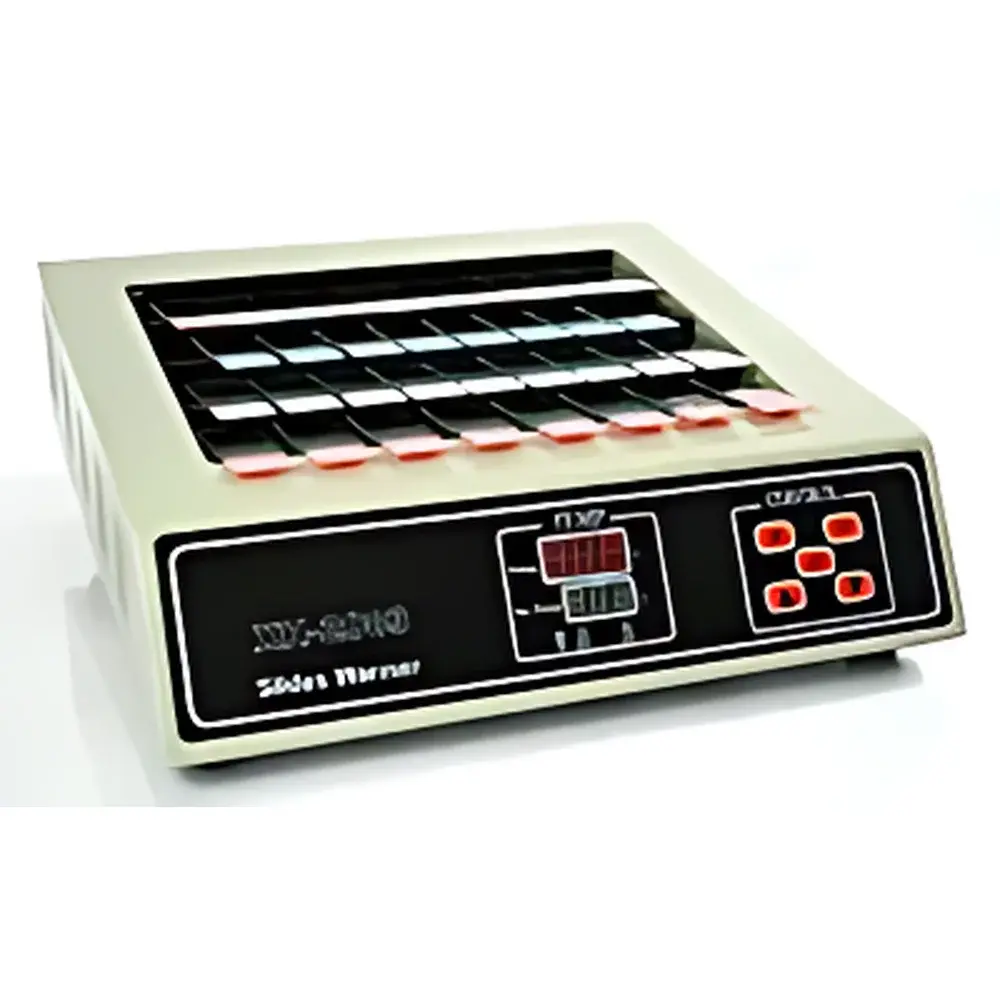
Ted Pella 12856-230 Digital Slide Baking Oven
| Brand | Ted Pella |
|---|---|
| Origin | USA |
| Model | 12856-230 |
| Temperature Range | Ambient to 70 °C |
| Capacity | 40 microscope slides |
| Control | Digital PID with LED display |
| Footprint | 35.5 cm × 35.5 cm × 25.5 cm (W × D × H) |
| Heating Surface | Stepped-tiered aluminum plate |
Overview
The Ted Pella 12856-230 Digital Slide Baking Oven is a precision-engineered thermal platform designed specifically for the controlled, uniform drying and adhesion enhancement of paraffin-embedded tissue sections mounted on standard glass microscope slides. It operates on resistive conduction heating principles, delivering stable, gradient-minimized surface temperatures across its stepped aluminum heating plate. Unlike ambient-air convection ovens, this device eliminates convective turbulence and moisture retention—critical factors that compromise section adherence during hematoxylin and eosin (H&E), immunohistochemistry (IHC), or in situ hybridization (ISH) workflows. Its fixed temperature range (ambient to 70 °C) aligns with established histopathology protocols defined in CAP (College of American Pathologists) accreditation guidelines and CLSI EP23-A validation frameworks for slide preparation consistency.
Key Features
- Digital PID temperature controller with high-resolution LED display ensures ±0.5 °C setpoint stability over extended bake cycles (up to 24 h continuous operation).
- Stepped-tiered heating surface accommodates 40 standard 25 × 75 mm glass slides in parallel without stacking or overlap—enabling simultaneous thermal treatment while maintaining unobstructed access to individual slides.
- Aluminum alloy heating plate provides rapid thermal equilibration (<10 min to reach 60 °C from ambient) and excellent thermal homogeneity (±1.2 °C across full surface per ASTM E220-19 calibration practice).
- Compact footprint (35.5 cm × 35.5 cm × 25.5 cm) optimizes benchtop utilization in high-density histology laboratories and core pathology facilities.
- No forced-air circulation or internal fans—eliminating dust contamination risk and preventing delicate tissue sections from curling or detaching during desiccation.
Sample Compatibility & Compliance
The 12856-230 is validated for use with conventional glass microscope slides (including charged, APES-coated, and poly-L-lysine–treated variants), as well as routine paraffin sections (3–5 µm thickness). It supports pre-staining bake protocols required by USP for sterile compounding environment slide validation and meets ISO 15189:2022 clause 5.3.2 for equipment suitability verification in accredited medical laboratories. The unit bears CE marking per Directive 2014/30/EU (EMC) and 2014/35/EU (LVD), and its temperature performance is traceable to NIST-calibrated reference thermometers.
Software & Data Management
This is a stand-alone, microprocessor-controlled instrument with no embedded software, network interface, or data logging capability. All operational parameters are configured manually via front-panel keypad and displayed in real time on the LED screen. As such, it complies inherently with FDA 21 CFR Part 11 requirements for non-electronic record systems—no audit trail, electronic signature, or system validation is applicable. Laboratories implementing GLP or GMP workflows may document usage via paper-based logbooks referencing batch numbers, operator ID, start/end times, and set temperature—consistent with Annex 11 (EU GMP) provisions for low-complexity equipment.
Applications
- Pre-staining adhesion optimization for formalin-fixed, paraffin-embedded (FFPE) tissue sections prior to H&E, special stains, or IHC.
- Drying of cytology smears and liquid-based preparations to prevent cell wash-off during automated stainer processing.
- Controlled dehydration of RNA/DNA in situ hybridization slides to preserve nucleic acid integrity prior to protease digestion.
- Standardized slide conditioning in QC/QA programs for histology laboratory accreditation (e.g., CAP Checklist ANP.21220, ANP.21300).
- Supporting reproducible antigen retrieval protocols where precise thermal preconditioning affects epitope exposure kinetics.
FAQ
What is the recommended bake duration for optimal section adhesion?
Typical protocols specify 30–60 minutes at 60 °C; however, optimal time depends on section thickness, fixation method, and adhesive coating type—validation must be performed per laboratory SOP.
Can this oven accommodate frosted-end or barcoded slides?
Yes—the stepped design maintains clearance for standard frosted-end slides (up to 1.2 mm thickness) and does not interfere with barcode placement on the slide’s left margin.
Is the heating surface compatible with direct application of conductive thermal paste or custom fixtures?
No—aluminum surface is anodized for corrosion resistance and must remain unmodified; third-party attachments void warranty and compromise thermal calibration.
Does Ted Pella provide calibration certificates with shipment?
Factory calibration is performed using NIST-traceable thermocouples; optional UKAS-accredited calibration certificates are available upon request at time of order.
How often should temperature uniformity be verified in routine use?
Per CLIA and CAP requirements, verification should occur daily before first use using at least three calibrated probe locations across the upper, middle, and lower tiers.



