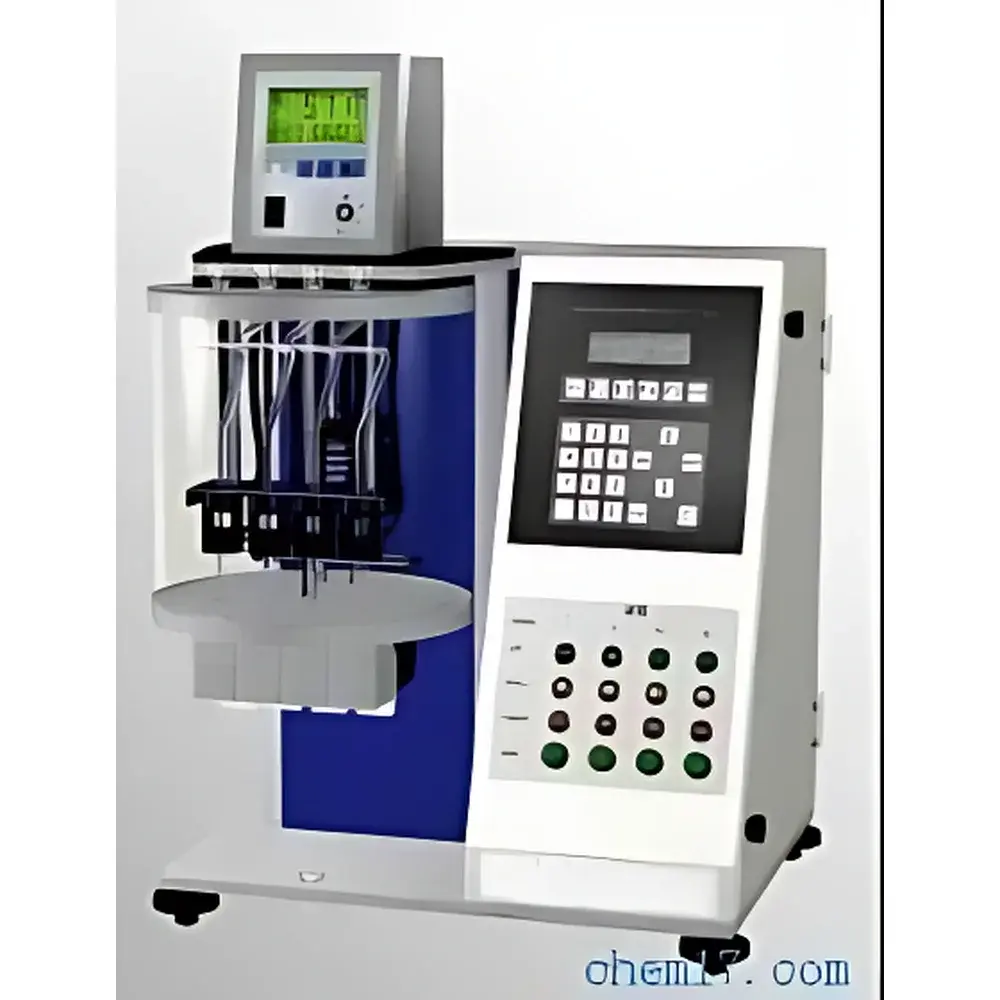
AmSpec 850 Automated Kinematic Viscosity Tester
| Origin | Imported |
|---|---|
| Manufacturer Type | Authorized Distributor |
| Model | 850 |
| Measurement Range | 0.6–3,000 cSt |
| Units | mm²/s (cSt) |
| Timer Accuracy | ±0.0025 s |
| Temperature Range | 20–110 °C |
| Temperature Stability | ±0.01 °C (20–100 °C), ±0.03 °C (>100 °C) |
| Bath Capacity | 7.5 L |
| Capillary Type | Four S-Flow viscometers (certified calibration optional) |
| Detection Method | Optical meniscus detection |
| Display | Integrated LCD interface |
| Cleaning | Manual solvent injection |
| Cooling | Internal helical coil compatible with external chiller (water/oil bath) |
| Dimensions | 435 × 475 × 620 mm |
| Weight | 32 kg |
| Compliance | CE certified |
| Auxiliary Requirement | External air compressor (5–6 bar at 50 L/min) |
| Optional | External thermal printer, PC-based software module (non-intrusive integration) |
Overview
The AmSpec 850 Automated Kinematic Viscosity Tester is a precision-engineered instrument designed for fully automated kinematic viscosity determination of transparent and opaque petroleum liquids—including base oils, lubricants, fuels, and distillates—according to internationally recognized standard test methods. It operates on the capillary flow principle governed by Poiseuille’s law, where kinematic viscosity (ν) is derived from the efflux time of a fixed volume of sample flowing under gravity through a calibrated glass capillary tube immersed in a precisely controlled thermostatic bath. The system employs four parallel S-Flow capillaries, enabling sequential or redundant measurements to enhance statistical robustness and throughput without manual intervention between runs. Its optical meniscus detection system eliminates subjective visual timing errors, delivering high reproducibility across laboratories engaged in ASTM D445, D446, ISO 3104, IP 71, and BS 188 compliance testing.
Key Features
- Four independently mounted S-Flow capillaries—each traceably calibrated per ISO/IEC 17025 requirements (certification available upon request)
- High-stability temperature control system with ±0.01 °C accuracy from 20 to 100 °C, extended to ±0.03 °C up to 110 °C
- 7.5 L stainless-steel thermostatic bath with integrated helical cooling coil for direct connection to external chillers (water or thermal oil)
- Optical meniscus detection with sub-millisecond resolution timer (±0.0025 s), eliminating parallax and operator-dependent timing variance
- Integrated LCD interface with real-time display of bath temperature, efflux time, calculated viscosity, and system status
- Manual solvent injection port for post-run cleaning—compatible with common hydrocarbon and chlorinated solvents per ASTM D445 Annex A1
- CE-marked electrical architecture compliant with IEC 61010-1 for laboratory equipment safety
- Compact footprint (435 × 475 × 620 mm) and optimized weight distribution (32 kg) for benchtop deployment in QC labs and refinery testing facilities
Sample Compatibility & Compliance
The AmSpec 850 accommodates a broad range of petroleum-based fluids with kinematic viscosities spanning 0.6 to 3,000 mm²/s (cSt), including mineral oils, synthetic lubricants, jet fuels (Jet A-1, JP-8), diesel fuels, and crude fractions. Its S-Flow capillary geometry ensures laminar flow conditions across this full range while minimizing shear-induced non-Newtonian artifacts. All operational protocols align strictly with ASTM D445 (Standard Test Method for Kinematic Viscosity of Transparent and Opaque Liquids), ASTM D446 (Specifications for Glass Capillary Kinematic Viscometers), ISO 3104 (Petroleum products — Determination of kinematic viscosity), and IP 71 (Determination of kinematic viscosity of petroleum products). The instrument supports GLP-compliant workflows when paired with optional audit-trail-enabled software and meets essential requirements for ISO/IEC 17025-accredited testing laboratories.
Software & Data Management
An optional Windows-compatible software package enables remote instrument control, automated data logging, report generation (PDF/CSV), and long-term trend analysis. The software implements secure user access levels, electronic signatures, and full audit trail functionality in accordance with FDA 21 CFR Part 11 requirements. Data integrity is preserved via timestamped raw efflux times, temperature logs, and calibration metadata—all stored locally or exported to LIMS environments. Integration with external thermal printers allows hard-copy documentation directly from the instrument interface without disrupting measurement continuity.
Applications
- Quality control of finished lubricants and base stocks in manufacturing plants
- Routine viscosity verification of aviation turbine fuels per ASTM D1655 and DEF STAN 91-91
- Refinery process monitoring of vacuum gas oil (VGO) and residuum streams
- Research and development of low-viscosity synthetic esters and polyalphaolefins (PAOs)
- Third-party certification testing for API licensing and OEM specification compliance (e.g., ACEA, SAE J300)
- Viscosity index (VI) calculations when combined with measurements at 40 °C and 100 °C
FAQ
What capillary standards does the AmSpec 850 support?
The system is configured with four S-Flow capillaries meeting ASTM D446 Type I and II specifications; certified calibration certificates (traceable to NIST or UKAS) are available as an option.
Is the instrument suitable for testing opaque samples such as heavy fuel oils?
Yes—the optical detection system uses infrared-sensitive photodiodes capable of reliably identifying meniscus passage in dark or turbid fluids without requiring sample dilution.
Does the 850 require continuous external cooling during operation?
Not inherently—the built-in helical coil enables passive heat exchange; however, sustained operation above 80 °C or ambient temperatures exceeding 30 °C necessitates connection to an external recirculating chiller.
Can the AmSpec 850 be integrated into an existing LIMS environment?
Yes—via the optional software module, which supports ASTM E1384-compliant data export formats and configurable OPC UA or TCP/IP communication protocols.
What air supply specifications must the external compressor meet?
A minimum of 5–6 bar pressure at 50 L/min free air delivery is required to actuate the capillary purge and solvent injection valves; oil-free compressors are strongly recommended to prevent contamination.
Related Products