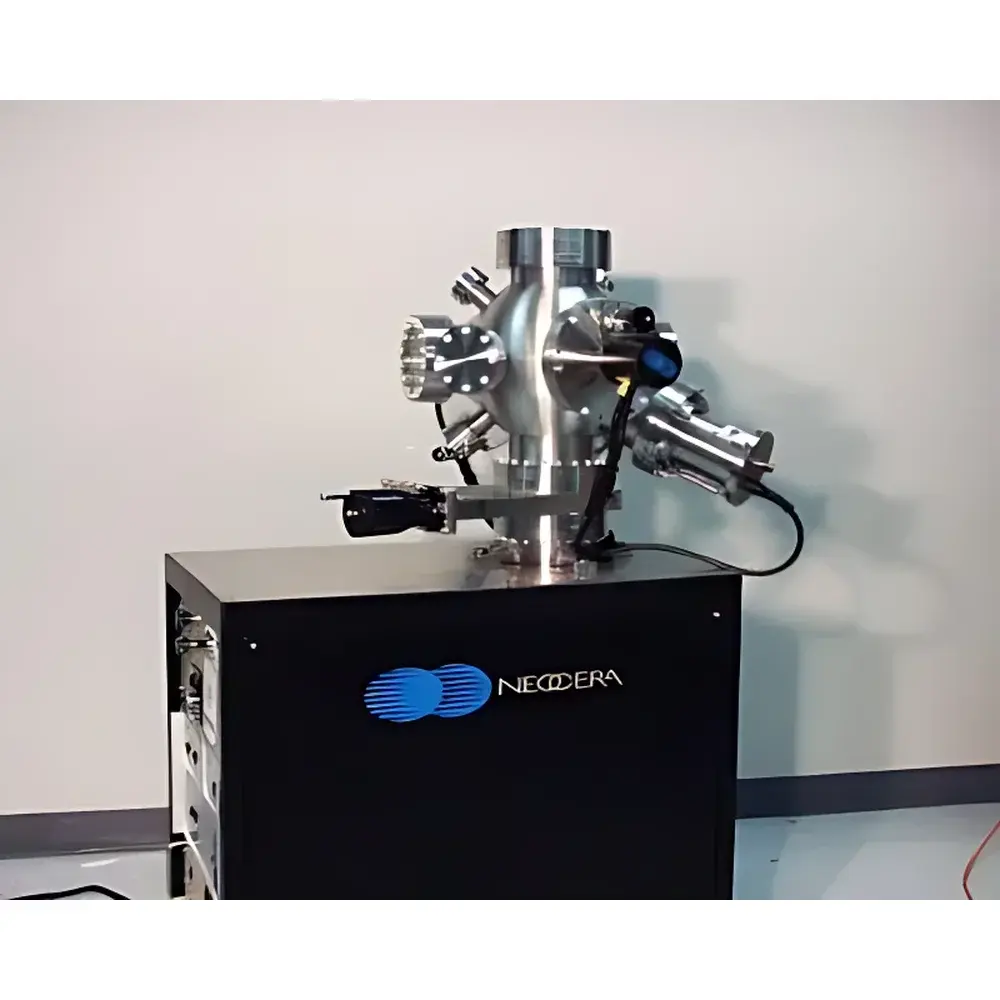
Neocera PED-120 Pulse Electron Beam Deposition System
| Brand | Neocera |
|---|---|
| Origin | Finland |
| Model | PED-120 |
| Vacuum Chamber | 12" Ø |
| Base Pressure | <1×10⁻⁶ Torr |
| Substrate Heater | 2" diameter, 950 °C max, ±1 °C stability |
| Target Capacity | six 1" or three 2" targets |
| Target-to-Substrate Distance | 4" |
| Gas Flow Control | 100 sccm MFC (O₂-compatible) |
| Turbo Pump | 260 L/s with cryo-trap |
| Roughing Pump | 4 m³/hr oil-free rotary vane |
| Electron Source | PEBS-20, 8–20 kV, 0.1–0.8 J/pulse, ~100 ns pulse width, ≤15 Hz rep rate, beam spot ≥6×10⁻² cm², energy density up to 1.3×10⁸ W/cm² |
| Z-axis travel | 50 mm, XY-axis travel: ±20 mm |
| Operating Lifetime | ≥10⁷ pulses |
| Max PEBS Housing Temp | 85 °C |
Overview
The Neocera PED-120 Pulse Electron Beam Deposition System is a high-precision, research-grade thin film growth platform engineered for the synthesis of complex, multi-component oxide and functional ceramic films under controlled reactive atmospheres. Unlike continuous-wave (CW) electron beam evaporation—where thermal equilibrium governs material transfer—the PED-120 employs short-duration, high-intensity electron pulses (typically ~100 ns) generated by the integrated PEBS-20 source. This non-equilibrium process delivers instantaneous power densities exceeding 1.3×10⁸ W/cm² at the target surface, enabling stoichiometric ablation of refractory compounds (e.g., YBCO, PZT, LSMO, STO) without significant thermal decomposition or preferential element loss. The system operates on pulsed energy coupling principles analogous to pulsed laser deposition (PLD), but with superior electrical efficiency (25–30%), deeper electron penetration depth, and reduced plasma shielding effects—making it especially suited for scalable, reproducible epitaxial and polycrystalline film growth on single-crystal substrates such as SrTiO₃, LaAlO₃, MgO, and silicon wafers.
Key Features
- Integrated PEBS-20 pulsed electron source with digitally stabilized high-voltage pulsing (8–20 kV), adjustable pulse energy (0.1–0.8 J), and precise temporal control (≤10 ns jitter)
- UHV-capable stainless steel vacuum chamber (12″ Ø) with base pressure <1×10⁻⁶ Torr, equipped with a cryo-trapped 260 L/s turbo molecular pump and oil-free 4 m³/hr backing pump
- High-stability substrate heater (2″ diameter) featuring closed-loop PID control, ±1 °C temperature stability over 950 °C operating range, and uniformity better than ±5 °C across the heating zone
- Modular target stage accommodating six 1″ or three 2″ targets; manual positioning with calibrated linear actuators (Z: 50 mm, XY: ±20 mm) for precise beam-target alignment
- O₂-compatible gas delivery subsystem with mass flow controller (0–100 sccm), dedicated safety interlocks, and manual gate valve isolation for atmospheric-pressure oxygen operation
- Full-system integration via industrial-grade control computer preloaded with Neocera’s proprietary PED Control Suite—supporting script-based sequence automation, real-time parameter logging, and hardware synchronization
Sample Compatibility & Compliance
The PED-120 supports deposition onto substrates up to 2″ in diameter—including Si, SiO₂/Si, sapphire, quartz, and lattice-matched perovskite oxides—with optional custom fixturing for wafer-level handling. Its design complies with standard laboratory safety protocols for high-voltage equipment (IEC 61010-1), vacuum integrity (ISO 2742), and reactive gas handling (CGA G-1.1). The system meets essential requirements for GLP-compliant thin film R&D environments, including audit-ready parameter traceability, user-access logs, and electronic signature support in accordance with FDA 21 CFR Part 11 when paired with validated software configurations. All vacuum components are UHV-baked compatible; flanges conform to CF-63 and KF-40 standards.
Software & Data Management
Neocera’s PED Control Suite provides deterministic, low-latency coordination between electron pulse triggering, substrate temperature ramping, gas flow modulation, and shutter actuation. The software architecture separates hardware abstraction layers from experiment logic, enabling repeatable protocol definition (e.g., “multi-target sequential deposition with O₂ partial pressure ramping”). Raw acquisition data—including pulse voltage/current waveforms, thermocouple feedback, pressure transients, and MFC setpoints—is timestamped with microsecond resolution and stored in HDF5 format for post-processing interoperability with Python (NumPy/H5Py), MATLAB, or OriginLab. Export modules generate ASTM E2911-compliant deposition reports, including layer thickness estimates (via in-situ quartz crystal monitoring integration), stoichiometry verification logs, and vacuum history summaries.
Applications
- Growth of high-Tc superconducting thin films (YBa₂Cu₃O₇₋δ, Bi₂Sr₂CaCu₂O₈₊δ) with preserved c-axis orientation and sharp superconducting transitions
- Deposition of ferroelectric perovskites (Pb(Zr,Ti)O₃, BaTiO₃) for memory capacitor stacks requiring atomic-scale compositional fidelity
- Preparation of mixed ionic-electronic conductors (La₀.₆Sr₀.₄Co₀.₂Fe₀.₈O₃₋δ) for solid oxide fuel cell cathodes
- Epitaxial integration of complex oxides on silicon for CMOS-compatible spintronic and memristive devices
- Rapid prototyping of composition-spread libraries using combinatorial target arrays and automated raster scanning
FAQ
What distinguishes pulse electron beam deposition (PED) from conventional e-beam evaporation?
PED uses nanosecond-scale, high-peak-power electron pulses rather than continuous thermal heating—enabling non-equilibrium ablation of multi-element targets while preserving stoichiometry.
Can the PED-120 operate with corrosive or reactive gases other than oxygen?
Yes—the gas manifold supports N₂, Ar, O₂, and forming gas mixtures; optional corrosion-resistant MFCs and stainless steel wetted parts enable compatibility with NH₃ and H₂S within defined concentration limits.
Is in-situ monitoring (e.g., RHEED, QCM) supported?
The chamber includes two 4.5″ CF viewports and one 2.75″ CF port for integration of reflection high-energy electron diffraction (RHEED), optical pyrometry, or quartz crystal microbalance (QCM) sensors.
How is calibration and maintenance handled for long-term reproducibility?
Neocera provides annual calibration services traceable to NIST standards for electron energy, pulse energy, temperature, and pressure sensors; all critical components feature field-replaceable modular design with documented MTBF metrics.
Does the system support remote operation and integration into automated lab networks?
Yes—Ethernet-based EtherCAT communication enables integration with LabVIEW, Python-based orchestration frameworks, and centralized facility SCADA systems via OPC UA or Modbus TCP protocols.