
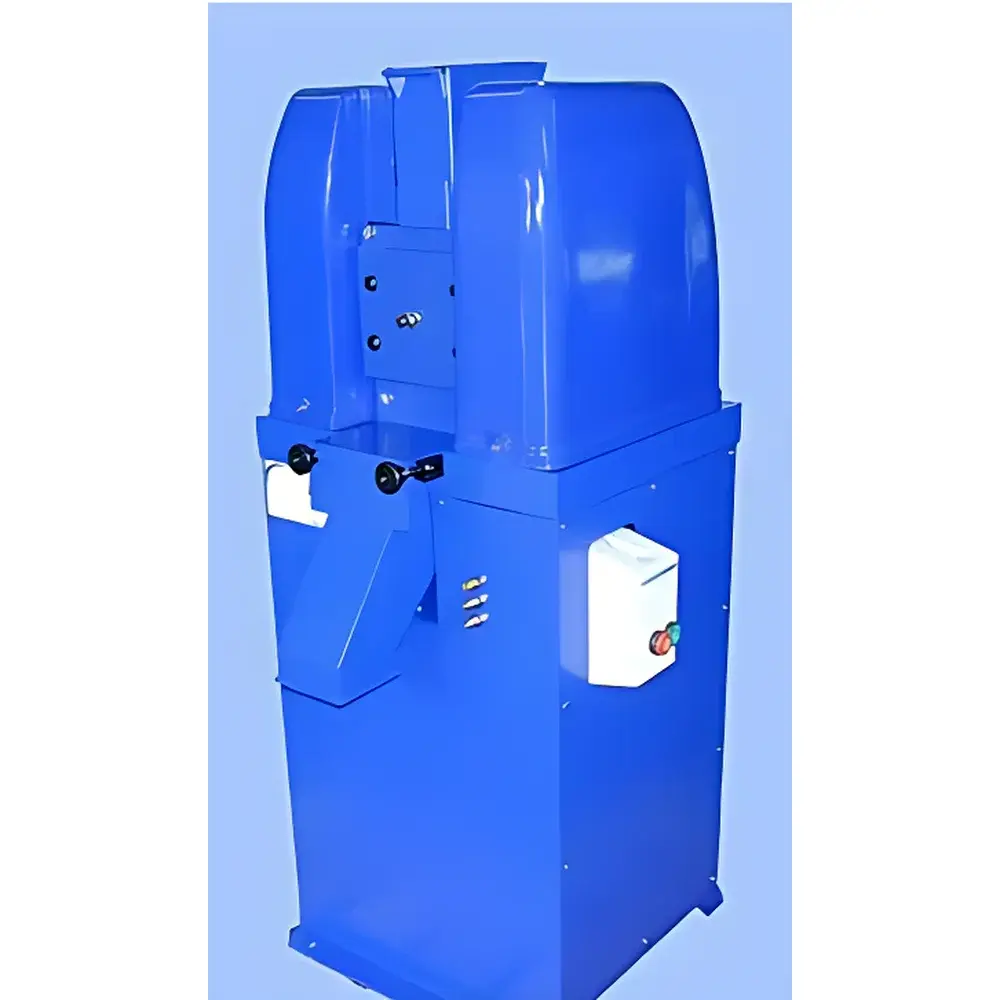
JAW1 Jaw Crusher by UK Manufacturer
| Origin | UK |
|---|---|
| Manufacturer Type | Authorized Distributor |
| Origin Category | Imported |
| Model | JAW1 |
| Price Range | USD 1,400 – 7,000 (FOB) |
| Instrument Type | Jaw Crusher |
| Sample Suitability | Brittle to Hard & Tough-Brittle Materials |
| Output Particle Size | ≥ 0.5 mm |
| Maximum Feed Size | < 14 mm |
| Jaw Opening Dimensions | 81 × 51 mm |
Overview
The JAW1 Jaw Crusher is a precision-engineered laboratory-scale primary crushing instrument designed for reproducible size reduction of heterogeneous solid samples prior to downstream analysis. Based on the classical Blake-type single-toggle jaw mechanism—refined over more than a century of industrial and analytical application—the JAW1 employs bidirectional jaw motion to enhance material throughput while minimizing energy consumption per unit mass. This patented kinematic design ensures uniform compressive force distribution across the crushing chamber, reducing particle agglomeration and minimizing fines generation during coarse comminution. The instrument is optimized for pre-treatment in geochemical assays, metallurgical sampling, cement and aggregate QA/QC, polymer characterization, and raw material qualification in pharmaceutical excipient manufacturing. Its robust cast-iron frame, sealed high-load spherical roller bearings, and modular jaw assembly support long-term operation under repetitive loading cycles without performance drift.
Key Features
- Single-toggle jaw mechanism with patented bidirectional motion for improved feed efficiency and reduced motor load
- Adjustable discharge gap (0–35 mm) enabling precise control over output particle size distribution
- Reversible feed hopper with splash-free tilting design to prevent sample loss and cross-contamination
- Interchangeable jaw plates in multiple wear-resistant materials: manganese steel (standard), stainless steel, tungsten carbide, hardened carbon steel, and heavy-metal-free compliant alloys
- Zero-point recalibration function compensates for mechanical wear over extended service life, maintaining consistent crush geometry
- Stainless-steel base and full perimeter guarding meet ISO 13857 and EN 61000-6-2 safety requirements for laboratory environments
- 3 HP (2.2 kW), three-phase induction motor with integrated thermal overload protection and variable-speed drive compatibility
- High-capacity collection tray (≥ 5 L) with ergonomic lift-and-remove design and anti-static lining
Sample Compatibility & Compliance
The JAW1 accommodates brittle, medium-hard, hard, and tough-brittle materials including but not limited to refractory ceramics, sintered metal powders, foundry sands, coal and coke, clays, natural polymers (e.g., lignin, shellac), synthetic thermoplastics, abrasive grains (SiC, Al₂O₃), and geological specimens (granite, basalt, limestone). It complies with ASTM D297–22 (rubber compounding), ISO 679:2018 (cement fineness testing), and EN 933-1:2022 (aggregates—particle size distribution). Jaw plate material options support regulatory compliance for trace-metal-sensitive applications (e.g., USP /, EPA Method 6010D), where stainless or heavy-metal-free linings eliminate elemental leaching risks.
Software & Data Management
While the JAW1 operates as a standalone mechanical crusher, its design integrates seamlessly into GLP/GMP-compliant workflows. Optional digital tachometer and load-cell interface modules enable real-time monitoring of motor current draw and cycle timing—data exportable via RS-485 or USB-C to LIMS platforms. All calibration events—including zero-point recalibration—are logged with timestamp, operator ID, and parameter values, satisfying audit requirements under FDA 21 CFR Part 11 when paired with validated electronic record systems. Maintenance logs and jaw plate replacement history can be tracked using the manufacturer’s web-based Asset Lifecycle Manager (ALM) portal.
Applications
- Geochemical sample preparation for XRF, ICP-OES, and fusion bead analysis
- Reduction of bulk aggregates and construction materials to ≤ 4 mm for sieve analysis per ASTM C136
- Pre-crushing of catalyst supports and ceramic monoliths prior to BET surface area measurement
- Size homogenization of recycled battery cathode materials (LiCoO₂, NMC) before hydrometallurgical leaching
- Primary comminution of pharmaceutical excipients (microcrystalline cellulose, lactose) for content uniformity testing
- Routine feedstock qualification in refractory manufacturing per ISO 2245:2019
FAQ
What is the maximum feed size the JAW1 can accept?
The nominal feed opening measures 81 × 51 mm; however, effective maximum feed dimension is limited to < 14 mm to ensure stable feeding and avoid jamming.
Can the JAW1 be used for wet or sticky samples?
No—it is engineered exclusively for dry, free-flowing brittle to hard solids. Moisture content > 2% w/w or cohesive materials (e.g., clays, gums) require prior drying or alternative milling methods.
Is the JAW1 compliant with electrical safety standards for EU laboratories?
Yes—CE-marked per Machinery Directive 2006/42/EC, EMC Directive 2014/30/EU, and RoHS 2011/65/EU, with full conformity documentation available upon request.
How often does jaw plate recalibration need to be performed?
Zero-point recalibration is recommended after every 200 operational hours or following jaw plate replacement—whichever occurs first—to maintain dimensional repeatability.
Does the JAW1 support automated feed control?
Not natively; however, third-party vibratory feeders with programmable rate control (e.g., Eriez Model VIBRA-TRAY®) can be integrated via 4–20 mA analog input with optional controller upgrade.



