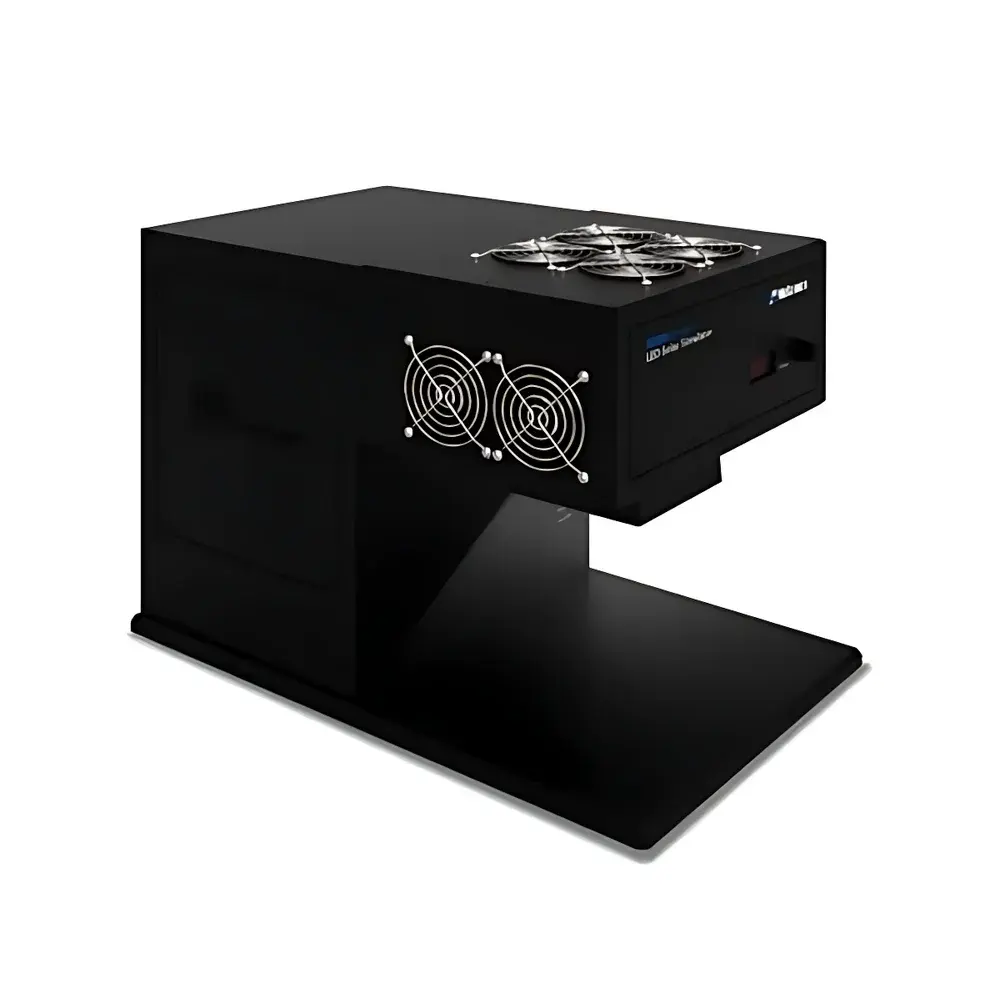
McScience SS-LD50 AAA-Class LED Solar Simulator for Photovoltaic I-V Characterization
| Brand | McScience |
|---|---|
| Origin | South Korea |
| Model | SS-LD50 |
| Automation Level | Fully Automatic |
| Effective Test Area | 55 mm × 55 mm |
| Voltage Measurement Accuracy | ±0.02% of reading |
| Current Measurement Accuracy | ±0.03% of reading |
| Spectral Classification | AAA (IEC 60904-9:2020 Ed.3, ASTM E927-19) |
| Light Source | Multi-channel High-Power LED Array |
| Spectral Tunability | Yes, per-channel LED current control |
| Compliance | IEC 61215, IEC 61646, IEC 62108, UL 1703, JIS C 8912 |
Overview
The McScience SS-LD50 is a fully automated, AAA-class LED-based solar simulator engineered for high-fidelity photovoltaic (PV) device characterization under standard test conditions (STC: 1000 W/m², AM1.5G spectrum, 25 °C cell temperature). Unlike traditional xenon or halogen lamp-based simulators, the SS-LD50 employs a spatially and spectrally optimized array of individually addressable high-power LEDs spanning the 350–1100 nm range. This architecture enables precise spectral reconstruction aligned with the IEC 60904-3 reference AM1.5G spectrum, while eliminating UV degradation, thermal drift, and arc instability inherent in broadband sources. The system achieves Class A performance across all three critical metrics defined in IEC 60904-9: spectral match (≤25% deviation in each wavelength band), spatial non-uniformity (≤2%), and temporal instability (≤0.5% over 10 s). Its solid-state design supports >20,000 hours of stable operation without lamp replacement—critical for accelerated lifetime testing protocols such as those specified in IEC 61215 for crystalline silicon modules or IEC 61646 for thin-film technologies.
Key Features
- Fully automated I-V sweep capability with sub-millisecond voltage step resolution and synchronized light triggering
- Real-time spectral tuning via independent current control of 12+ LED channels, enabling custom irradiance spectra for spectral response analysis or multi-junction PV validation
- Integrated temperature-controlled stage with PID-regulated heating/cooling (±0.1 °C stability) to maintain STC or extended temperature conditions (−40 °C to +85 °C)
- High-accuracy source-measure unit (SMU) with 6½-digit resolution, programmable compliance limits, and four-quadrant operation for dark I-V, light I-V, and capacitance-voltage (C-V) measurements
- Optimized optical path featuring collimated output beam, uniformity-enhancing diffuser optics, and calibrated reference cell feedback loop for closed-loop irradiance stabilization
- Modular mechanical design supporting scalable test areas—from the standard 55 mm × 55 mm active area up to 300 mm × 300 mm configurations upon request—without compromising spectral fidelity or uniformity
Sample Compatibility & Compliance
The SS-LD50 accommodates rigid and flexible PV devices including silicon wafers, PERC, TOPCon, HJT, CIGS, perovskite mini-modules, and tandem cells on glass, polymer, or metal substrates. Standard fixtures include spring-loaded probe cards with adjustable pitch (0.5–5 mm), vacuum chuck options for thin-film handling, and shielded triaxial cabling to minimize noise during low-current (<1 µA) measurements. All hardware and firmware comply with ISO/IEC 17025 requirements for calibration traceability, and measurement data logs meet FDA 21 CFR Part 11 audit trail standards—including user authentication, electronic signatures, and immutable timestamped records. System validation reports are provided per IEC 60904-9 Annex B and include full spectral irradiance maps, spatial uniformity scans, and temporal stability histograms.
Software & Data Management
Control and analysis are performed via McScience’s PVLab Pro software—a Windows-based application supporting both manual instrument configuration and script-driven batch testing (Python API included). The software implements automated parameter extraction per IEC 60891: Pmax, Voc, Isc, FF, series resistance (Rs), shunt resistance (Rsh), and temperature coefficients (α, β, δ). Raw I-V curves, spectral irradiance datasets, and environmental logs are stored in HDF5 format with embedded metadata (test standard, operator ID, calibration certificate ID, ambient conditions). Export options include CSV, PDF reports compliant with GLP/GMP documentation requirements, and direct integration with LIMS platforms via OPC UA or RESTful web services.
Applications
- Routine STC efficiency certification of lab-scale solar cells and mini-modules
- Spectral response (QE/IPCE) mapping using monochromatic LED stepping mode
- Light-soaking and burn-in testing for perovskite and organic PV stability assessment
- Temperature-dependent I-V characterization for thermal coefficient derivation
- Multi-junction cell current matching evaluation under tunable sub-cell spectra
- Accelerated aging studies under controlled irradiance profiles (e.g., UV-enhanced or IR-filtered spectra)
FAQ
Does the SS-LD50 support flash testing or only steady-state illumination?
The SS-LD50 operates exclusively in continuous (CW) mode to ensure thermal equilibrium during measurement—essential for accurate Rs/Rsh extraction and reliability testing. Flash-mode capability is not implemented, as it contradicts the design objective of long-term stability and repeatability.
Can the system be integrated into an environmental chamber?
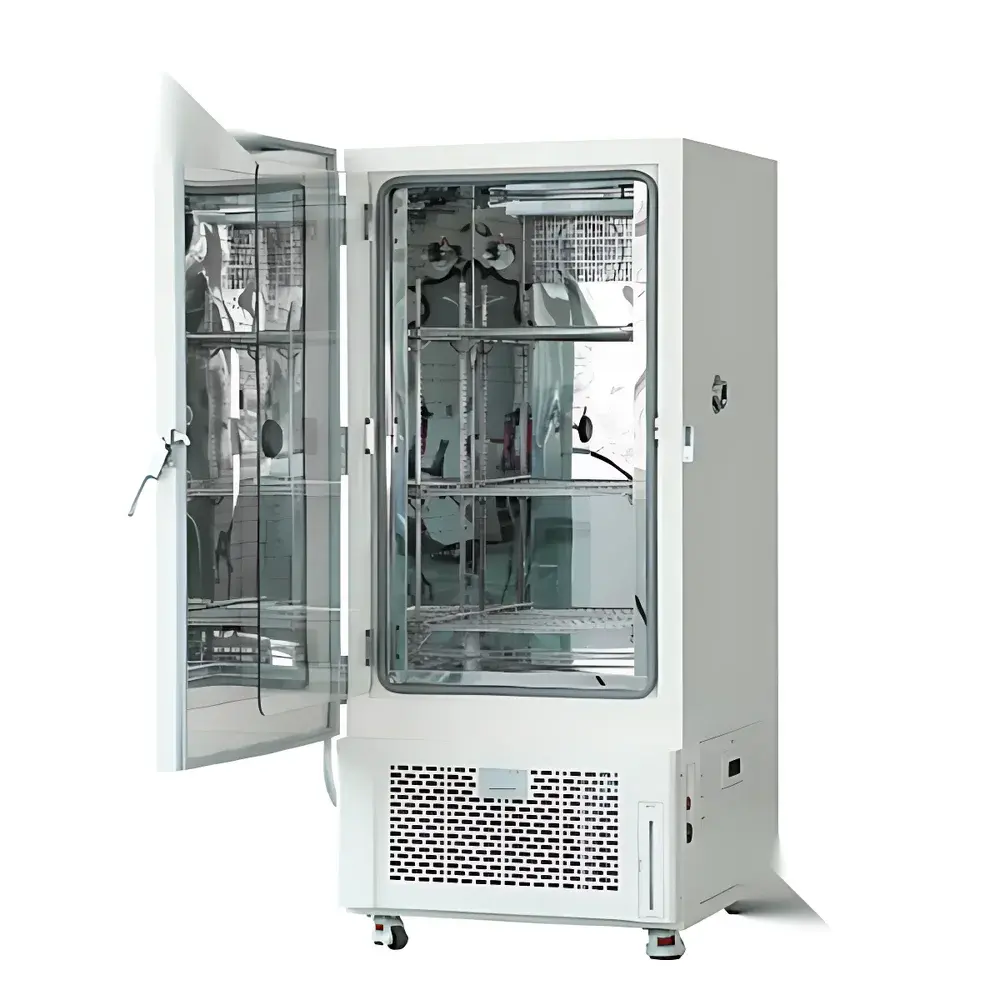
Yes—the SS-LD50 features modular optical coupling ports and external I/O triggers compatible with third-party climate chambers. Optional fiber-optic light delivery kits enable remote illumination while maintaining chamber integrity.
Is NIST-traceable calibration included with purchase?
Each unit ships with a factory calibration certificate traceable to KRISS (Korea Research Institute of Standards and Science), with optional upgrade to NIST-traceable reference cell calibration available upon order.
What maintenance is required beyond routine cleaning of optical surfaces?
No consumables or periodic recalibration are required within the first 24 months. LED output drift is compensated automatically via the built-in reference photodiode feedback loop; annual verification against a primary standard is recommended per ISO/IEC 17025 quality management protocols.