
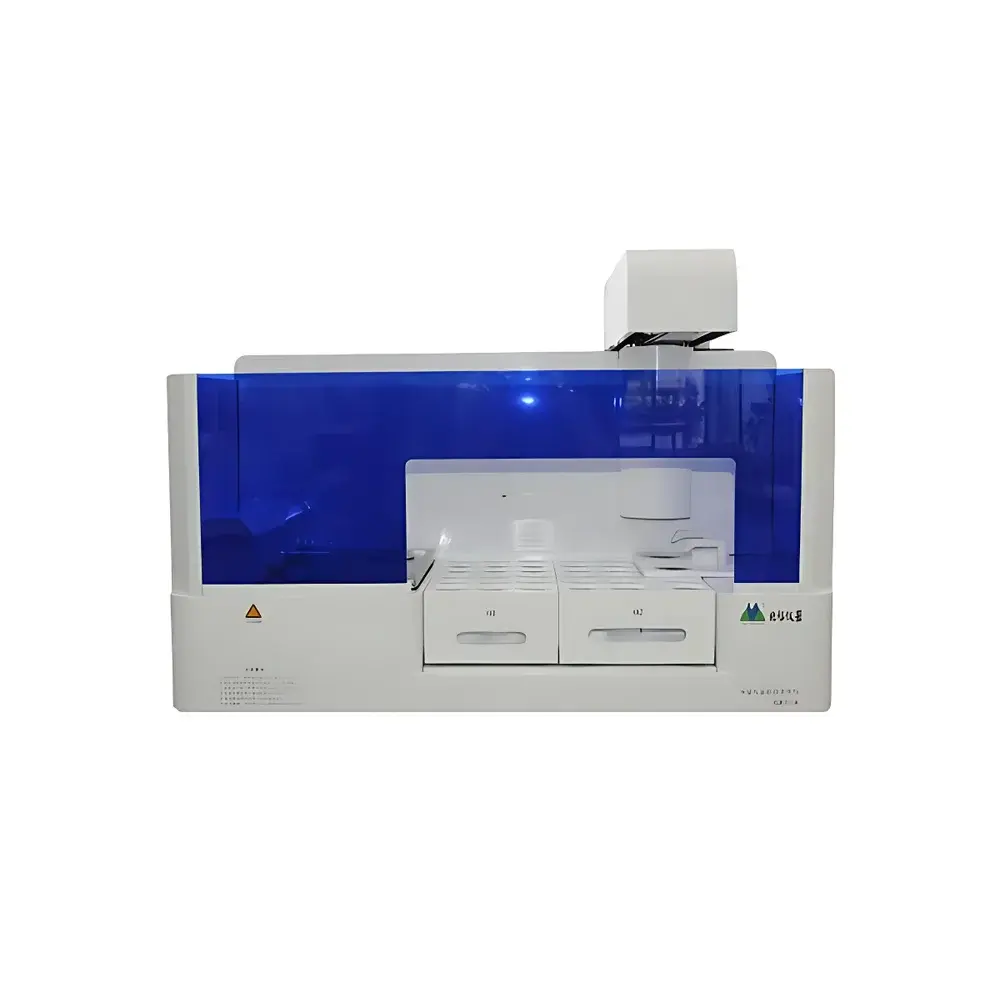
BEIYU CGM201W/202W/205W Automated Permanganate Index Analyzer
| Brand | BEIYU TECHNOLOGIES |
|---|---|
| Origin | Shanghai, China |
| Manufacturer Type | Direct Manufacturer |
| Instrument Type | Benchtop Laboratory Analyzer |
| Model | CGM201W / CGM202W / CGM205W |
| Measurement Principle | Colorimetric Titration with Thermal Digestion |
| Range | 0–5 mg/L as O₂ |
| Repeatability | ±3% RSD |
| Accuracy | ±3% of reading |
| LOD | 0.05 mg/L |
| Resolution | 0.05 mg/L |
| Cycle Time per Sample | 6 minutes |
| Digestion Method | Water Bath Heating (30 min at 98–100 °C) |
| Titration Temperature Control | Adjustable up to 80 °C |
| Endpoint Detection | Biomimetic Color Recognition System |
Overview
The BEIYU CGM201W/202W/205W Automated Permanganate Index Analyzer is a fully integrated benchtop system engineered for precise, standardized determination of the permanganate index (CODMn) in drinking water, surface water, groundwater, and low-organic wastewater samples. It implements the classical acidic potassium permanganate oxidation method—strictly aligned with ISO 8467:1993 and national standards GB/T 11892–1989 and GB/T 5750.7–2006. The instrument automates the complete analytical sequence: thermal digestion in sulfuric acid medium with KMnO₄, followed by quantitative back-titration with standardized sodium oxalate solution under controlled temperature conditions. Unlike spectrophotometric or electrochemical approximations, this system reproduces the reference wet-chemistry protocol with mechanical and optical fidelity—ensuring traceability to certified reference materials and regulatory compliance for environmental laboratories operating under GLP or ISO/IEC 17025 frameworks.
Key Features
- Full automation of digestion and titration cycles—including reagent dispensing, heating control, stirring, endpoint detection, and data calculation—eliminating manual intervention and inter-operator variability.
- Biomimetic color recognition engine calibrated to human visual perception thresholds (CIE L*a*b* space), delivering >99.2% endpoint identification accuracy across varying sample turbidity and chromaticity—significantly outperforming conventional potentiometric or photometric endpoint methods.
- Integrated water bath digestion block maintaining ±0.5 °C stability over 30-minute heating cycles at 98–100 °C, ensuring consistent oxidative degradation of organic matter per standard requirements.
- Programmable titration temperature control (ambient to 80 °C), enabling optimization for diverse matrix types while preserving stoichiometric integrity of the KMnO₄–Na₂C₂O₄ redox reaction.
- Robotic sample handling arm with 3-axis precision motion control, replicating human wrist-and-finger coordination for vial positioning, cap removal, and burette alignment—minimizing mechanical drift and cross-contamination risk.
- Modular design supporting three throughput configurations: CGM201W (1-position), CGM202W (2-position), and CGM205W (5-position), facilitating scalability without workflow redesign.
Sample Compatibility & Compliance
The analyzer accommodates standard 100 mL borosilicate glass digestion vials and accepts liquid samples with total suspended solids ≤50 mg/L and chloride concentration <300 mg/L (within GB/T 11892 tolerance limits). It is validated for use with EPA Method 410.4–derived protocols and meets functional equivalency criteria under ISO 8467 Annex A. All calibration, blank, and QC runs generate audit-ready metadata including timestamp, operator ID (optional), digestion temperature log, titrant consumption volume, and raw color trajectory curves—supporting 21 CFR Part 11-compliant electronic records when paired with BEIYU LabManager™ software.
Software & Data Management
The embedded firmware provides real-time graphical monitoring of color evolution during titration, with configurable pass/fail logic based on ΔE*ab thresholds. Data export supports CSV, PDF report generation, and direct integration into LIMS via ASTM E1384-compliant HL7 or ODBC drivers. Firmware updates are delivered via secure HTTPS with SHA-256 signature verification. Audit trail functionality logs all parameter modifications, result overrides, and maintenance events with immutable timestamps—fully compliant with ISO/IEC 17025:2017 clause 7.11.2 and GLP Principle 5.
Applications
- Routine monitoring of source water and treated drinking water in municipal utilities and third-party testing labs.
- Regulatory reporting for Class I–III surface water bodies under China’s Environmental Quality Standards for Surface Water (GB 3838–2002).
- Validation of pretreatment efficiency in advanced oxidation processes (AOPs) and biological filtration systems.
- Quality control of ultrapure water in pharmaceutical manufacturing where low-level organic load must be verified per USP .
- Research applications requiring high-reproducibility CODMn datasets for correlation modeling with TOC, UV₂₅₄, or fluorescence indices.
FAQ
Does the CGM series comply with international standard methods beyond Chinese national standards?
Yes—the system’s operational parameters and validation data meet the technical equivalence requirements of ISO 8467:1993 and APHA Standard Method 5210 B (Permanganate Oxidizability), with documented recovery rates of 96–102% for certified reference water matrices.
Can the instrument handle high-chloride samples commonly found in coastal aquifers?
Chloride interference is mitigated per GB/T 11892 through optional pre-addition of Ag₂SO₄ precipitant; however, samples exceeding 300 mg/L Cl⁻ require dilution or alternative CODCr analysis per ISO 6060.
Is remote operation and diagnostics supported?
Remote firmware updates, live camera feed of titration endpoint detection, and diagnostic self-tests are accessible via encrypted TLS 1.3 web interface—no proprietary client software required.
What maintenance intervals are recommended for long-term reliability?
Daily: Cleaning of optical sensor window and titration tip; Quarterly: Calibration verification using NIST-traceable KMnO₄ and Na₂C₂O₄ standards; Annually: Full metrological recalibration and robotic arm positional accuracy validation.
How is data integrity ensured during power interruption?
Non-volatile FRAM memory retains active run state, reagent levels, and temperature logs; upon power restoration, the system resumes from last valid step without data loss or manual reinitialization.
Related Products







