
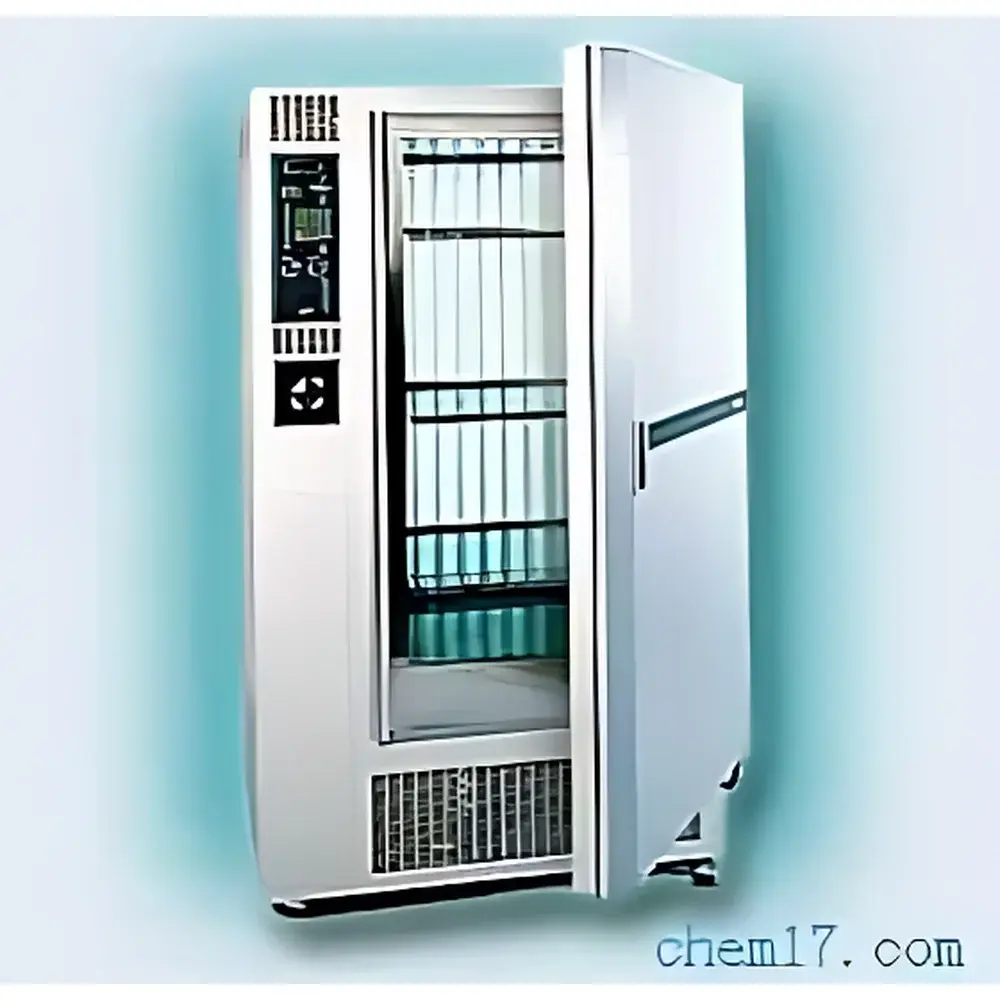
KB8400FL Illuminated Constant Temperature and Humidity Chamber
| Origin | UK |
|---|---|
| Manufacturer Type | Authorized Distributor |
| Origin Category | Imported |
| Model | KB8400FL |
| Pricing | Upon Request |
Overview
The KB8400FL Illuminated Constant Temperature and Humidity Chamber is an engineered environmental simulation system designed for precise, reproducible control of temperature (0–70 °C), relative humidity (0–100 %RH), and programmable illumination intensity across three spatial zones. Built upon a dual-loop PID control architecture with independent silicon-based sensors for temperature and capacitive polymer sensors for humidity, the chamber ensures high-fidelity environmental replication required in stability testing, seed germination studies, photobiological assays, and accelerated aging protocols per ICH Q1A(R3), ISO 187, and ASTM D4332. Its 395 L working volume accommodates multi-tier sample configurations while maintaining uniformity—±0.2 °C spatial temperature deviation and ±2 %RH spatial humidity deviation—validated under steady-state conditions at 25 °C/60 %RH. The chamber’s structural integrity derives from a seamless 304 stainless steel interior and a corrosion-resistant exterior composed of electropolished stainless steel overlaid with polyester powder coating, ensuring long-term compliance with GLP laboratory infrastructure requirements.
Key Features
- Triple-parameter control: Simultaneous, independent regulation of temperature, humidity, and light intensity via microprocessor-based controller with LCD interface
- High-precision sensing: Platinum RTD (Pt100) temperature sensor and NIST-traceable capacitive RH sensor, both integrated into a closed-loop PID feedback system
- Illumination system: Three-zone LED array delivering calibrated lux levels—8,000 lux (front), 12,000 lux (center), and 22,000 lux (rear)—with digital stepwise intensity selection (0%, 33%, 66%, 100%) and programmable on/off scheduling
- Ultrasonic humidification: Integrated 0.5 bar-rated ultrasonic humidifier using distilled water feed (1/2″ BSP inlet/outlet), minimizing mineral deposition and enabling rapid RH ramping
- Safety architecture: Dual-stage thermal protection including hardware-limiting safety thermostat (±3 °C offset) and software-configurable alarm thresholds (±2 °C / ±5 %RH), with visual and audible alert outputs
- Calibration-ready design: Digital sensor offset correction capability for both temperature and humidity channels, supporting traceable field calibration per ISO/IEC 17025 practices
- Ergonomic utility integration: Adjustable leveling feet, four standard stainless steel shelves (430 × 430 mm; 20 kg load capacity each), and optional shelf extension up to fourteen positions
Sample Compatibility & Compliance
The KB8400FL supports diverse sample formats—including Petri dishes, culture flasks, stability test packages, plant trays, and pharmaceutical primary packaging—without cross-contamination risk, owing to its fully welded stainless steel chamber cavity and non-porous interior surfaces. It meets mechanical and electrical safety standards EN 61010-1 and EN 61326-1, and its environmental control performance aligns with regulatory expectations for stability-indicating conditions defined in ICH Q5C, USP , and FDA Guidance for Industry on Stability Testing of Drug Substances and Products. Data integrity functionality—including audit trail logging of setpoint changes, alarm events, and sensor drift corrections—is compatible with 21 CFR Part 11-compliant data management systems when interfaced via RS-485 or optional Ethernet module.
Software & Data Management
The embedded controller provides full programmability with up to 99 user-defined cycles, each comprising multiple segments with independent ramp/soak profiles for temperature, humidity, and light. Real-time parameter logging is stored internally (≥30 days at 1-minute intervals) and exportable via USB flash drive in CSV format. Optional PC software (KB-Control Suite v3.x) enables remote monitoring, historical trend analysis, automated report generation (PDF/Excel), and integration with LIMS platforms via OPC UA or Modbus TCP. All logged data includes timestamp, operator ID (if enabled), and sensor status flags—supporting ALCOA+ principles for data reliability in regulated environments.
Applications
- Pharmaceutical stability testing under ICH Q1A–Q1E conditions (e.g., 25 °C/60 %RH, 30 °C/65 %RH, 40 °C/75 %RH)
- Seed viability and germination studies requiring photoperiod-controlled environments
- Material aging tests for polymers, coatings, and adhesives exposed to combined thermal-hygrometric stress
- Biological incubation of phototrophic microorganisms and algal cultures
- Electronics component testing under temperature-humidity bias (THB) per JEDEC JESD22-A110
- Reference standard conditioning prior to gravimetric or spectroscopic analysis
FAQ
What is the maximum allowable ambient room temperature for stable operation?
The unit is rated for continuous operation in rooms maintained at ≤30 °C and ≤70 %RH. Higher ambient temperatures may reduce dehumidification efficiency and extend stabilization time.
Can the chamber operate at 0 %RH without desiccant or nitrogen purge?
No. The minimum controllable RH is 0 % only in theoretical mode; practical low-RH operation (<10 %RH) requires external dry air or nitrogen supply connected via auxiliary port.
Is validation documentation (IQ/OQ/PQ) provided with the system?
Factory-issued IQ/OQ protocols are available upon request. PQ execution must be performed by the end user or qualified third party using certified reference instruments per ISO 17025.
Does the ultrasonic humidifier require periodic maintenance?
Yes. The transducer plate should be inspected and cleaned with isopropyl alcohol every 200 operating hours; distilled water quality must be verified monthly to prevent scaling.
How is temperature uniformity verified across the working volume?
Uniformity mapping is conducted per ASTM E2251 using nine calibrated thermocouples placed at standardized locations (corners, center, mid-height); results are recorded in the commissioning report.



