
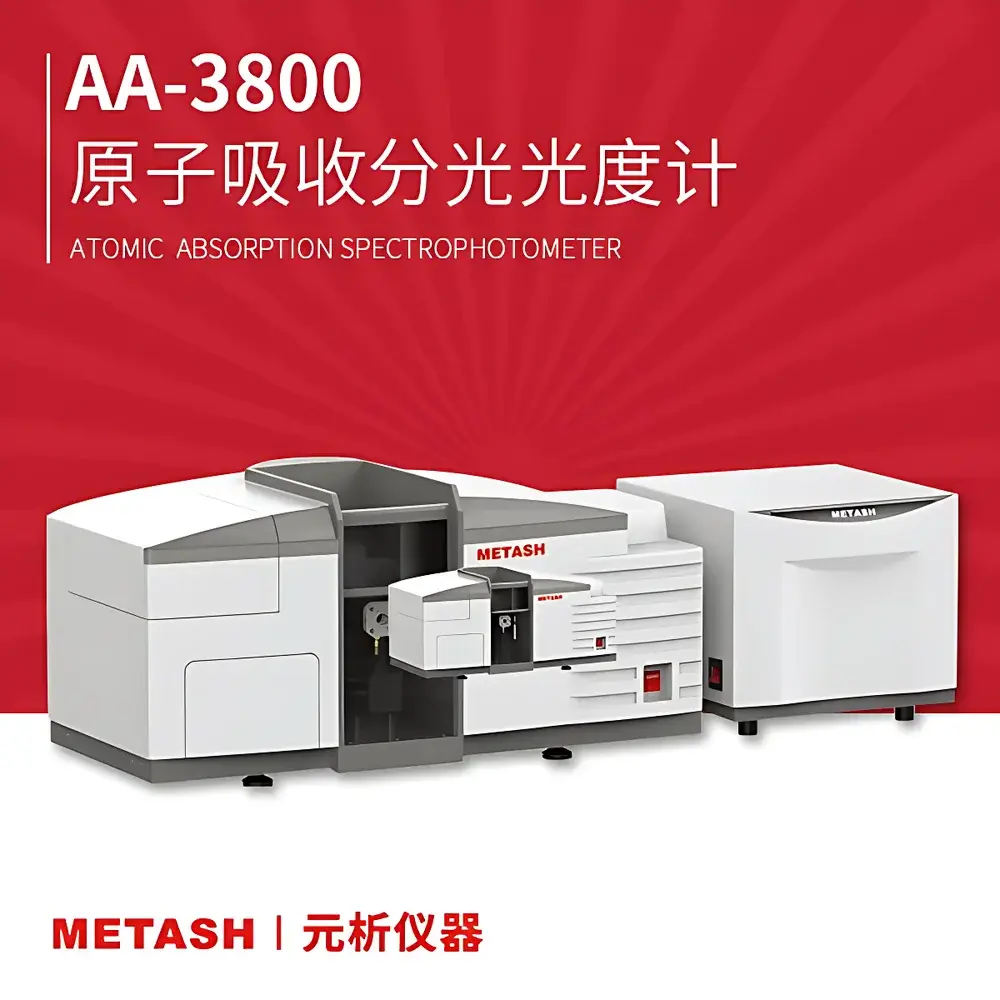
Metash AA-3800 Flame and Graphite Furnace Atomic Absorption Spectrometer
| Brand | Metash Instruments |
|---|---|
| Origin | Shanghai, China |
| Manufacturer Type | Original Equipment Manufacturer (OEM) |
| Instrument Type | Flame and Graphite Furnace AAS |
| Monochromator | Plane Grating (1800 grooves/mm) |
| Optical System | Single-beam |
| Detector | Photomultiplier Tube (PMT) |
| Background Correction | Deuterium Lamp + Self-Absorption |
| Spectral Resolution | 0.1 nm |
| Sensitivity | 0.02 µg/mL/1% (Cu), 0.4 × 10⁻¹² g (Cd) |
| Detection Limit | 0.002 µg/mL (Cu), 0.5 × 10⁻¹² g (Cd) |
| Precision (RSD) | ≤1.0% (Flame), ≤3.0% (Graphite Furnace) |
| Wavelength Range | 190–900 nm |
| Wavelength Accuracy | ±0.1 nm |
| Wavelength Repeatability | 0.1 nm |
| Baseline Drift | 0.004 A / 30 min |
| Spectral Bandwidths | 0.2 / 0.4 / 1.0 / 2.0 nm (auto-switchable) |
Overview
The Metash AA-3800 is a dual-mode atomic absorption spectrometer engineered for high-precision quantitative analysis of trace metal elements in diverse sample matrices. Based on the fundamental principle of atomic absorption spectroscopy—where ground-state free atoms in the gaseous phase absorb characteristic radiation emitted by a hollow cathode lamp—the instrument integrates flame atomization (FAAS) and electrothermal graphite furnace atomization (GFAAS) within a single platform. This architecture enables users to select the optimal atomization mode depending on analyte concentration, matrix complexity, and required detection sensitivity. The AA-3800 employs a single-beam optical path with a high-line-density plane grating (1800 grooves/mm) and a photomultiplier tube detector, delivering stable signal acquisition across the 190–900 nm spectral range. Its design adheres to internationally recognized quality management practices aligned with ISO 9001 principles, supporting laboratories operating under GLP or regulated environments where method validation and instrument qualification are routine requirements.
Key Features
- Integrated flame/graphite furnace atomizer with fully automated mode switching and real-time optimization of gas flow, power, and temperature profiles
- Eight-lamp turret with automatic lamp selection, alignment, and current control—enabling rapid multi-element analysis without manual intervention
- Dual background correction system combining deuterium lamp (D₂) and self-absorption (SA) techniques; D₂ correction achieves >30-fold background suppression at 1 A absorbance
- Intelligent wavelength scanning: auto peak search, auto bandwidth selection (0.2/0.4/1.0/2.0 nm), auto negative high-voltage adjustment, and spectral calibration verification
- Comprehensive safety architecture: acetylene leak detection, flame-out sensing with immediate gas cutoff, graphite furnace cooling water flow monitoring, argon pressure supervision, and thermal overload protection
- Proprietary graphite furnace design featuring uniform radial heating, reduced chemical interference, minimized memory effect, and extended tube lifetime—validated through repeated thermal cycling tests
- Half-silvered mirror beam splitter ensures dynamic energy balancing between sample and background beams during D₂ background correction
Sample Compatibility & Compliance
The AA-3800 accommodates liquid samples compatible with both flame nebulization (e.g., aqueous standards, digested environmental or biological extracts) and graphite furnace micro-injection (e.g., serum, wastewater concentrates, geological leachates). It supports hydride generation (HG-AAS) via optional accessory integration for As, Se, Sb, Bi, Te, and Pb analysis. Instrument operation complies with core analytical standards including ASTM D1688 (copper in water), ISO 11171 (metal content in lubricants), and USP (elemental impurities in pharmaceuticals). Data integrity features—including user-access logs, parameter change history, and audit-trail-capable software—facilitate alignment with FDA 21 CFR Part 11 expectations when deployed in regulated QC/QA labs.
Software & Data Management
Control and data processing are executed via Metash’s proprietary AAS Analysis Suite, a Windows-based application supporting method development, sequence programming, calibration curve fitting (linear, quadratic, weighted least squares), and QC charting (Levey-Jennings, control limits). All instrument parameters—including lamp settings, slit width, burner height, furnace temperature ramp profiles, and background correction mode—are stored as editable method files. Raw absorbance/time or absorbance/wavelength data are exported in CSV or ASCII format for third-party statistical analysis or LIMS integration. Software updates follow a documented version control process, and configuration backups can be scheduled automatically to external storage media.
Applications
- Environmental testing: quantification of Cd, Pb, Cr, Ni, and Zn in soil digests, drinking water, and industrial effluents per EPA Method 7000B
- Pharmaceutical quality control: elemental impurity screening in active pharmaceutical ingredients (APIs) and excipients per ICH Q3D guidelines
- Clinical and life sciences: Cu, Fe, Zn determination in serum/plasma using graphite furnace mode with matrix modifiers
- Food and cosmetics safety: As, Hg, and Pb analysis in raw materials and finished products following ISO 17294-2 and EU Cosmetics Regulation Annex II
- Geological and metallurgical research: multi-element profiling in rock powders, ore concentrates, and alloy samples after acid digestion
FAQ
What atomization modes does the AA-3800 support?
It supports flame atomic absorption spectroscopy (FAAS), graphite furnace AAS (GFAAS), and hydride generation AAS (HG-AAS) when equipped with the optional hydride generator module.
Is the instrument compliant with regulatory data integrity requirements?
Yes—the software provides configurable user roles, electronic signatures, audit trails for all method and result modifications, and secure data export options consistent with ALCOA+ principles and FDA 21 CFR Part 11 Annex 11 expectations.
Can the AA-3800 be integrated into an automated laboratory workflow?
Yes—it features RS-232 and USB interfaces for communication with autosamplers (e.g., Metash AS-3800), LIMS systems, and enterprise reporting tools via standard ASCII or CSV protocols.
What maintenance routines are recommended for long-term performance stability?
Daily: burner head cleaning, lens inspection, and gas line leak check. Weekly: graphite tube resistance verification and D₂ lamp intensity calibration. Quarterly: optical alignment verification and PMT dark current assessment per the manufacturer’s Preventive Maintenance Guide.
Does the AA-3800 support method validation documentation?
Yes—built-in validation utilities generate reports for limit of detection (LOD), limit of quantitation (LOQ), linearity (r² ≥ 0.999), precision (RSD), and recovery (spike experiments), aligned with ICH Q2(R2) and ISO/IEC 17025 clause 7.2.2 requirements.





