
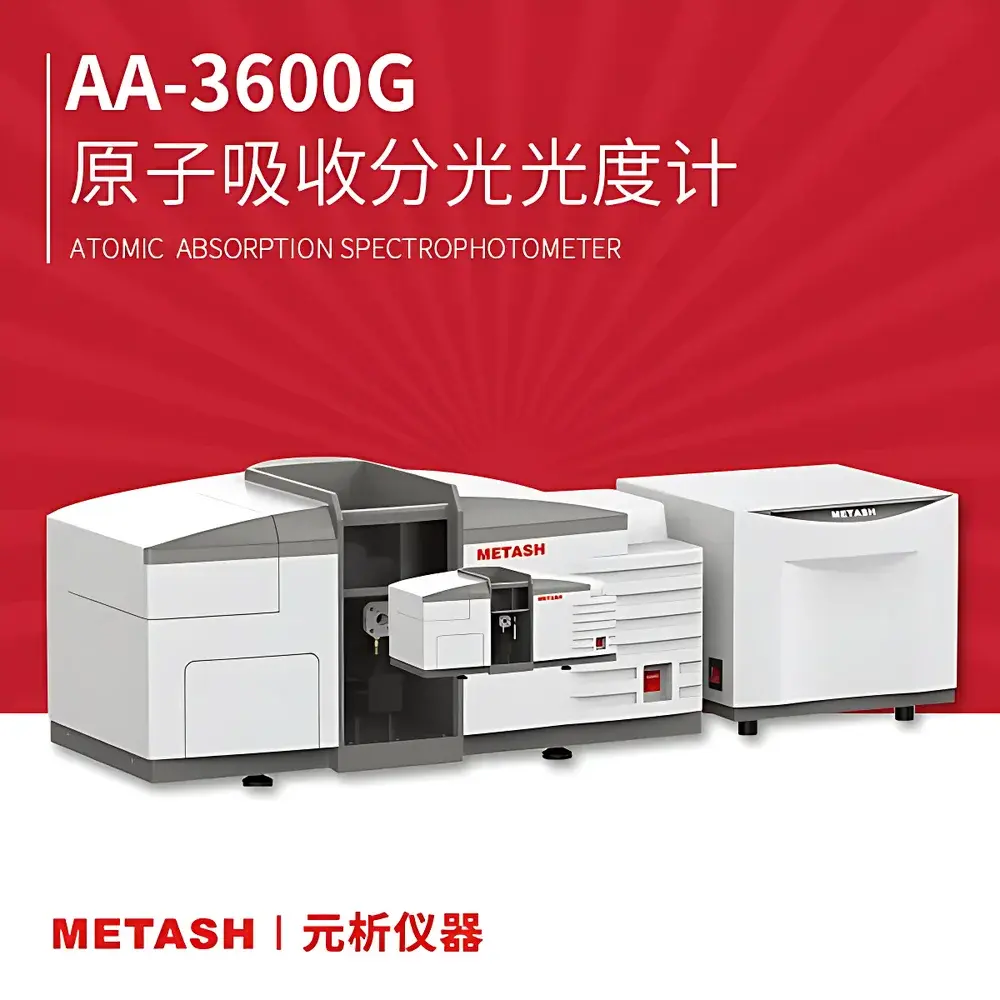
Metash AA-3600G Graphite Furnace Atomic Absorption Spectrometer
| Brand | Metash Instruments |
|---|---|
| Origin | Shanghai, China |
| Manufacturer | Yes |
| Instrument Type | Graphite Furnace AAS |
| Monochromator | Plane Grating |
| Optical System | Single-Beam |
| Detector | Photomultiplier Tube (PMT) |
| Background Correction | D₂ Lamp + Self-Reversal Method |
| Spectral Resolution | 0.1 nm |
| Characteristic Mass (Cd) | 0.4 × 10⁻¹² g |
| Detection Limit (Cd) | 0.5 × 10⁻¹² g |
| Precision (RSD) | ≤3% |
| Wavelength Range | 190–900 nm |
| Grating Grooves | 1800 lines/mm |
| Spectral Bandwidths | 0.2 / 0.4 / 1.0 / 2.0 nm (auto-switchable) |
| Wavelength Accuracy | ±0.1 nm |
| Wavelength Repeatability | 0.1 nm |
| Baseline Drift | 0.004 A / 30 min |
| Background Correction Capacity | >30× at 1 A |
Overview
The Metash AA-3600G is a high-performance graphite furnace atomic absorption spectrometer engineered for trace metal quantification in complex matrices. Based on the fundamental principle of atomic absorption spectroscopy—where ground-state free atoms in the gaseous phase absorb light at element-specific wavelengths—the AA-3600G employs electrothermal atomization to volatilize and atomize samples within a pyrolytically coated graphite tube. This enables detection at sub-picogram levels, making it suitable for regulated applications in environmental monitoring, pharmaceutical quality control, clinical toxicology, geological surveying, and cosmetic safety testing. Its single-beam optical architecture, combined with a high-efficiency 1800-line/mm plane grating monochromator and low-noise photomultiplier tube detector, ensures stable spectral isolation and high signal-to-noise ratio. The instrument conforms to internationally recognized design and manufacturing practices aligned with ISO 9001 quality management systems and supports compliance with method validation requirements under USP , ASTM D3694, and EPA Method 200.8.
Key Features
- Automated six-lamp turret with programmable lamp selection and automatic current optimization for hollow cathode lamps (HCLs) or electrodeless discharge lamps (EDLs)
- Intelligent wavelength scanning, peak search, and auto-bandwidth switching across four fixed slit widths (0.2/0.4/1.0/2.0 nm) to balance resolution and sensitivity per analyte
- Dual-mode background correction: Deuterium arc lamp for broad-band correction and self-reversal (SR) technique for narrow-line interference—both implemented without mechanical movement for enhanced reproducibility
- Proprietary graphite furnace design featuring symmetrical radial heating and integrated temperature gradient compensation, minimizing thermal memory effects and chemical interferences while extending tube lifetime
- Comprehensive safety interlock system: real-time monitoring of cooling water flow rate, argon purge pressure, furnace temperature ramp profiles, and power failure recovery protocols
- Fully automated parameter optimization engine—preloaded with validated methods for >30 elements including Cd, Pb, As, Cr, Ni, and Al—reducing method development time and operator dependency
Sample Compatibility & Compliance
The AA-3600G accommodates liquid samples (aqueous, acidic digests, organic extracts) and solid micro-samples via direct slurry introduction. It supports matrix modifiers (e.g., Pd-Mg nitrate, NH₄H₂PO₄) and platform-assisted atomization for improved precision in high-salt or viscous matrices. All operational parameters—including temperature programs, gas flow timing, and charring/atomization steps—are fully programmable and auditable. The system meets GLP and GMP documentation requirements through timestamped, user-identified method logs and instrument status records. While not inherently 21 CFR Part 11 compliant out-of-the-box, its software architecture allows integration with validated electronic signature and audit trail modules when deployed in regulated laboratories.
Software & Data Management
Controlled via Windows-based Metash AAS Suite v4.x, the software provides full instrument automation, real-time spectral visualization, multi-point calibration (linear/non-linear), QC charting (Levey-Jennings, Shewhart), and customizable report generation. Raw data files are stored in vendor-neutral ASCII format (.txt) with embedded metadata (wavelength, slit width, lamp ID, integration time). Export options include CSV, PDF, and XML for LIMS interoperability. Audit trails record all critical events—including method edits, calibration updates, and result overrides—with immutable timestamps and operator IDs. Optional network licensing supports multi-user access across local area networks with role-based permissions.
Applications
- Environmental: Quantification of heavy metals (Pb, Cd, As) in drinking water, wastewater, soil digests, and airborne particulate matter (PM₂.₅ filters)
- Pharmaceuticals: Elemental impurities testing per ICH Q3D guidelines—particularly for catalyst residues (Pd, Pt, Rh) in active pharmaceutical ingredients (APIs)
- Clinical & Forensic: Blood lead level (BLL) screening, urinary cadmium assessment, and toxic metal profiling in hair/nail tissues
- Food & Cosmetics: Ni, Cr, and Co analysis in pigments, preservatives, and packaging leachates per EU Cosmetics Regulation (EC) No 1223/2009
- Geological & Mining: Ultra-trace analysis of rare earth elements (REEs) and transition metals in rock powders following HF-HNO₃ digestion
FAQ
What types of samples can be analyzed directly on the AA-3600G?
Aqueous standards, acid-digested environmental or biological samples (e.g., HNO₃/HF digests), and stabilized slurries (e.g., soil or sediment suspensions with dispersants) are compatible. Direct solid sampling requires optional accessories.
Is the AA-3600G compatible with autosamplers from third-party vendors?
Yes—it supports RS-232 and USB TTL communication protocols for integration with most commercially available programmable autosamplers, including those meeting ASTM D6728 specifications.
How does the self-reversal background correction differ from standard D₂ correction?
Self-reversal uses the same HCL as the analytical source, modulating its emission to generate a continuum-like profile at the line center—enabling correction of structured background near atomic lines where D₂ correction may underperform.
What maintenance intervals are recommended for the graphite furnace system?
Graphite tubes should be replaced after 200–300 firings depending on matrix load; platform cleaning is advised every 50 runs; furnace alignment verification is recommended quarterly or after mechanical shock.
Can the AA-3600G be upgraded to support hydride generation or cold vapor techniques?
No—this model is dedicated to graphite furnace AAS. Hydride/cold vapor functionality requires separate instrumentation (e.g., Metash HG-3600 or CV-AAS add-on modules).





