
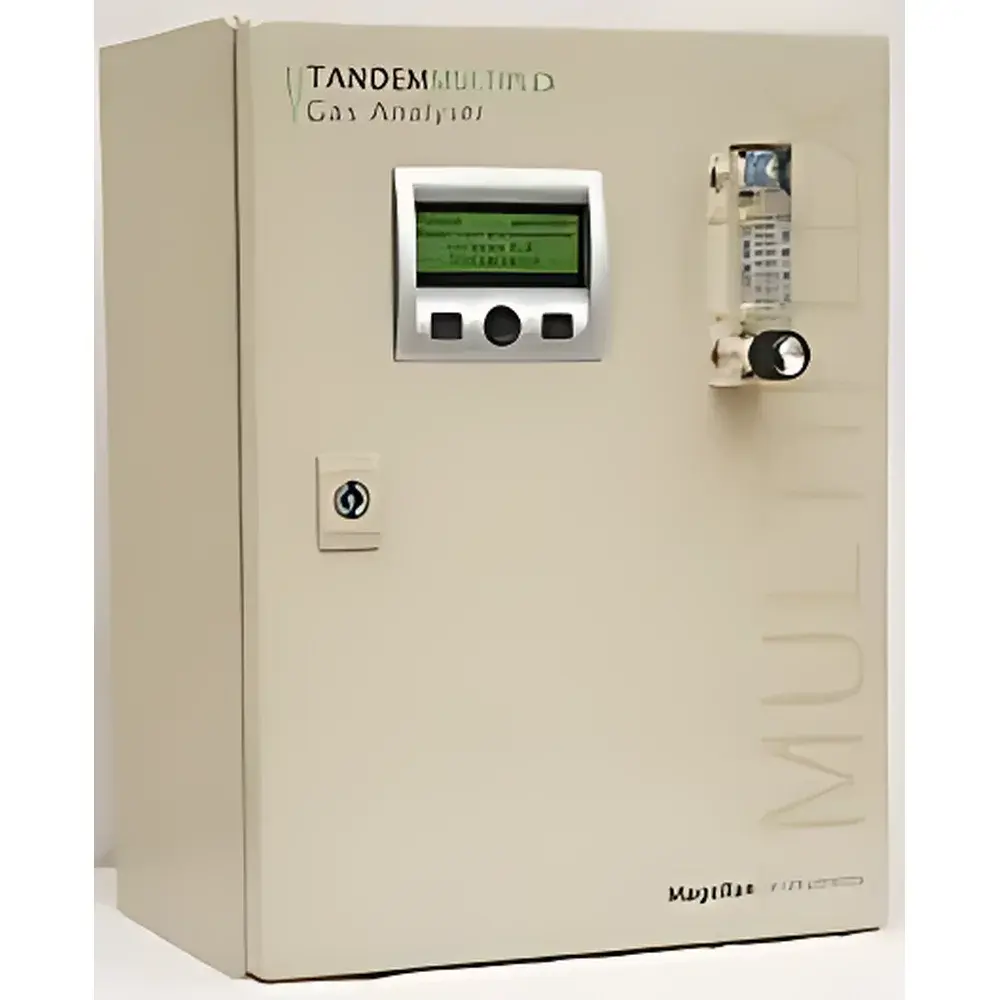
HEL Tandem MULTI Gas Analyzer for Bioreactor Off-Gas Monitoring
| Brand | HEL (UK) |
|---|---|
| Origin | United Kingdom |
| Model | Tandem MULTI |
| Construction Material | Stainless Steel |
| Operating Pressure | Low-Pressure System |
| Working Volume | 5 L |
| Vacuum Range | 0–1 MPa |
| CO₂ Measurement Principle | Non-Dispersive Infrared (NDIR) Absorption |
| O₂ Measurement Principle | Electrochemical Sensor |
| CO₂ Range Options | 5%, 10%, 20%, 50%, 60%, 100% |
| O₂ Range Options | 25%, 30%, 50%, 60%, 100% |
| CO₂/O₂ Resolution | 0.01% |
| Accuracy | ±2% of Full Scale |
| Drift | <0.05% FS/month |
| Response Time (T90) | <50 s (CO₂), <10 s (O₂) |
| Sample Flow Rate | 25–1000 mL/min |
| Operating Temperature | 0–45 °C |
| Temperature Compensation | Integrated |
| Output Signals | Dual 0–10 V and 4–20 mA analog outputs |
| Digital Interface | RS232 |
| Internal Sampling Pump | Yes |
| Local Display | Yes |
| Calibration | Manual and Auto-calibration support |
| Channel Capacity | Up to 12 multiplexed gas streams |
| Sampling Interval | User-definable from 30 seconds |
| Compliance | Designed for GLP/GMP-aligned bioprocess environments |
| Software Integration | Compatible with SCADA, DCS, and LabVIEW via RS232 and analog I/O |
Overview
The HEL Tandem MULTI Gas Analyzer is an engineered solution for real-time, continuous off-gas analysis in bioprocess applications. It employs dual-sensor technology—non-dispersive infrared (NDIR) absorption for precise CO₂ quantification and electrochemical sensing for high-fidelity O₂ measurement—to deliver robust, reproducible data under dynamic fermentation and cell culture conditions. Unlike standalone probe-based systems requiring frequent recalibration and drift correction, the Tandem MULTI integrates flow-controlled sampling, temperature-compensated signal processing, and built-in pump-assisted aspiration to ensure stable baseline performance across extended operation cycles. Its design conforms to the operational constraints of low-pressure stainless-steel bioreactors (up to 5 L working volume) and supports vacuum ranges from ambient to 1 MPa absolute—enabling compatibility with both aerobic and microaerobic cultivation strategies. The analyzer operates within a controlled thermal envelope (0–45 °C), with internal compensation algorithms minimizing environmental interference on sensor output.
Key Features
- Dual-analyte capability: Simultaneous, independent measurement of CO₂ and O₂ concentrations with configurable range selection (e.g., 0.1–5% CO₂; 0.1–25% O₂) to match specific metabolic profiles.
- High temporal resolution: T90 response times of <50 seconds for CO₂ and <10 seconds for O₂ enable detection of rapid physiological shifts during induction, infection, or nutrient depletion events.
- Industrial-grade analog and digital I/O: Dual isolated 0–10 V and 4–20 mA outputs support direct integration into PLCs, DCS, and PID controllers; RS232 interface enables bidirectional communication with process monitoring software.
- Modular multiplexing architecture: Configurable channel capacity (4, 6, 8, or 12 streams) allows centralized monitoring of multiple reactors or sequential sampling from a single vessel using time-scheduled valve sequencing.
- Self-contained sampling system: Integrated diaphragm pump ensures consistent flow rates (25–1000 mL/min) without reliance on external vacuum sources or pressurized carrier gases.
- Calibration flexibility: Supports both manual span/gain adjustment and automated zero/span routines using certified calibration gases—documented per FDA 21 CFR Part 11 requirements when paired with compliant software platforms.
Sample Compatibility & Compliance
The Tandem MULTI is validated for use with humid, particulate-laden, and condensate-prone bioreactor off-gas streams typical of mammalian cell culture, microbial fermentation (e.g., E. coli, S. cerevisiae), and anaerobic digestion processes. Its stainless-steel wetted path and hydrophobic particulate filter prevent sensor fouling and extend maintenance intervals. The analyzer meets CE marking requirements for electromagnetic compatibility (EMC Directive 2014/30/EU) and low-voltage safety (LVD Directive 2014/35/EU). While not intrinsically rated for hazardous areas, it is routinely deployed in ISO Class 5–8 cleanrooms and GMP manufacturing suites where environmental controls mitigate explosion risks. Data integrity features—including audit-trail-enabled calibration logs and timestamped raw signal exports—support compliance with ICH GCP, USP , and Annex 11 expectations for analytical instrument qualification.
Software & Data Management
The Tandem MULTI does not include proprietary control software but provides deterministic, low-latency data streaming via RS232 at user-defined baud rates (default 9600 bps, 8-N-1). Raw sensor values (CO₂ %, O₂ %, temperature, flow status) are transmitted as ASCII-encoded comma-separated fields, enabling seamless ingestion into third-party platforms such as DeltaV, Siemens Desigo, MATLAB, or custom Python-based dashboards. Analog outputs facilitate hardwired connection to historian systems (e.g., OSIsoft PI, AVEVA Historian) for long-term trending of respiratory quotient (RQ = CO₂/O₂), oxygen uptake rate (OUR), carbon evolution rate (CER), and volumetric mass transfer coefficient (kLa) calculations. All configuration parameters—including sampling interval, alarm thresholds, and range selection—are stored in non-volatile memory and persist through power cycling.
Applications
- Real-time metabolic monitoring in CHO, HEK293, and hybridoma cell cultures for feed strategy optimization and viability prediction.
- Batch-to-batch consistency assessment in antibiotic or therapeutic protein production by correlating off-gas dynamics with HPLC and qPCR endpoints.
- Scale-down model validation: Matching RQ and OUR profiles between benchtop (250 mL) and pilot-scale (10 m³) bioreactors to de-risk tech transfer.
- Metabolic flux analysis (MFA) input generation via stoichiometric mass balance of gaseous inputs/outputs and liquid-phase substrate/product assays.
- Early detection of contamination events through anomalous O₂ consumption or CO₂ accumulation patterns outside historical control limits.
- Regulatory submission support: Providing auditable, timestamped off-gas records for IND/BLA dossiers demonstrating process understanding per Q5C and Q5D guidelines.
FAQ
Is the Tandem MULTI suitable for anaerobic digestion monitoring?
Yes—it supports CO₂ ranges up to 100% and O₂ down to 1%, making it appropriate for biogas stream analysis when configured with appropriate sample conditioning (e.g., moisture removal, particulate filtration).
Can it be used with disposable bioreactors?
Yes—its analog outputs interface directly with common single-use controller systems (e.g., Sartorius BIOSTAT STR, Thermo Fisher HyPerforma), and its compact footprint (<200 × 150 × 100 mm) allows benchtop or rack-mount installation.
What maintenance is required?
Annual sensor verification using NIST-traceable calibration gases is recommended; electrochemical O₂ sensors typically require replacement every 18–24 months under continuous operation, while NDIR CO₂ cells exhibit >5-year service life.
Does it support 21 CFR Part 11 compliance?
The hardware itself is Part 11–capable when integrated with validated software that enforces electronic signatures, audit trails, and role-based access control—functions managed externally by the host SCADA or LIMS platform.
How is flow rate controlled during multiplexed sampling?
Each channel is equipped with a solenoid valve and calibrated orifice; total system flow is regulated by the internal pump, while individual stream residence time is governed by programmable dwell duration per port.



