
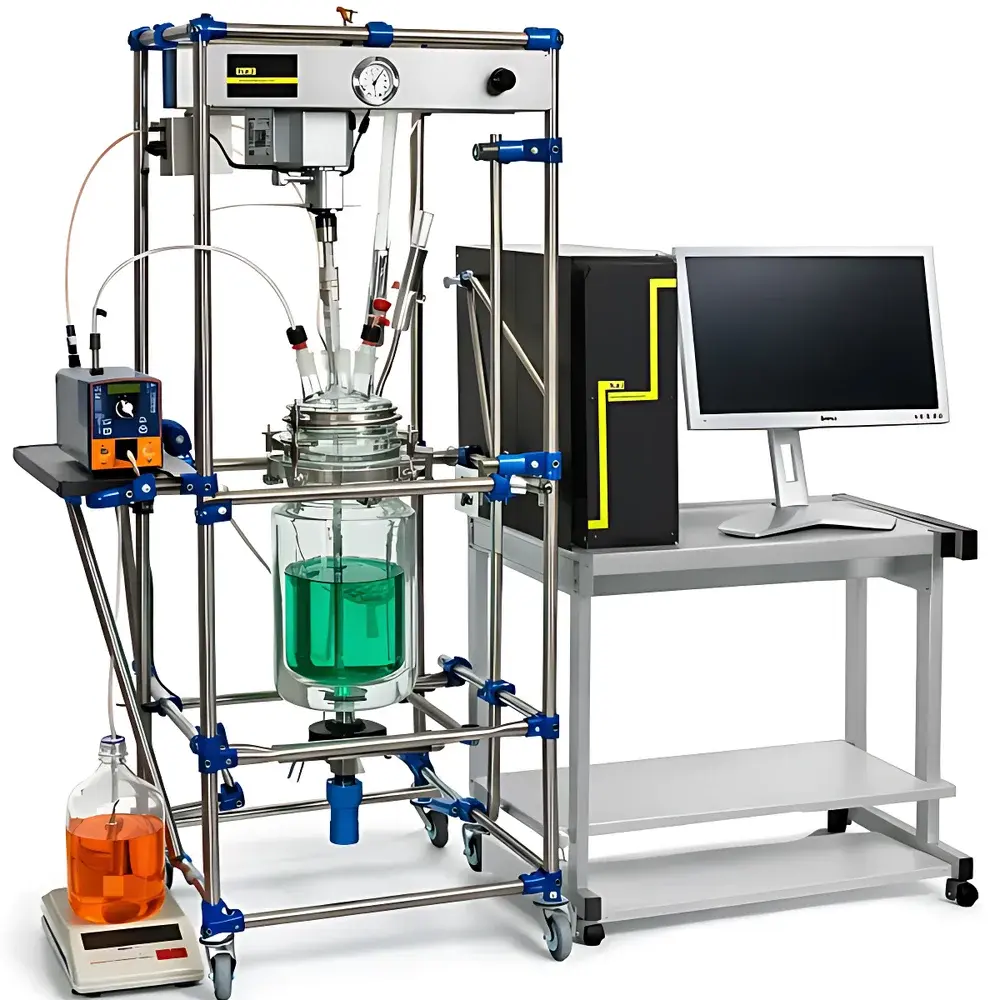
HEL Simular 10L/20L Large-Scale Reaction Calorimeter
| Brand | HEL (UK) |
|---|---|
| Origin | United Kingdom |
| Model | Simular 10L/20L |
| Calorimetry Mode | Adiabatic |
| Instrument Type | Reaction Calorimeter |
| Automation | Fully Automated |
| Temperature Range | −30 °C to 225 °C |
| Temperature Resolution | 0.2 mK |
| Temperature Precision | ±0.1 K |
| Maximum Jacket Pressure | 100 bar |
| Heat Capacity Range | ±750 J/K |
| Vessel Materials | Borosilicate Glass, 316 Stainless Steel, Hastelloy C-276 |
| Compatible PAT Interfaces | FTIR, Raman, pH, DO, ORP, Turbidity, Pressure, Temperature |
Overview
The HEL Simular 10L/20L Large-Scale Reaction Calorimeter is an engineered platform for quantitative thermal and kinetic characterization of chemical reactions under conditions closely mirroring industrial-scale production. Unlike conventional laboratory-scale calorimeters (e.g., 0.5–2 L), the Simular system operates at volumetric scales—10 L and 20 L—that preserve critical scale-dependent phenomena including heat accumulation dynamics, mixing-induced local concentration gradients, gas–liquid mass transfer limitations, and wall-to-bulk thermal resistance. Its adiabatic calorimetry architecture enables direct measurement of reaction enthalpy (ΔHr), heat release rate (dQ/dt), and cumulative thermal power with high reproducibility. The system adheres to fundamental principles of heat balance modeling (Qgen = Qloss + Qaccum) while minimizing parasitic heat exchange via active jacket temperature control and real-time adiabatic correction algorithms. This makes it particularly suitable for process safety evaluation, reaction hazard assessment (e.g., RC1-type studies), and thermally driven process design in regulated environments.
Key Features
- Fully automated adiabatic, heat-flow, and reflux calorimetry modes—enabling consistent comparison across operating regimes without hardware reconfiguration
- Modular reactor configuration supporting pressurized (up to 100 bar), atmospheric, and dual-vessel setups for parallel or sequential reaction studies
- Integrated multi-sensor monitoring: high-precision Pt100 temperature sensors (0.2 mK resolution), calibrated pressure transducers, pH, dissolved oxygen (DO), oxidation-reduction potential (ORP), and turbidity probes
- Open PAT integration architecture compliant with OPC UA and Modbus TCP protocols—validated for real-time synchronization with inline FTIR, Raman spectroscopy, and particle size analyzers
- Robust mechanical design featuring interchangeable vessel assemblies in borosilicate glass, 316 stainless steel, and Hastelloy C-276—ensuring compatibility with corrosive, hydrogenation, or high-pressure chemistries
- Dynamic agitation control with programmable torque, RPM, and impeller power density profiles—enabling faithful replication of industrial mixing intensity and circulation time
Sample Compatibility & Compliance
The Simular 10L/20L accommodates heterogeneous, multiphase, and catalytic reaction systems common in pharmaceutical synthesis, fine chemical manufacturing, battery electrolyte decomposition studies, and petrochemical oxidation processes. Vessel geometry maintains representative surface-area-to-volume (A/V) ratios—critical for accurate extrapolation of thermal runaway onset temperatures (TMRAD) and time-to-maximum-rate (TMRad) values per ASTM E659 and ISO 8064 standards. All electronic subsystems comply with IEC 61000-6-2/6-4 for electromagnetic compatibility, and the control architecture supports audit trails, electronic signatures, and role-based access control required under FDA 21 CFR Part 11 and EU Annex 11 for GMP-regulated development labs. Calibration procedures follow ISO/IEC 17025 traceability requirements through NPL-recognized reference standards.
Software & Data Management
Control and analysis are executed via HEL’s unified Reaction Manager™ software—a validated, Windows-based application designed for both novice and expert users. The interface supports fully scriptable experiment sequences—including ramp-hold-cool profiles, multi-step addition protocols, and conditional safety triggers. Real-time visualization includes synchronized plots of thermal power, temperature deviation, stirrer torque, and PAT-derived concentration trajectories. All raw data (including timestamped sensor metadata and system status flags) are stored in HDF5 format with embedded units and SI prefixes, ensuring long-term readability and third-party interoperability. Data export options include CSV, MATLAB .mat, and ASTM E2500-compliant PDF reports with embedded uncertainty propagation estimates. Software validation packages (IQ/OQ/PQ documentation) and 21 CFR Part 11 compliance modules are available as optional add-ons.
Applications
- Process safety assessment: Determination of adiabatic temperature rise (ΔTad), maximum self-heat rate (dT/dt)max, and TMRad for HAZOP and LOPA studies
- Kinetic parameter estimation: Direct extraction of apparent activation energy (Ea), reaction order (n), and pre-exponential factor (k0) from dynamic calorimetric data
- Thermal stability screening of battery cathode materials, electrolytes, and solid-state interfaces under inert or controlled-atmosphere conditions
- Scale-up validation: Quantification of heat transfer coefficient (U-value) deviations and mixing time effects between lab, pilot, and production vessels
- Reaction optimization: Evaluation of dosing strategy, catalyst loading, and solvent effects on exothermicity profile and byproduct formation kinetics
- Regulatory submission support: Generation of GLP-compliant calorimetric datasets for REACH, ICH Q5C, and EPA OPPTS 830.6303 submissions
FAQ
What distinguishes Simular from traditional RC1 or CPA calorimeters?
The Simular platform eliminates geometric scaling artifacts by matching industrial A/V ratios and mixing power densities—whereas RC1 systems (typically ≤ 2 L) suffer from excessive surface cooling and non-representative flow fields.
Can the system operate under vacuum or inert atmosphere?
Yes—vessels are rated for full vacuum to 100 bar, with gas-handling modules supporting continuous purge, headspace analysis, and controlled stoichiometric dosing via mass flow controllers.
Is third-party PAT integration supported out-of-the-box?
All Simular configurations include native Ethernet ports and protocol libraries for FTIR (ReactIR), Raman (ExoScan), and particle imaging (FBRM) devices—with vendor-validated communication drivers supplied.
How is temperature uniformity maintained across the 20 L volume?
Through a combination of jacketed vessel design, calibrated axial temperature profiling (using up to six independent Pt100 sensors), and adaptive PID control with feedforward compensation based on measured power input and agitator torque.
Does the software support automated safety interlocks?
Yes—users define custom safety limits (e.g., dT/dt > 5 K/min, T > 180 °C, P > 80 bar) that trigger immediate cooling, stirring cessation, reagent shut-off, and alarm logging with timestamped event capture.



