
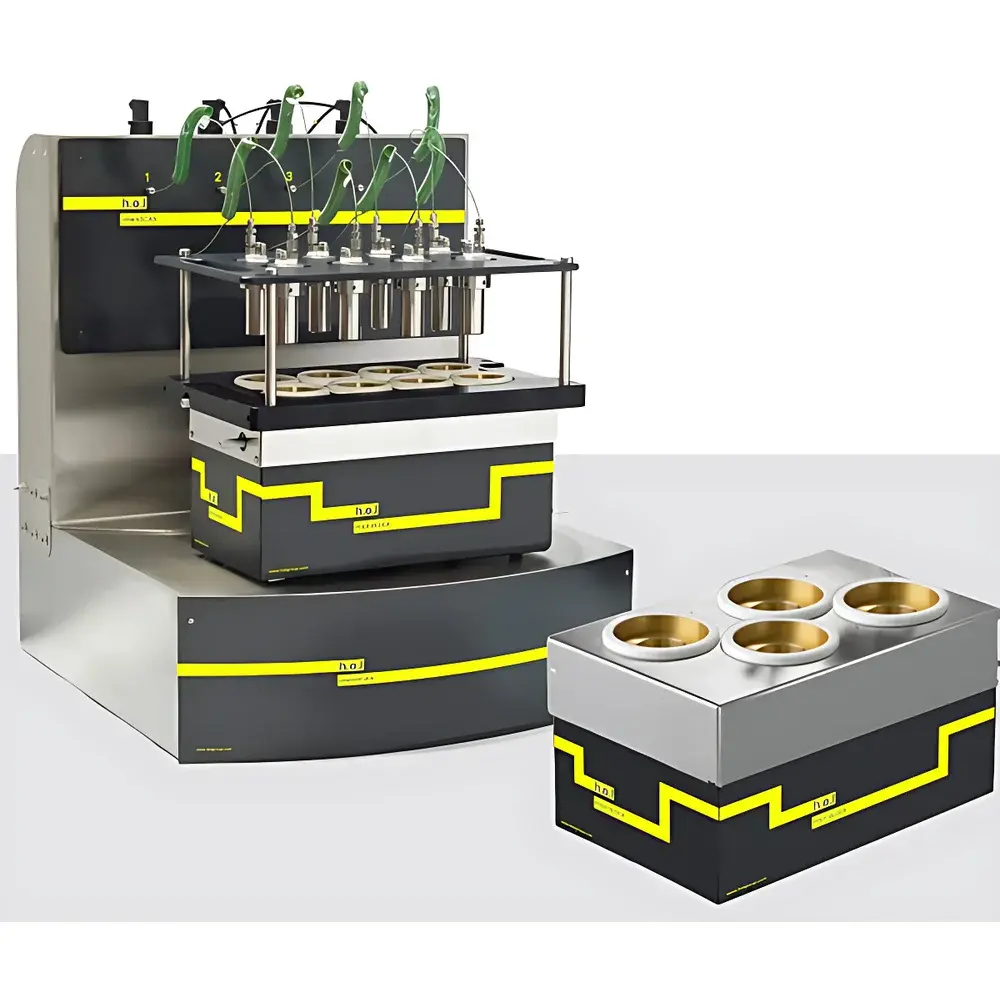
HEL ChemSCAN & ChemSCAN Custom Automated High-Pressure Catalyst Screening Platform
| Brand | HEL (UK) |
|---|---|
| Origin | United Kingdom |
| Model | ChemSCAN & ChemSCAN Custom |
| Operating Pressure | 200 bar |
| Operating Temperature | −60 °C to 200 °C |
| Catalyst Bed Volume | 120 mL |
| Reactor Configuration | 8 independently controlled parallel reactors |
| Standard Vessel Capacity | 16 mL |
| Optional Vessel Capacities | 25 mL, 50 mL, 75 mL, 120 mL, 160 mL, 300 mL, 400 mL |
| Stirring Options | Magnetic suspension stirring, overhead mechanical stirring (optional), stir-controlled per reactor |
| Gas Consumption Monitoring | Real-time, reactor-specific calculation |
| Liquid Dosing | Optional automated high-pressure liquid injection |
| Compliance | Designed for GLP/GMP-aligned R&D environments |
Overview
The HEL ChemSCAN and ChemSCAN Custom are benchtop, fully automated parallel reaction platforms engineered for high-pressure heterogeneous catalysis research and process development. Based on Couette-type flow dynamics and precision-managed gas–liquid–solid mass transfer, the system enables rigorous kinetic profiling under industrially relevant conditions—up to 200 bar and 200 °C. Each of the eight independent reactor zones incorporates dual-sensor temperature control (with ±0.5 °C stability), individual pressure regulation (including inter-reactor differential pressure up to 30 bar), and real-time stoichiometric gas uptake quantification via integrated mass flow correlation. The platform’s architecture eliminates cross-talk between zones, ensuring statistically valid parallel experimentation—critical for catalyst structure–activity relationship (SAR) mapping and early-stage reaction pathway de-risking.
Key Features
- Eight fully isolated reactor channels with independent PID-controlled heating/cooling (−60 °C to 200 °C), enabled by dual-circuit thermal management and optional cryogenic recirculation
- Reactor vessels available in volumes from 16 mL to 400 mL, constructed from 316 stainless steel or Hastelloy C-276 for corrosion resistance under acidic, halogenated, or sulfur-rich reaction media
- Multi-mode agitation: standard magnetic suspension stirring (optimized for 16–75 mL vessels); optional overhead mechanical stirring with magnetic drive seal (for ≥100 mL vessels, up to 250 °C and 200 bar)
- Real-time, per-reactor gas consumption calculation derived from pressure decay kinetics, calibrated against reference gas standards (N2, H2, CO, CH4)
- Optional high-pressure liquid dosing module (up to 200 bar) with syringe-driven precision metering and inert-gas purged fluid paths to prevent catalyst poisoning
- Modular sensor expansion: each vessel accommodates auxiliary probes (pH, IR, Raman fiber-optic ports, turbidity sensors) via standardized multi-port head design
Sample Compatibility & Compliance
The ChemSCAN platform supports solid catalysts (supported metals, MOFs, zeolites), slurries, viscous organometallic solutions, and gas-sensitive intermediates. Vessel geometries maintain consistent gas–liquid interfacial area across scales—enabling direct translation from 16 mL screening data to pilot-scale reactor design. All hardware conforms to PED 2014/68/EU and ASME BPVC Section VIII Div. 1 for pressure equipment. Software operation complies with FDA 21 CFR Part 11 requirements when configured with electronic signatures, role-based access control, and immutable audit trails. Data export formats (CSV, HDF5, .mat) align with ISO/IEC 17025 analytical data integrity standards.
Software & Data Management
HEL’s proprietary ReactionLab™ software provides closed-loop automation of temperature ramps, pressure holds, gas purging sequences, and multi-step liquid addition protocols. Each reactor logs timestamped, synchronized datasets—including thermocouple readings, pressure transducer outputs, stir speed feedback, and calculated molar gas uptake—into a relational database. Batch comparison tools enable statistical analysis (ANOVA, PCA) across catalyst batches or ligand libraries. Raw data files are SHA-256 hashed and archived with metadata tags (operator ID, calibration certificate IDs, environmental loggers). Optional integration with ELN systems (e.g., LabArchives, Benchling) via REST API ensures seamless traceability from screening to regulatory submission.
Applications
- Accelerated discovery of Fischer–Tropsch, hydrodeoxygenation (HDO), and asymmetric hydrogenation catalysts
- Structure–performance evaluation of supported Ni, Pd, Ru, and Ir catalysts under syngas, CO2, or NH3 atmospheres
- Reaction calorimetry integration for ΔHr determination during exothermic hydrogenations
- Long-duration stability testing (≥100 h) with periodic online GC sampling via integrated septum ports
- Scale-down validation for continuous-flow microreactor development and CFD model parameterization
FAQ
What is the maximum allowable temperature differential between adjacent reactors?
Up to 100 °C—enabled by thermally decoupled heating blocks and independent PID loops.
Can the system operate under inert atmosphere without active gas flow?
Yes; vacuum-purge cycles followed by static pressurization are programmable, with leak rate monitoring (<0.1 mbar·L/s) verified per reactor.
Is catalyst loading performed in situ or ex situ?
Both options supported: pre-loaded disposable cartridges (for 16–50 mL vessels) or manual charging into reusable vessels with torque-sealed top heads.
How is gas composition handled in multi-component feeds (e.g., H2/CO/N2)?
Mass flow controllers (MFCs) are calibrated per gas species; blending occurs upstream of the manifold, with real-time composition verification via integrated FTIR (optional).
Does the platform support PAT (Process Analytical Technology) integration?
Yes—standard RS-485 and Ethernet/IP interfaces allow synchronization with inline ATR-FTIR, UV-Vis, or Raman spectrometers for reaction progress tracking.



