
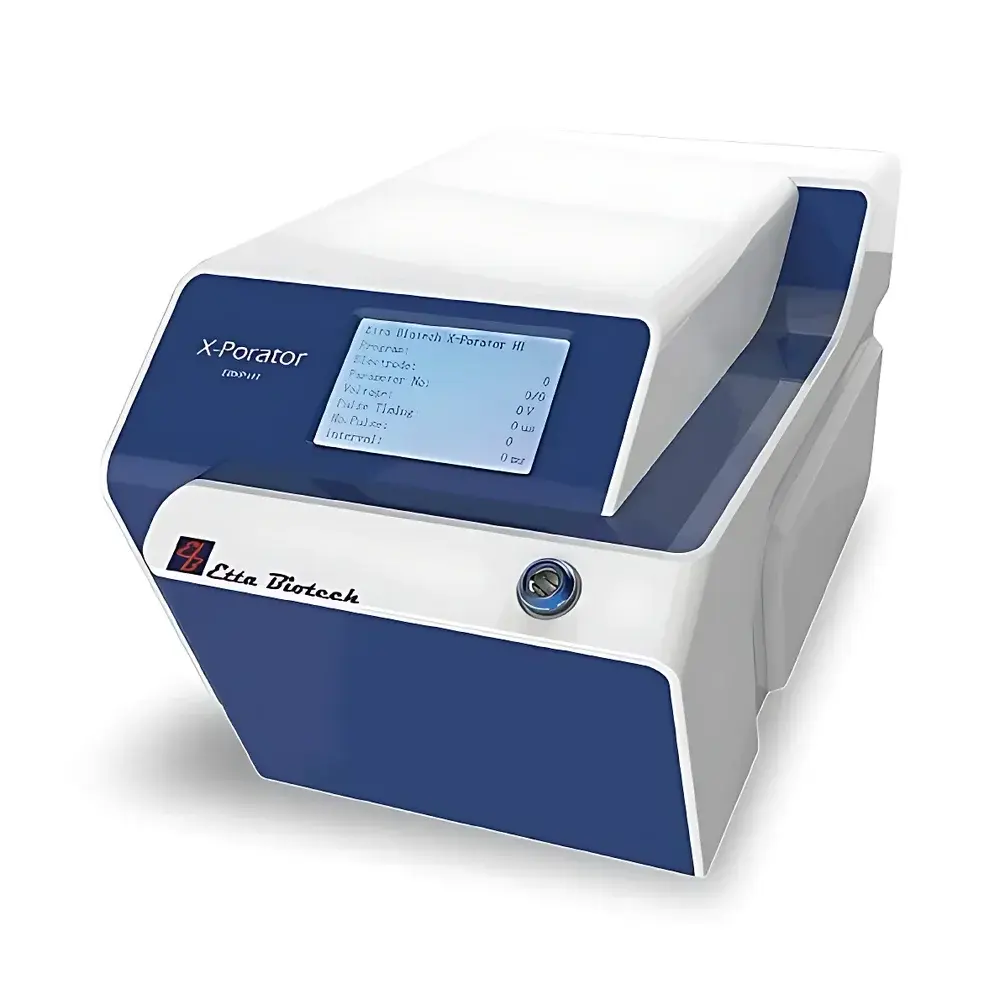
Etta Biotech X-Porator H1 Flow-Through Electroporation System
| Brand | Etta Biotech |
|---|---|
| Origin | Jiangsu, China |
| Manufacturer Type | Authorized Distributor |
| Country of Origin | China |
| Model | X-Porator H1 |
| High-Voltage Range | 30–600 VDC |
| Low-Voltage Range | 30–600 VDC |
| Output Waveform | Square Wave |
| Cell Throughput | 3–250 mL per run |
| Recommended Cell Density | 1 × 10⁸ cells/mL |
| Compatible Vessels | Corning 15 mL, 50 mL, and 250 mL centrifuge tubes |
| Flow Rate | 1–50 mL/min |
| Input Voltage | 210–240 VAC |
| Control Software | X-Porator F1 (Linux-based) |
| Dimensions (W × D × H) | 623 × 452 × 325 mm |
| Weight | 28 kg |
Overview
The Etta Biotech X-Porator H1 is a benchtop flow-through electroporation system engineered for high-efficiency nucleic acid delivery into suspension-phase eukaryotic cells. Unlike conventional cuvette-based electroporators, the X-Porator H1 employs a proprietary continuous-flow electrode architecture that generates a spatially uniform electric field across a laminar cell suspension stream—enabling scalable, reproducible transfection without thermal hotspots or electrode polarization artifacts. This design adheres to fundamental principles of electroporation physics: transient membrane permeabilization occurs when the transmembrane potential exceeds ~0.5–1 V, induced by externally applied DC square-wave pulses. The system’s dual-range voltage capability (30–600 VDC) supports both low-voltage protocols optimized for sensitive primary cells and higher-voltage regimes required for refractory lines or large-molecule delivery (e.g., mRNA, CRISPR RNP complexes). Its integration into early-stage bioprocess workflows—including CAR-T/NK manufacturing and therapeutic antibody discovery—reflects its alignment with process intensification goals under evolving regulatory expectations for modalities developed under GLP and GMP-aligned conditions.
Key Features
- Continuous-flow electroporation platform supporting single-run volumes from 3 mL to 250 mL—up to 30× greater throughput than standard cuvette systems.
- Patented flow-cell electrode geometry ensuring homogeneous electric field distribution, minimizing Joule heating and enabling consistent transfection efficiency across variable cell densities (1 × 10⁷–1 × 10¹⁰ cells per run).
- GMP-compliant disposable processing kits: sterilized via gamma irradiation in certified cleanrooms; validated for endotoxin levels ≤0.25 EU/mL and sterility per ISO 11737-1.
- Optimized proprietary electroporation buffer formulated to maintain cytosolic pH and osmolarity during pulse delivery, reducing post-electroporation apoptosis and improving viable transfectant yield by ≥2.3-fold versus commercial alternatives (data on file, Etta Biotech Technical Report TR-XPH1-2023-04).
- Embedded Linux-based control interface (X-Porator F1 software) with audit-trail functionality compliant with FDA 21 CFR Part 11 requirements for electronic records and signatures.
- Modular hardware architecture compatible with standard Corning centrifuge tubes (15 mL, 50 mL, 250 mL), eliminating need for custom cartridges and lowering consumables cost-of-ownership.
Sample Compatibility & Compliance
The X-Porator H1 is validated for use with suspension-adapted mammalian cell lines (e.g., CHO-S, HEK293F, Jurkat) and primary human lymphocytes (T, NK, B cells). It does not support adherent cells without prior detachment and resuspension in defined low-conductivity media. All disposable components meet USP Class VI biocompatibility standards and are free of animal-derived materials. Device firmware and software comply with IEC 62304 Class B for medical device software lifecycle management. Documentation packages include IQ/OQ templates aligned with ASTM E2500-13 and ISO 13485:2016 for equipment qualification in regulated environments.
Software & Data Management
The X-Porator F1 software provides parameter-driven protocol definition (voltage, pulse width, number of pulses, inter-pulse interval), real-time monitoring of current draw and temperature stabilization, and automated export of raw pulse logs in CSV and HDF5 formats. Audit trails record user identity, timestamp, parameter changes, and run outcomes—retained for ≥36 months with optional encrypted network backup. Integration with LIMS platforms is supported via RESTful API endpoints (OAuth 2.0 secured), enabling traceability from electroporation event to downstream assay data in QC/QA workflows.
Applications
- Preclinical biologics development: Rapid generation of stable or transient expression clones for monoclonal antibody screening, bispecific construct evaluation, and Fc-engineering studies.
- Cell therapy process development: Scalable non-viral transfection of T and NK cells with CAR constructs or gene-editing ribonucleoproteins—reducing reliance on lentiviral vectors and associated biosafety containment requirements.
- Vaccine research: High-yield mRNA loading into dendritic cells or ex vivo antigen-presenting cell populations for immunogenicity assessment.
- Functional genomics: Genome-wide CRISPR knockout or activation screens using pooled sgRNA libraries delivered at multi-million-cell scale per condition.
FAQ
Is the X-Porator H1 suitable for adherent cell lines?
No—only suspension-cultured eukaryotic cells are supported. Adherent cells must be enzymatically detached, washed, and resuspended in low-conductivity electroporation buffer prior to processing.
Can the system be integrated into automated liquid handling workflows?
Yes—via programmable digital I/O ports and Ethernet-controlled relay triggers, enabling synchronization with upstream cell harvesters or downstream incubation modules.
What validation documentation is provided for GMP-relevant use?
Certificate of Conformance, Installation Qualification (IQ) and Operational Qualification (OQ) templates, electrical safety test reports (IEC 61010-1), and software verification summary per IEC 62304 Annex C.
Does the system support exponential decay waveforms?
No—only square-wave pulses are implemented, as they provide superior temporal control and energy efficiency for flow-through configurations.
Are third-party buffers compatible with the X-Porator H1?
While technically operable, use of non-Etta buffers voids performance guarantees and may compromise reproducibility due to uncontrolled conductivity, pH, and ion composition effects on field homogeneity.




