
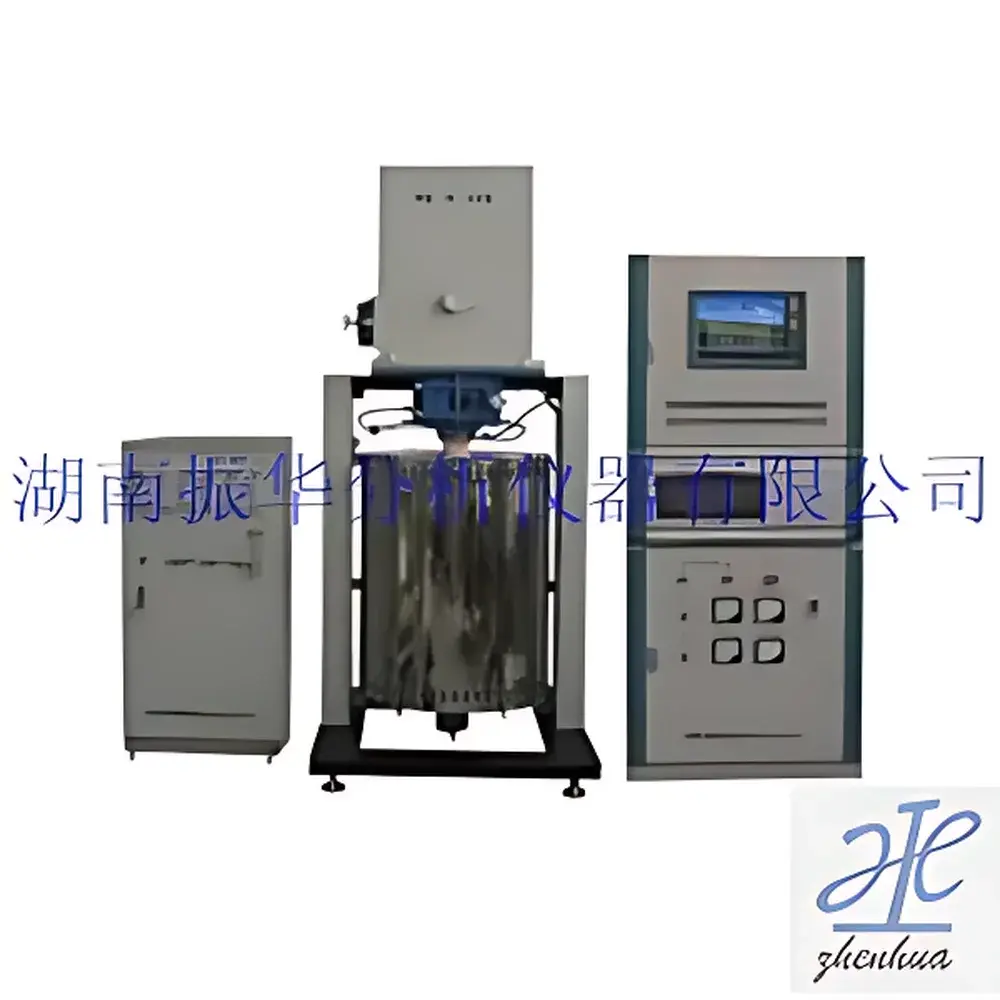
RZW High-Temperature Thermogravimetric Analyzer (TGA)
| Key | Max Sample Mass: 1500 g |
|---|---|
| Mass Resolution | 0.01 g |
| Max Operating Temperature | 1600 °C (short-term up to 1650 °C) |
| Heating Rate | 0–10 °C/min |
| Isothermal Temperature Stability | ±2 °C |
| Atmosphere Options | Air, N₂, Ar |
| Chamber Pressure Range | −0.095 to 0.1 MPa |
| Power Supply | 220 V, 8 kW, 50 Hz |
| Origin | Hunan, China |
| Manufacturer Type | Authorized Distributor |
| Regional Classification | Domestic (PRC) |
Overview
The RZW High-Temperature Thermogravimetric Analyzer is an industrial-grade TGA system engineered for precise, reproducible measurement of mass change in solid and refractory materials under controlled thermal and atmospheric conditions. It operates on the fundamental principle of thermogravimetry—monitoring real-time sample mass as a function of temperature or time—within a high-stability furnace environment. Designed specifically to meet the stringent requirements of refractory material evaluation, the RZW complies with GB/T 13244–2019 “Test Method for Oxidation Resistance of Carbon-Containing Refractories”, making it suitable for quality control, R&D validation, and regulatory testing in metallurgical, ceramic, and advanced materials laboratories. Its robust architecture supports extended operation at temperatures up to 1600 °C, with short-term excursions to 1650 °C, enabling characterization of high-melting-point oxides, carbides, graphite composites, and slag-resistant linings.
Key Features
- High-capacity weighing system with 1500 g maximum load and 0.01 g resolution, calibrated traceably to national metrological standards
- Programmable heating profile with linear ramp rates from 0 to 10 °C/min and isothermal hold capability with ±2 °C thermal accuracy
- Sealed, pressure-controlled reaction chamber supporting dynamic or static gas atmospheres (Air, N₂, Ar) across a pressure range of −0.095 to +0.1 MPa (i.e., vacuum to slight overpressure)
- Industrial-grade silicon carbide (SiC) or molybdenum disilicide (MoSi₂) heating elements integrated into a double-layer insulated furnace housing for uniform thermal distribution and minimal thermal drift
- Dedicated high-temperature ceramic sample holder and crucible support compatible with platinum, alumina, and graphite crucibles (user-supplied)
- Integrated safety interlocks including overtemperature cutoff, gas flow monitoring, and pressure anomaly detection compliant with IEC 61000-6-2/6-4 EMC standards
Sample Compatibility & Compliance
The RZW accommodates bulk samples—including shaped refractory bricks, castables, granular raw materials, and sintered ceramics—without requiring powderization, preserving structural integrity during thermal analysis. Its large chamber volume and high-load balance allow direct evaluation of full-size ASTM C212 or ISO 2245 test specimens. The system satisfies technical criteria outlined in GB/T 13244 for oxidation resistance testing and is routinely deployed in third-party certification labs accredited to CNAS-CL01 (equivalent to ISO/IEC 17025). While not pre-certified to ASTM E1131 or ISO 11358, its operational parameters and calibration methodology are fully aligned with those standards’ procedural requirements for high-temperature TGA.
Software & Data Management
The RZW is operated via dedicated Windows-based acquisition software supporting multi-step temperature programs, real-time mass/temperature/differential signal (DTG) visualization, and automated baseline correction. Raw data files are exported in ASCII-compatible .csv format with timestamped metadata (including furnace temperature, gas flow rate, chamber pressure, and ambient humidity if external sensors are connected). Audit trail functionality records all user actions, method modifications, and calibration events—supporting GLP-compliant documentation workflows. For regulated environments, optional 21 CFR Part 11 compliance packages include electronic signatures, role-based access control, and encrypted data archiving.
Applications
- Oxidation kinetics assessment of carbon-bonded refractories in steel ladle linings
- Decomposition onset and volatile evolution profiling of phosphate-bonded castables
- Thermal stability evaluation of SiC-based ceramic matrix composites (CMCs)
- Moisture, binder burnout, and phase transformation quantification in green ceramic bodies
- Residue yield determination in ash fusion and slag viscosity precursor studies
- Quality conformance testing per GB/T 2992.1 (Shaped Refractory Products) and YB/T 5200 (Unshaped Refractories)
FAQ
What crucible materials are recommended for 1600 °C operation?
Platinum-rhodium (Pt–Rh 10%) crucibles are recommended for inert or oxidizing atmospheres up to 1600 °C; high-purity alumina crucibles may be used below 1500 °C in reducing environments.
Can the RZW perform simultaneous DTA or DSC measurements?
No—the RZW is a dedicated thermogravimetric platform. Differential thermal analysis requires a separate DTA/DSC module or hybrid instrument configuration.
Is remote monitoring supported?
Yes—via Ethernet-connected PC with secure VPN access; live data streaming and alarm notifications are configurable through the host software.
Does the system include NIST-traceable calibration certificates?
Factory calibration certificates for temperature and mass are provided; NIST-traceable verification services are available upon request through authorized metrology partners.
What maintenance intervals are recommended for continuous industrial use?
Furnace insulation inspection every 500 operating hours; thermocouple verification every 200 hours; microbalance zero-check before each test sequence.



