
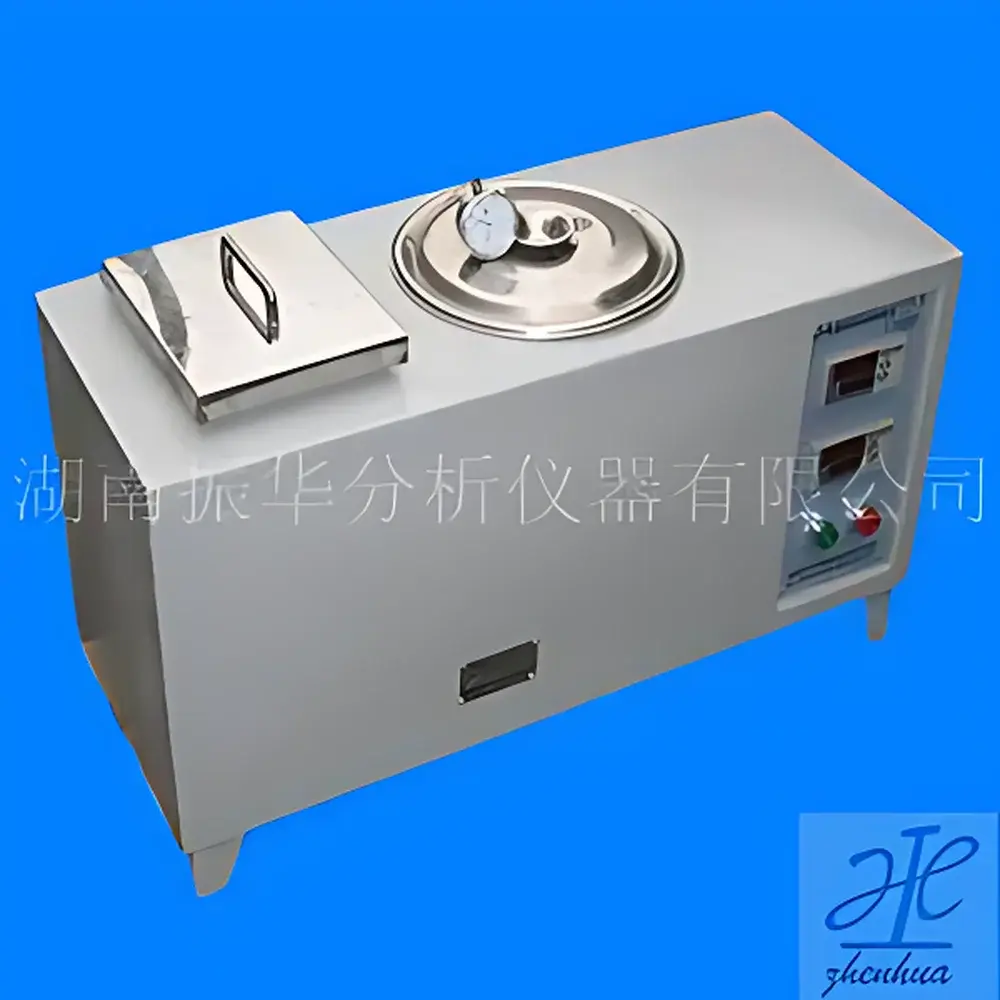
Ceramic Tile Linear Wet Expansion Tester SPY
| Origin | Hunan, China |
|---|---|
| Manufacturer Type | Distributor |
| Origin Category | Domestic |
| Model | SPY |
| Pricing | Upon Request |
| Max Furnace Temperature | 1000 °C |
| Heating Rate | Programmable |
| Power Supply | 200 V ±10%, 50 Hz |
| Max Power Consumption | 2 kW |
| Displacement Measurement Error | ≤0.01 mm |
| Temperature Recording Accuracy | ±1% of reading |
| Loading Range | 35–500 g |
| Reproducibility at 1000 °C | Expansion Rate δ ≤0.036% |
| Displacement Indication | Digital or Mechanical (Dial Indicator), Optional Resolution: 1 µm |
Overview
The SPY Ceramic Tile Linear Wet Expansion Tester is a precision thermal-mechanical instrument engineered to quantify the dimensional change of ceramic tiles and related silicate-based materials upon controlled moisture exposure and thermal cycling. It operates in strict accordance with GB/T 3810.10–2006, the Chinese national standard equivalent to ISO 10545-10 for the determination of wet expansion — a critical parameter influencing long-term dimensional stability, glaze integrity, and installation performance in architectural ceramics. The system integrates a programmable high-temperature furnace (up to 1000 °C), a calibrated mechanical loading frame, and a high-resolution displacement transduction module to measure linear strain under defined humidity and thermal conditions. Unlike generic dilatometers, the SPY is purpose-built for the standardized wet expansion test protocol: specimens are first dried, then immersed in distilled water at ambient temperature for 24 hours, re-dried, and finally subjected to controlled heating while continuously monitoring length change. This sequence isolates hygroscopic swelling from thermal expansion effects, enabling accurate separation of moisture-induced strain components.
Key Features
- Programmable furnace with precise ramp-hold profiles: Achieves 1000 °C in ≤2.0 hours with stable isothermal control (±1 °C) during measurement intervals.
- Dual-mode displacement sensing: Supports interchangeable digital linear encoders (1 µm resolution) or certified mechanical dial indicators (0.001 mm graduation), both traceable to national metrology standards.
- Adjustable axial loading mechanism: Applies consistent compressive force across the specimen (35–500 g range) to simulate realistic service constraints without inducing plastic deformation.
- Thermal uniformity optimized chamber: Minimizes axial and radial temperature gradients (<±3 °C over 50 mm specimen zone), ensuring representative expansion behavior across the entire test surface.
- Robust mechanical architecture: Stainless steel frame and ceramic-insulated furnace elements ensure long-term dimensional stability and resistance to thermal fatigue over repeated cycles.
- Compliance-ready documentation: Includes calibration certificates for displacement and temperature sensors, as well as traceable verification reports aligned with JJG 707–2014 (Chinese verification regulation for expansion testers).
Sample Compatibility & Compliance
The SPY accommodates standard ceramic tile specimens per GB/T 3810.10–2006: rectangular samples measuring 100 mm × 100 mm × thickness (typically 6–12 mm), with parallel, ground faces and minimal edge chipping. It is equally applicable to porcelain stoneware, glazed vitrified tiles, and extruded ceramic cladding panels. While GB/T 3810.10–2006 is the primary reference, the instrument’s measurement methodology aligns with the physical principles underlying ASTM C286–22 (Standard Test Method for Linear Thermal Expansion of Rigid Solids by Thermomechanical Analysis) and ISO 11359-1:2014 (Plastics — Thermomechanical Analysis — Part 1: General Principles). For quality assurance laboratories operating under GLP or ISO/IEC 17025 frameworks, the SPY supports documented instrument qualification (IQ/OQ/PQ), including temperature mapping, displacement linearity verification, and repeatability assessment at 1000 °C (δ ≤0.036%; α ≤0.25 × 10⁻⁶/°C).
Software & Data Management
The SPY operates in standalone mode with optional PC interface via RS-232 or USB-to-serial adapter. Data acquisition software (Windows-compatible, supplied) records time-stamped displacement and furnace temperature at user-defined intervals (1–60 seconds), generating CSV-exportable datasets compliant with LIMS integration requirements. All raw measurements include embedded metadata: operator ID, sample ID, test date/time, environmental RH/T, and calibration certificate IDs. Audit trail functionality logs all parameter modifications and manual interventions, satisfying basic data integrity expectations under China’s NMPA Good Laboratory Practice guidelines. Though not FDA 21 CFR Part 11–certified out-of-the-box, the software architecture permits configuration for electronic signature and role-based access control when deployed in regulated QC environments.
Applications
- Quality control of ceramic tile batches prior to shipment — verifying compliance with maximum allowable wet expansion limits (e.g., ≤0.06% for floor tiles per GB/T 4100–2015).
- R&D evaluation of new body formulations (e.g., low-expansion feldspathic blends) and glaze-frit compatibility under cyclic wet-heat stress.
- Root-cause analysis of field failures such as tile buckling, grout cracking, or debonding linked to excessive moisture uptake.
- Validation of drying and firing schedules in tile manufacturing to minimize residual stresses contributing to post-installation expansion.
- Interlaboratory comparison studies supporting harmonization of wet expansion testing across domestic ceramic certification bodies (e.g., CMA-accredited labs).
FAQ
What standards does the SPY tester comply with?
It is fully compliant with GB/T 3810.10–2006 and technically aligned with ISO 10545-10. Its measurement principles support cross-referencing to ASTM C286 and ISO 11359-1 where applicable.
Can the SPY measure expansion under saturated steam conditions?
No — it is designed exclusively for the standardized water-immersion + drying + thermal expansion protocol per GB/T 3810.10. It does not support pressurized or steam-saturated environments.
Is third-party calibration available?
Yes — accredited metrology institutes in China (e.g., CNAS-certified labs) provide annual calibration services for displacement and temperature subsystems, with full uncertainty budgets reported per ISO/IEC 17025.
What maintenance is required for long-term accuracy?
Annual verification of furnace thermocouple drift, mechanical indicator zero drift, and loading weight calibration is recommended. Ceramic insulation integrity should be inspected visually before each high-temperature cycle.
Does the system support automated reporting?
The included software generates customizable PDF reports containing raw curves, calculated expansion rates, coefficients, pass/fail flags against specification limits, and operator-signature fields.



