
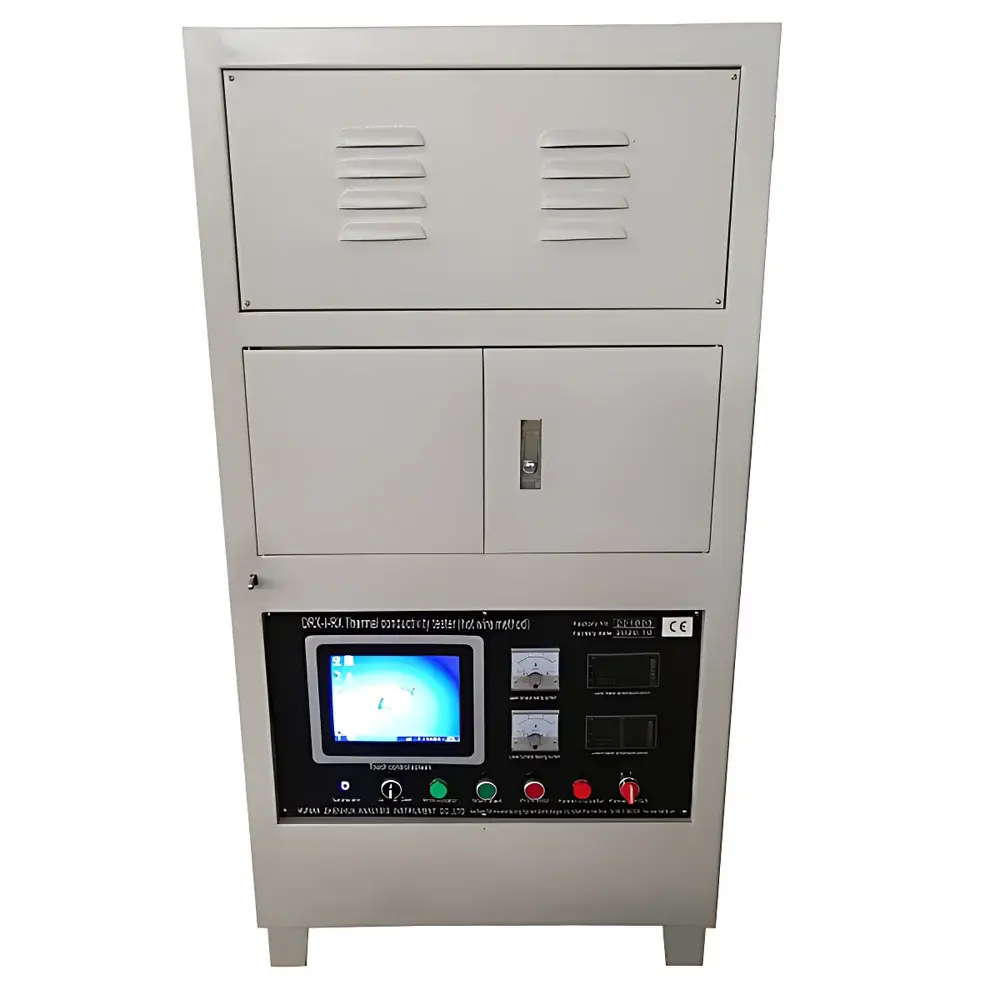
DRX-I-RX Hot Wire Method Thermal Conductivity Analyzer for High-Temperature Insulation Materials
| Origin | Hunan, China |
|---|---|
| Manufacturer Type | Authorized Distributor |
| Country of Origin | China |
| Model | DRX-I-RX |
| Price Range | USD 1,400–7,200 (FOB) |
| Instrument Type | Transient Hot Wire Method (THW) |
| Dimensions (L×W×H) | 110 × 150 × 65 cm |
| Accuracy | ±5% |
| Thermal Conductivity Range | 0.015–20 W/(m·K) |
| Repeatability | ±2% |
| Max Test Temperature | 1000 °C / 1400 °C / 1600 °C (configurable) |
| Sample Size Limit | 230 × 114 × 65 mm |
| Heating Power Control | Programmable & Computer-Regulated |
| Dual-Mode Capability | Cross-Wire & Parallel-Wire THW |
| Software Platform | Windows 7/XP-based thermal analysis application with automated data acquisition and report generation |
| Optional Modules | Specific Heat Capacity Measurement Module (accuracy: ±7–10%), Transient Line Source (TLS), and Needle Probe Method Adapters |
Overview
The DRX-I-RX Hot Wire Method Thermal Conductivity Analyzer is a dual-mode transient thermal property measurement system engineered for precision characterization of thermal conductivity in refractory insulation materials, ceramic composites, powdered media, and non-metallic solids across elevated temperature regimes. It operates on the principle of the transient hot wire (THW) method—where a thin metallic wire serves as both heater and resistance thermometer—and measures thermal conductivity by analyzing the time-dependent temperature rise in response to a controlled step current input. The system supports two standardized THW configurations: cross-wire (for low-conductivity materials: 0.015–1.7 W/(m·K)) and parallel-wire (for extended range up to 20 W/(m·K)), enabling rigorous compliance with GB 5990–1986, GB/T 10297–1998, and GB/T 17106–1997. Designed for operation at sustained temperatures up to 1600 °C, the instrument integrates high-purity alumina or molybdenum furnace assemblies, calibrated platinum-rhodium thermocouples (Type S or B), and active thermal shielding to minimize radial heat loss and ensure one-dimensional axial conduction assumptions remain valid during measurement.
Key Features
- Dual-mode THW architecture supporting both cross-wire and parallel-wire configurations within a single platform, eliminating need for separate instruments and reducing inter-system calibration drift.
- Programmable DC power supply with real-time feedback control for precise joule heating (±0.1% stability), ensuring consistent thermal pulse energy delivery across repeated tests.
- High-temperature furnace chamber with three configurable maximum operating points: 1000 °C, 1400 °C, and 1600 °C—each validated per ASTM E1113 and ISO 8301 thermal stability protocols.
- Integrated sample holder accommodating specimens up to 230 × 114 × 65 mm, with adjustable clamping force and thermal interface optimization for minimal contact resistance error.
- Modular expansion capability: optional specific heat capacity module (via differential scanning calorimetry–based transient technique) enables simultaneous determination of cp and λ under identical thermal history conditions.
- Computer-controlled automation with embedded PID temperature regulation, automatic zero-drift compensation, and self-diagnostic routines for heater continuity, thermocouple integrity, and ambient drift correction.
Sample Compatibility & Compliance
The DRX-I-RX accommodates rigid insulating bricks, castables, fiberboard, granular powders (e.g., vermiculite, aerogel composites), and sintered ceramics. Sample preparation follows ISO 10456 and ASTM C177 guidelines for geometry, surface flatness, and moisture content control (<0.5% w/w recommended). All measurement procedures adhere to national standards referenced in the Chinese National Standardization Management Committee (SAC) framework and are traceable to NIM (National Institute of Metrology, China) certified reference materials. While not inherently 21 CFR Part 11 compliant, audit-ready data logs—including timestamped raw voltage/time series, calibration certificate IDs, operator credentials, and environmental chamber readings—can be exported in CSV and PDF formats suitable for GLP/GMP documentation workflows.
Software & Data Management
The native Windows-based thermal analysis suite provides full instrument orchestration: automated temperature ramping, dynamic power modulation, real-time curve fitting using nonlinear least-squares regression (Levenberg–Marquardt algorithm), and uncertainty propagation per ISO/IEC Guide 98-3 (GUM). Data files include metadata headers compliant with ASTM E2500-19 for instrument qualification records. Export options support SI-unit–normalized reports (W/(m·K), °C, s), comparative trend charts, and batch statistical summaries (mean, SD, CV%). Raw binary acquisition files (.thw) are archived with SHA-256 checksums to ensure long-term data integrity.
Applications
- Quality assurance of industrial refractories used in kiln linings, ladles, and incinerator walls.
- R&D validation of novel aerogels, nano-insulation composites, and phase-change material (PCM) matrices.
- Thermal design input for nuclear fuel cladding simulations and aerospace thermal protection systems (TPS).
- Educational laboratories conducting undergraduate thermophysics experiments on Fourier’s law and thermal diffusivity–conductivity relationships.
- Third-party certification labs performing accredited testing per CNAS-CL01:2018 requirements.
FAQ
What temperature ranges does the DRX-I-RX support, and how is furnace uniformity verified?
The system offers three factory-configured maximum temperatures: 1000 °C, 1400 °C, and 1600 °C. Uniformity is confirmed via five-point thermocouple mapping per IEC 60584-2, with ≤±5 °C deviation across the central 60% of the hot zone.
Can the instrument measure anisotropic materials, and what sample orientation controls are available?
Yes—by rotating the specimen mount ±90° relative to the wire axis, users can assess directional conductivity differences in layered ceramics or fiber-reinforced composites. Orientation is mechanically indexed and logged with each test run.
Is calibration traceable to international standards, and what reference materials are supplied?
Each unit ships with NIST-traceable quartz and stainless-steel reference samples (certified λ values at 25 °C, 100 °C, and 500 °C), accompanied by calibration certificates issued by a CNAS-accredited metrology lab.
How is contact resistance between wire and sample mitigated during high-temperature testing?
A proprietary platinum–rhodium alloy wire (90/10 wt%) with laser-welded micro-contacts and graphite-based thermal paste (stable to 1600 °C) ensures stable interfacial conduction without oxidation-induced drift.
Does the software support automated pass/fail evaluation against specification limits?
Yes—the reporting engine allows user-defined upper/lower bounds per material grade; results are color-coded and flagged in summary dashboards with ISO 17025–compliant uncertainty annotations.



