
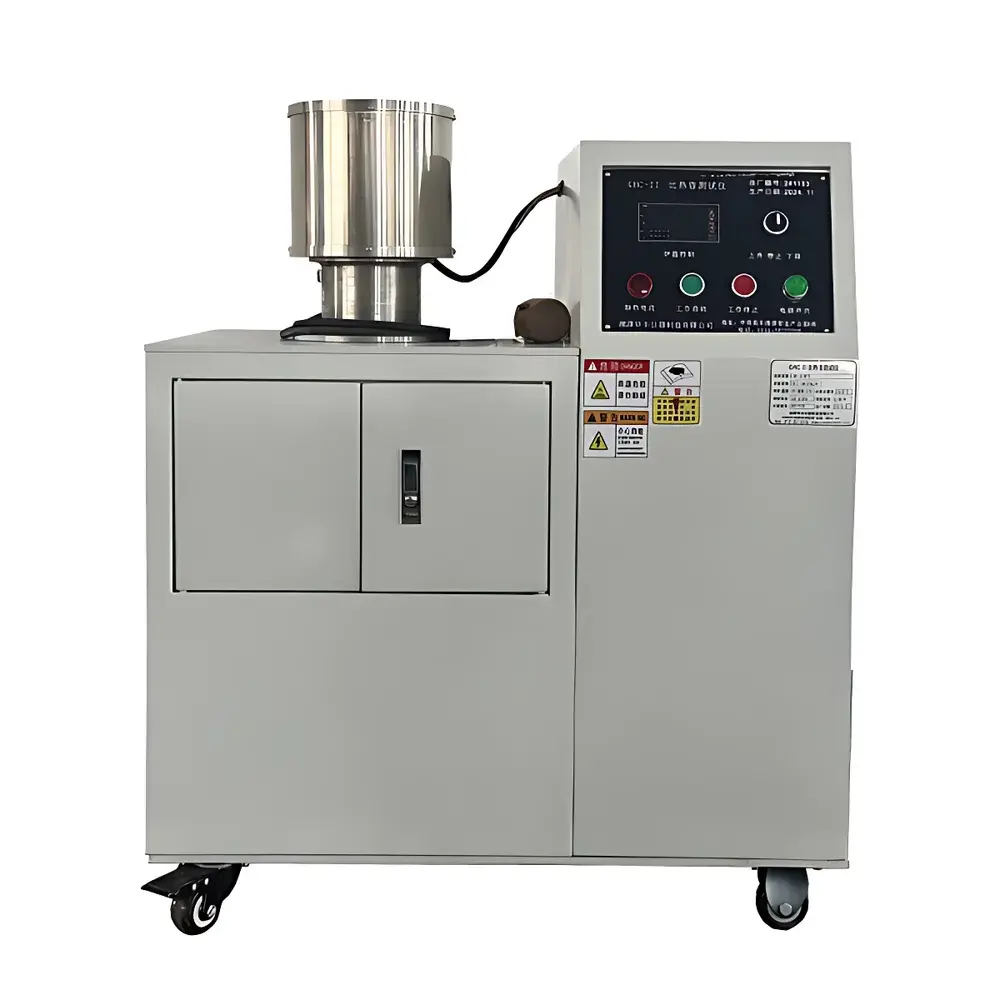
ZHENHUAFENXI GHC-II High-Temperature Specific Heat Capacity Tester for Solid Materials
| Brand | ZHENHUAFENXI |
|---|---|
| Model | GHC-II |
| Temperature Range | Ambient to 1400 °C |
| Specific Heat Capacity Range | >0.5 J/(g·K) |
| Accuracy | ≤1% |
| Temperature Control Stability | ±0.3 K over 30 min |
| Temperature Resolution | 0.01 K |
| Heating Element | Graphite Rod (Carbon Rod) |
| Control Method | Intelligent PID with Programmable Ramp/Soak Profiles |
| Data Acquisition | Fully Automated PC-Based System |
| Calorimeter Heat Capacity | ~1500 J/K |
| Calorimeter Temperature Resolution | 0.01 °C |
| Thermal Shield Monitoring | Triple Thermocouple Array (0.01 K resolution) |
| Constant-Temperature Bath Range | −5.00 to 60.00 °C |
| Oxidation Protection | Argon Purge Compatible |
| Sample Dimensions | Ø11 mm × 30 mm (solid) |
| Compliance | GJB 330A–2000, GJB 1715–93 |
| Power Supply | 220 V / 50 Hz, <6 kW |
Overview
The ZHENHUAFENXI GHC-II High-Temperature Specific Heat Capacity Tester is a precision calorimetric system engineered for the accurate determination of specific heat capacity (cp) of solid materials under controlled elevated-temperature conditions. It operates on the principle of the *method of mixtures*—a well-established, traceable thermodynamic technique in which a pre-heated sample is rapidly transferred into a thermally isolated calorimeter of known heat capacity, and the resulting temperature equilibration is monitored with high temporal and thermal resolution. This approach avoids assumptions inherent in differential scanning calorimetry (DSC) and provides direct, absolute cp values without calibration against reference standards—making it particularly suitable for validation, inter-laboratory comparison, and materials certification. The GHC-II supports testing from ambient temperature up to 1400 °C, accommodating refractory metals, ceramics, composites, and nuclear fuel simulants. Its modular architecture integrates a vertical tubular resistance furnace (graphite-heated), a high-stability adiabatic calorimeter, dual-stage temperature control, and real-time data acquisition—all synchronized under a deterministic timing protocol to minimize heat loss during sample transfer.
Key Features
- Graphite rod heating element enabling stable, uniform heating up to 1400 °C with low thermal inertia and minimal contamination risk
- Triple thermocouple thermal shielding system (0.01 K resolution) for active compensation of radial and axial temperature gradients
- Calorimeter with calibrated heat capacity of ~1500 J/K and sub-millikelvin temperature resolution (0.01 °C)
- Integrated constant-temperature bath (−5.00 to 60.00 °C) for precise baseline stabilization and post-transfer thermal equilibrium monitoring
- Intelligent PID controller with programmable ramp/soak profiles and real-time deviation correction (±0.3 K stability over 30 min)
- Automated sample drop mechanism synchronized with high-frequency temperature logging (≥10 Hz) for transient thermal response capture
- Argon-purge compatible chamber design to suppress oxidation of reactive or high-temperature-sensitive samples (e.g., Ti alloys, UO2, MoSi2)
- Touchscreen HMI with embedded Windows XP-based software; also supports remote operation and data export via USB/Ethernet interfaces
Sample Compatibility & Compliance
The GHC-II accommodates cylindrical solid specimens (Ø11 mm × 30 mm) and powdered materials using standardized holders—ensuring reproducible thermal mass and surface-to-volume ratios critical for minimizing conduction and radiation errors. Sample geometry and mass are input directly into the analysis module to correct for heat loss corrections based on NIST-traceable models. The system complies fully with Chinese military standards GJB 330A–2000 (“Test Methods for Specific Heat Capacity of Solid Materials”) and GJB 1715–93 (“Thermal Analysis Test Procedures”), both of which align with ISO 11357-4 (Plastics — DSC — Part 4: Determination of specific heat capacity) in methodology and uncertainty reporting. While not certified to ASTM E1269 or ISO 17873, its mixture-method foundation satisfies GLP audit requirements for raw material qualification in aerospace, nuclear, and defense supply chains where first-principles metrology is mandated.
Software & Data Management
The GHC-II’s native software provides full experimental workflow control—from furnace pre-conditioning and soak duration definition to automatic trigger logic for sample release and calorimeter integration. All temperature/time series data are timestamped with microsecond precision and stored in binary format with embedded metadata (operator ID, sample ID, furnace setpoint, bath temperature, purge gas flow rate). Export options include CSV, Excel (.xlsx), and XML formats compliant with LIMS ingestion protocols. Audit trails record all parameter modifications, user logins, and instrument state transitions—supporting 21 CFR Part 11 readiness when deployed in regulated environments. Raw thermal transients undergo automated baseline correction, kinetic heat-loss compensation (via inverse modeling), and cp calculation using the fundamental relation: cp = Ccal·ΔTcal / (m·ΔTsample), where Ccal is the calorimeter’s calibrated heat capacity.
Applications
- Thermophysical property validation for high-temperature structural ceramics (SiC, Al2O3, ZrO2) used in turbine blades and thermal barrier coatings
- Specific heat characterization of nuclear fuel matrices (UO2, MOX) and cladding alloys (Zircaloy, FeCrAl) across reactor operating ranges
- Material screening for additive manufacturing feedstocks requiring accurate enthalpy-of-fusion inputs in process simulation
- Calibration reference generation for DSC and TGA instruments in metrology labs
- Temperature-dependent cp mapping of shape-memory alloys (NiTi, CuAlBe) to support phase transition modeling
- Academic research in solid-state physics, including phonon density-of-states estimation via low-temperature extrapolation
FAQ
What is the maximum recommended heating rate for stable cp measurements?
For optimal accuracy below 1000 °C, a ramp rate of ≤10 °C/min is advised; above 1000 °C, ≤5 °C/min ensures thermal homogeneity and minimizes radiative error.
Can the system be upgraded for vacuum operation beyond 1400 °C?
Yes—the furnace chamber is flanged for UHV-compatible CF connections; optional graphite insulation upgrades and tungsten thermocouples enable operation up to 1700 °C under vacuum (≤10−3 Pa).
Is the calorimeter heat capacity recalibration required between tests?
No—each calorimeter unit is factory-calibrated with NIST-traceable standards; revalidation is only necessary annually or after mechanical impact.
Does the software support custom uncertainty propagation per ISO/IEC 17025?
Yes—uncertainty budgets can be configured per test, incorporating contributions from temperature resolution, mass measurement, time synchronization, and heat-loss model residuals.
What sample preparation guidelines ensure minimal measurement bias?
Specimens must be polished to ≤0.4 µm Ra surface finish, cleaned ultrasonically in acetone, and dried under inert gas to eliminate adsorbed moisture and oxide layers affecting thermal contact.



